

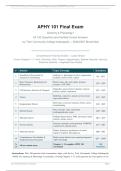
APHY 101 Final Exam | Ivy Tech Community College Indianapolis | 2026/2027 Brand New
APHY 101 Final Exam
Anatomy & Physiology I
All 100 Questions and Verified Correct Answers
Ivy Tech Community College Indianapolis | 2026/2027 Brand New
Comprehensive Final Examination — Latest Version
Covers Chapters 1–11: Intro, Chemistry, Cells, Tissues, Integumentary, Skeletal, Muscular, Nervous,
Endocrine Systems + Integrated Case Studies
# Section Topic Coverage Questions
Introduction, Homeostasis & Anatomy vs. physiology, levels of organization,
1 Q1 – Q12
Anatomical Terminology feedback, body cavities, regions
Basic Chemistry, Biochemistry & Bonds, water, pH, carbs, lipids, proteins,
2 Q13 – Q20
Biomolecules enzymes, ATP, DNA
Organelles, passive/active transport, osmosis,
3 Cell Structure, Function & Transport Q21 – Q30
tonicity, mitosis, respiration
Epithelial, connective, muscle, nervous tissue
4 Tissues Q31 – Q40
types and locations
Skin layers, accessory structures, burns, cancer,
5 Integumentary System Q41 – Q48
wound healing
Bone structure, cells, ossification,
6 Skeletal System Q49 – Q60
axial/appendicular, joints
Sliding filament theory, NMJ, sarcomere, major
7 Muscular System Q61 – Q70
muscles, energy sources
Neurons, neuroglia, action potential, CNS/PNS,
8 Nervous System Q71 – Q85
cranial nerves, special senses
Glands, hormones, mechanisms of action,
9 Endocrine System Q86 – Q92
negative feedback, blood glucose
Comprehensive Case Studies & Multi-system clinical cases requiring integrated
10 Q93 – Q100
Integrated Clinical Scenarios A&P; knowledge
To Chapters 1–11 complete APHY 101 100
All ten content areas
tal curriculum Questions
Instructions: This 100-question final examination aligns with the Ivy Tech Community College Indianapolis
APHY 101 Anatomy & Physiology I curriculum, covering Chapters 1–11. Each question has four options (A–D)
Z.ai | Verified Answers | A+ Graded Page 1
,APHY 101 Final Exam | Ivy Tech Community College Indianapolis | 2026/2027 Brand New
with one verified correct answer and a comprehensive rationale citing anatomical principles, physiological
concepts, and clinical applications. The exam integrates recall (30%), application (50%), and analysis (20%)
across all body systems, with comprehensive case studies in Section 10 requiring multi-system integration.
Style distribution: 70% scenario-based, 25% direct recall, 5% identification/classification. Recommended
strategy: Visualize anatomical structures, apply homeostatic principles (negative vs. positive feedback),
distinguish tissue types by structure/function, trace physiological pathways (sliding filament, action potential,
hormone cascades), and integrate across systems in clinical scenarios. Always anchor directional terms to the
anatomical position.
Z.ai | Verified Answers | A+ Graded Page 2
, APHY 101 Final Exam | Ivy Tech Community College Indianapolis | 2026/2027 Brand New
Section 1: Introduction to Anatomy and Physiology, Homeostasis,
and Anatomical Terminology
Questions Q1–Q12 • Anatomy vs. Physiology, Levels of Organization, Homeostasis, Directional
Terms, Body Cavities, Regions
This section contains 12 questions testing anatomy vs. physiology, levels of organization, homeostasis,
directional terms, body cavities, regions.
Q1: A student observes that the heart is located superior to the liver. Which statement best explains this
relationship using anatomical terminology?
A. The heart is closer to the head than the liver; superior means toward the head. [CORRECT]
B. The heart is farther from the head than the liver; superior means toward the feet.
C. The heart is medial to the liver; superior means toward the midline.
D. The heart is anterior to the liver; superior means toward the front.
Correct Answer: A
Rationale: Superior (cranial) means toward the head, while inferior (caudal) means toward the feet. The heart lies
superior to the liver in the thoracic cavity. Medial refers to the midline; anterior/ventral refers to the front. Confusing
these directional terms is a common APHY 101 error—always anchor superior/inferior to the head/feet axis.
Q2: During a clinical examination, the physician describes a patient'scar accident injury as located in the
'left hypochondriac region.' Which organs are most likely located in this abdominopelvic region?
A. Stomach and spleen [CORRECT]
B. Liver and gallbladder
C. Appendix and cecum
D. Urinary bladder and uterus
Correct Answer: A
Rationale: The left hypochondriac region contains the stomach, spleen, and part of the large intestine. The right
hypochondriac contains the liver and gallbladder. The right iliac (inguinal) region contains the appendix and cecum. The
hypogastric region contains the urinary bladder and uterus. Knowing the nine abdominopelvic regions is essential for
clinical localization.
Q3: A patient's blood glucose rises after a meal. The pancreas releases insulin, which lowers blood glucose
back to a normal range. This is an example of which homeostatic mechanism?
A. Positive feedback, because the deviation is amplified
B. Negative feedback, because the deviation from the set point is reversed [CORRECT]
C. Positive feedback, because the response is sustained
D. Negative feedback, because the response amplifies the original change
Correct Answer: B
Rationale: Negative feedback reverses the deviation from a set point to restore homeostasis. Rising blood glucose triggers
insulin release, which lowers glucose back to normal—classic negative feedback. Positive feedback amplifies the original
change (e.g., childbirth contractions, blood clotting). The receptor → control center → effector pathway applies.
Q4: Which of the following is an example of positive feedback in the human body?
A. Body temperature regulation through sweating
B. Blood clotting after a vessel injury [CORRECT]
Z.ai | Verified Answers | A+ Graded Page 3
APHY 101 Final Exam
Anatomy & Physiology I
All 100 Questions and Verified Correct Answers
Ivy Tech Community College Indianapolis | 2026/2027 Brand New
Comprehensive Final Examination — Latest Version
Covers Chapters 1–11: Intro, Chemistry, Cells, Tissues, Integumentary, Skeletal, Muscular, Nervous,
Endocrine Systems + Integrated Case Studies
# Section Topic Coverage Questions
Introduction, Homeostasis & Anatomy vs. physiology, levels of organization,
1 Q1 – Q12
Anatomical Terminology feedback, body cavities, regions
Basic Chemistry, Biochemistry & Bonds, water, pH, carbs, lipids, proteins,
2 Q13 – Q20
Biomolecules enzymes, ATP, DNA
Organelles, passive/active transport, osmosis,
3 Cell Structure, Function & Transport Q21 – Q30
tonicity, mitosis, respiration
Epithelial, connective, muscle, nervous tissue
4 Tissues Q31 – Q40
types and locations
Skin layers, accessory structures, burns, cancer,
5 Integumentary System Q41 – Q48
wound healing
Bone structure, cells, ossification,
6 Skeletal System Q49 – Q60
axial/appendicular, joints
Sliding filament theory, NMJ, sarcomere, major
7 Muscular System Q61 – Q70
muscles, energy sources
Neurons, neuroglia, action potential, CNS/PNS,
8 Nervous System Q71 – Q85
cranial nerves, special senses
Glands, hormones, mechanisms of action,
9 Endocrine System Q86 – Q92
negative feedback, blood glucose
Comprehensive Case Studies & Multi-system clinical cases requiring integrated
10 Q93 – Q100
Integrated Clinical Scenarios A&P; knowledge
To Chapters 1–11 complete APHY 101 100
All ten content areas
tal curriculum Questions
Instructions: This 100-question final examination aligns with the Ivy Tech Community College Indianapolis
APHY 101 Anatomy & Physiology I curriculum, covering Chapters 1–11. Each question has four options (A–D)
Z.ai | Verified Answers | A+ Graded Page 1
,APHY 101 Final Exam | Ivy Tech Community College Indianapolis | 2026/2027 Brand New
with one verified correct answer and a comprehensive rationale citing anatomical principles, physiological
concepts, and clinical applications. The exam integrates recall (30%), application (50%), and analysis (20%)
across all body systems, with comprehensive case studies in Section 10 requiring multi-system integration.
Style distribution: 70% scenario-based, 25% direct recall, 5% identification/classification. Recommended
strategy: Visualize anatomical structures, apply homeostatic principles (negative vs. positive feedback),
distinguish tissue types by structure/function, trace physiological pathways (sliding filament, action potential,
hormone cascades), and integrate across systems in clinical scenarios. Always anchor directional terms to the
anatomical position.
Z.ai | Verified Answers | A+ Graded Page 2
, APHY 101 Final Exam | Ivy Tech Community College Indianapolis | 2026/2027 Brand New
Section 1: Introduction to Anatomy and Physiology, Homeostasis,
and Anatomical Terminology
Questions Q1–Q12 • Anatomy vs. Physiology, Levels of Organization, Homeostasis, Directional
Terms, Body Cavities, Regions
This section contains 12 questions testing anatomy vs. physiology, levels of organization, homeostasis,
directional terms, body cavities, regions.
Q1: A student observes that the heart is located superior to the liver. Which statement best explains this
relationship using anatomical terminology?
A. The heart is closer to the head than the liver; superior means toward the head. [CORRECT]
B. The heart is farther from the head than the liver; superior means toward the feet.
C. The heart is medial to the liver; superior means toward the midline.
D. The heart is anterior to the liver; superior means toward the front.
Correct Answer: A
Rationale: Superior (cranial) means toward the head, while inferior (caudal) means toward the feet. The heart lies
superior to the liver in the thoracic cavity. Medial refers to the midline; anterior/ventral refers to the front. Confusing
these directional terms is a common APHY 101 error—always anchor superior/inferior to the head/feet axis.
Q2: During a clinical examination, the physician describes a patient'scar accident injury as located in the
'left hypochondriac region.' Which organs are most likely located in this abdominopelvic region?
A. Stomach and spleen [CORRECT]
B. Liver and gallbladder
C. Appendix and cecum
D. Urinary bladder and uterus
Correct Answer: A
Rationale: The left hypochondriac region contains the stomach, spleen, and part of the large intestine. The right
hypochondriac contains the liver and gallbladder. The right iliac (inguinal) region contains the appendix and cecum. The
hypogastric region contains the urinary bladder and uterus. Knowing the nine abdominopelvic regions is essential for
clinical localization.
Q3: A patient's blood glucose rises after a meal. The pancreas releases insulin, which lowers blood glucose
back to a normal range. This is an example of which homeostatic mechanism?
A. Positive feedback, because the deviation is amplified
B. Negative feedback, because the deviation from the set point is reversed [CORRECT]
C. Positive feedback, because the response is sustained
D. Negative feedback, because the response amplifies the original change
Correct Answer: B
Rationale: Negative feedback reverses the deviation from a set point to restore homeostasis. Rising blood glucose triggers
insulin release, which lowers glucose back to normal—classic negative feedback. Positive feedback amplifies the original
change (e.g., childbirth contractions, blood clotting). The receptor → control center → effector pathway applies.
Q4: Which of the following is an example of positive feedback in the human body?
A. Body temperature regulation through sweating
B. Blood clotting after a vessel injury [CORRECT]
Z.ai | Verified Answers | A+ Graded Page 3


