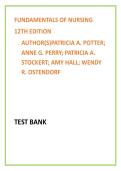
FUNDAMENTALS OF NURSING
12TH EDITION
• AUTHOR(S)PATRICIA A. POTTER;
ANNE G. PERRY; PATRICIA A.
STOCKERT; AMY HALL; WENDY
R. OSTENDORF
TEST BANK
,Question 1
A newly licensed registered nurse is asked by a family member,
"What makes nursing a profession rather than simply a job?"
Which response by the nurse is most accurate?
A. "Nursing is primarily based on carrying out provider
prescriptions."
B. "Nursing is a profession because it uses specialized
knowledge, follows ethical standards, and is accountable for
independent clinical judgment."
C. "Nursing is considered a profession because nurses work only
in hospitals."
D. "Nursing is a profession because it requires physical skills
more than intellectual skills."
Correct Answer: B
Rationale:
A profession is characterized by a specialized body of
knowledge, formal education, ethical practice, accountability,
evidence-based decision-making, and commitment to lifelong
learning. Registered nurses apply clinical judgment
independently while collaborating with other healthcare
professionals. Choice A minimizes the independent role of
,nursing. Choice C is incorrect because nurses practice in many
settings. Choice D overlooks the scientific and critical thinking
foundation of nursing.
Question 2
A nurse is caring for a hospitalized client when a physical
therapist recommends changes to the mobility plan. What is
the nurse's best action?
A. Implement the recommendation without reviewing it.
B. Ignore the recommendation because mobility is the
therapist's responsibility.
C. Collaborate with the therapist, evaluate the client's
condition, and update the nursing plan of care as appropriate.
D. Wait until the next provider visit before discussing mobility.
Correct Answer: C
Rationale:
Professional nursing emphasizes collaboration and coordinated
care. The nurse evaluates recommendations, integrates
appropriate interventions into the care plan, and communicates
with the healthcare team. Blindly implementing
recommendations is unsafe. Ignoring interdisciplinary input or
delaying communication may compromise patient outcomes.
Question 3
, A nursing student asks why evidence-based practice is
important. Which explanation by the instructor is most
appropriate?
A. It eliminates the need for clinical judgment.
B. It combines current research, clinical expertise, and patient
preferences to guide care.
C. It requires nurses to follow routines regardless of patient
differences.
D. It replaces communication with standardized protocols.
Correct Answer: B
Rationale:
Evidence-based practice integrates the best available evidence,
clinical expertise, and patient values to improve outcomes. It
supports—not replaces—clinical judgment. Standardized
protocols are useful but should always be individualized to the
patient's condition and preferences.
Question 4
A nurse notices another staff member preparing to administer
medication without verifying the client's identity. What is the
nurse's priority action?
A. Document the incident after the medication is given.
B. Report the staff member to the licensing board immediately.
C. Intervene immediately to prevent a potential error and
12TH EDITION
• AUTHOR(S)PATRICIA A. POTTER;
ANNE G. PERRY; PATRICIA A.
STOCKERT; AMY HALL; WENDY
R. OSTENDORF
TEST BANK
,Question 1
A newly licensed registered nurse is asked by a family member,
"What makes nursing a profession rather than simply a job?"
Which response by the nurse is most accurate?
A. "Nursing is primarily based on carrying out provider
prescriptions."
B. "Nursing is a profession because it uses specialized
knowledge, follows ethical standards, and is accountable for
independent clinical judgment."
C. "Nursing is considered a profession because nurses work only
in hospitals."
D. "Nursing is a profession because it requires physical skills
more than intellectual skills."
Correct Answer: B
Rationale:
A profession is characterized by a specialized body of
knowledge, formal education, ethical practice, accountability,
evidence-based decision-making, and commitment to lifelong
learning. Registered nurses apply clinical judgment
independently while collaborating with other healthcare
professionals. Choice A minimizes the independent role of
,nursing. Choice C is incorrect because nurses practice in many
settings. Choice D overlooks the scientific and critical thinking
foundation of nursing.
Question 2
A nurse is caring for a hospitalized client when a physical
therapist recommends changes to the mobility plan. What is
the nurse's best action?
A. Implement the recommendation without reviewing it.
B. Ignore the recommendation because mobility is the
therapist's responsibility.
C. Collaborate with the therapist, evaluate the client's
condition, and update the nursing plan of care as appropriate.
D. Wait until the next provider visit before discussing mobility.
Correct Answer: C
Rationale:
Professional nursing emphasizes collaboration and coordinated
care. The nurse evaluates recommendations, integrates
appropriate interventions into the care plan, and communicates
with the healthcare team. Blindly implementing
recommendations is unsafe. Ignoring interdisciplinary input or
delaying communication may compromise patient outcomes.
Question 3
, A nursing student asks why evidence-based practice is
important. Which explanation by the instructor is most
appropriate?
A. It eliminates the need for clinical judgment.
B. It combines current research, clinical expertise, and patient
preferences to guide care.
C. It requires nurses to follow routines regardless of patient
differences.
D. It replaces communication with standardized protocols.
Correct Answer: B
Rationale:
Evidence-based practice integrates the best available evidence,
clinical expertise, and patient values to improve outcomes. It
supports—not replaces—clinical judgment. Standardized
protocols are useful but should always be individualized to the
patient's condition and preferences.
Question 4
A nurse notices another staff member preparing to administer
medication without verifying the client's identity. What is the
nurse's priority action?
A. Document the incident after the medication is given.
B. Report the staff member to the licensing board immediately.
C. Intervene immediately to prevent a potential error and