

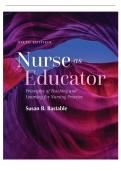
,TESTBANK FOR Nurse as Educator Principles of Teaching and Learning for
Nursing Practice Sixth Edition Bastable
Important Notes
The file includes the complete test bank, organized chapter by chapter.
A sample of selected pages has been provided for preview.
All available appendices and Excel files (if included in the original resources) are
provided.
Quizzes, Midterm and final exams are included (if available in the original resources).
We continuously update our files to ensure you receive the latest and most accurate
editions.
New editions are added regularly – stay connected for updates!
⚠️Note on Answer Keys: If the answer key is not included within the chapter
questions, you will find the complete answers and solutions at the end of each
chapter.
✅ Why Buy From Us?
📚 Complete & organized chapter-by-chapter – no missing content, no guessing.
⚡ Instant digital delivery – get your file the moment you pay, no waiting.
📅 Always up to date – we track new editions so you always get the latest version.
💬 Friendly support – real humans ready to help, anytime you need us.
🔒 Safe & secure – thousands of satisfied students trust us every semester.
🛡️Our Guarantees
💰 Money-Back Guarantee: Not satisfied? We offer a full refund – no questions asked.
🔄 Wrong File? No Problem: Contact us and we will replace it immediately with the
correct version, free of charge.
⏰ 24/7 Support: We are always here – reach out anytime and expect a fast response.
, Nurse as Educator 6E – Test Bank
Bastable_CH01-NURSE AS EDUCATOR 6E ADVANTAGE DIGITAL
1. Which nursing organization first observed the importance of health teaching as a function
of the nurse's professional role?
a. American Association of Colleges of Nursing (AACN)
✓ b. National League for Nursing (NLN, formerly NLNE)
c. American Nurses Association (ANA)
d. International Council of Nurses (ICN)
2. What does the term training the trainer mean?
a. Educating nurses to assume the role of faculty in nursing education programs
b. Exposing nursing students to teaching and learning theory to raise their awareness of the role of the
nurse as educator
✓ c. Preparing nursing staff to maintain and improve their clinical and teaching abilities
d. Convincing physicians of the important role nurses play in educating clients
3. Which of the following is not a reason why nurses are in a key position to carry out health
education?
a. Nurses have continuous contact with clients and families.
b. Nurses are accessible as sources of information for the consumer.
✓ c. Nurses have expertise in the principles of teaching and learning.
d. Nurses are highly trusted by clients and their families.
4. Which of the following best defines the term teachable moment ?
a. The moment when the nurse feels educationally prepared to teach
✓ b. The moment when circumstances make a patient more open to learning
c. The moment when a nurse conveys new health information to a patient
d. The moment when an informed patient adheres to medical treatment plans
5. What is the first step is in the education process?
a. Gathering resources to share with the client and family
✓ b. Conducting an assessment of client needs, readiness to learn, and learning styles
c. Developing a teaching plan based on mutually predetermined outcomes as objectives
d. Choosing methods and tools to convey information in a manner that the learner can understand
6. Which of the following best describes the term education process ?
a. A purposeful activity with a definite planned goal to be achieved in a specified period of time
b. A plan and an implementation of instructional activities and experiences to meet intended learner
outcomes
, c. A special form of communication that encompasses knowledge about a particular subject to produce
learning
✓ d. A systematic, sustained effort of mutually desired behavior changes for a participatory, shared
approach to teaching and learning
7. How is learning best defined?
a. The gap in knowledge that exists between a desired level of performance and the actual level of
performance
✓ b. A change in behavior that can be observed or measured
c. An outcome by which learners demonstrate more confidence in what they are expected to do
d. The manner by which an individual perceives and processes information
8. In comparing the nursing process to the education process, which statement is false ?
a. The nursing process appraises physical and psychosocial needs, whereas the education process
ascertains cognitive needs of the individual.
b. Both processes focus on mutual goal setting as well as a partnership in establishing objectives to meet
the needs of the client.
c. Carrying out nursing interventions is done in the implementation phase of the nursing process, and
performing the act of teaching is done in the implementation phase of the education process.
✓ d. Determining the extent of physical and psychosocial care required constitutes the evaluation phase
only of the nursing process, and determining which instructional methods and tools are best constitutes the
evaluation phase of the education process.
9. The home care nurse is making an initial visit to a mother and baby as routine follow-up for
maternal–child assessment. The client was discharged from the hospital 24 hours ago after
the birth of her first child. The client is 17 years old, single, in the 11th grade, and staying at
home with her parents and younger sibling until she can make alternative living
arrangements. The client is uncertain about keeping the baby because she doesn't know
whether she wants to commit to the responsibilities of single parenthood at such a young
age. Based on this information, which is a primary obstacle that may interfere with the client's
potential for learning?
a. Low literacy
b. Knowledge deficit
c. Lack of social support
✓ d. Lack of readiness to learn
10. Identify four barriers to teaching, and briefly describe why they are barriers.
✎ Students may describe any of the following barriers to teaching: Lack of time: Nurses may focus on
other priorities or rush through the education process. Lack of teaching competence: Nurses may be less
likely to teach if they feel they are ineffective at it. Lack of motivation to teach: If nurses don't view it as a
priority, it may be short-changed. Lack of administrative support and resources: Limited resources can
negatively affect learning. Lack of space for teaching and/or a lack of privacy: Distractions can interfere
with both teaching and learning. Lack of reimbursement for teaching efforts: May have the effect of
reducing the time nurses spend on teaching. Concerns about the effectiveness of patient education and
violating clients' autonomy: Nurses may feel frustrated if their teaching efforts don't result in behavior
change and then may reduce teaching efforts. Insufficient documentation systems: Inadequate forms may
result in insufficient teaching. Fields: Ahead: Barriers to Teaching and Obstacles to Learning Complexity:
Moderate Subject: Chapter 1 Title: Overview of Education in Health Care
,11. Identify three goals of patient education.
✎ The primary goal of patient education is to increase the responsibility and independence for self-care.
Other goals include increasing customer satisfaction, improving quality of life, ensuring continuity of care,
decreasing patient anxiety, reducing complications, and promoting adherence to treatment plans. Fields:
Ahead: Purposes, Goals, and Benefits of Patient and Nursing Staff/Student Education Complexity: Easy
Subject: Chapter 1 Title: Overview of Education in Health Care
12. Compare the education process to the nursing process by citing the similarities of as well
as the differences between the two processes.
✎ The education process and nursing process both include assessment, planning, implementation, and
evaluation. However, the actions taken in each step can differ. In the education process, assessment is
focused on ascertaining learning needs, readiness to learn, and learning styles. In the nursing process, it is
focused on assessing physical and psychosocial needs. The planning step for both processes focuses on
goal setting. The implementation step of the education process is when teaching takes places; in the
nursing process, it is when nursing interventions are performed. The evaluation step in the education
process involves determining what behavior changes occurred; this step in the nursing process focuses on
assessing physical and psychosocial outcomes. Fields: Ahead: The Education Process Defined
Complexity: Moderate Subject: Chapter 1 Title: Overview of Education in Health Care
13. Identify four obstacles to learning, and briefly describe why they are obstacles.
✎ Students may describe any of the following obstacles to learning: Lack of time: Can affect willingness to
learn. Stress: Can decrease motivation and interfere with learning. Low literacy and functional health
literacy: Prevents clients from using instructions provided to them. Hospital environment: Can cause
feelings of loss of control and be demotivating. Personal characteristics of the learner: Can relate to
motivation to developmental capabilities. Extent of change needed: Can be overwhelming and
demotivating. Lack of support: May block potential for learning. Psychological obstacles: Lack of
responsibility and denial can affect learning. Structure of the healthcare system: Can result in frustration
and abandonment of efforts by the learner. Fields: Ahead: Barriers to Teaching and Obstacles to Learning
Complexity: Easy Subject: Chapter 1 Title: Overview of Education in Health Care
Bastable_CH02-NURSE AS EDUCATOR 6E ADVANTAGE DIGITAL
1. Which is a characteristic of nurse practice acts?
a. They are based on a code of ethical behavior.
✓ b. They are enforceable by the police authority of each state.
c. They spell out the ethical and moral obligation of the nurse to provide care for the client.
d. They are not enforceable by anyone outside the nursing profession.
2. When a nurse serves as an expert witness, which ethical principle is being operationalized?
a. Autonomy
b. Beneficence
c. Justice
✓ d. Veracity
3. How can the principle of beneficence be operationalized?
a. By sufficiently and accurately documenting the scope and depth of skilled services rendered to patients
, ✓ b. By adhering to institutional policies and to critical tasks and duties of one's job description
c. By equally distributing goods and services to patients in any healthcare setting
d. By nurses being adequately committed to providing services to patients
4. Breach of contract, or failure to perform one's duties based on client diagnosis, cultural
background, race, or sexual preference, is a violation of which ethical principle?
a. Autonomy
b. Beneficence
✓ c. Justice
d. Nonmaleficence
5. The nurse is preparing a client for gallbladder surgery. The client has signed the consent
document. Which action should the nurse carry out to verify that the client understands the
procedure?
a. Check whether the client's reading level is equivalent to the level of the consent form.
b. Talk to a family member or the nurse who witnessed the client's signature on the consent form.
✓ c. Ask the client to explain the procedure in his or her own words.
d. Discuss with the client's physician what the client was told about the procedure.
6. Which statement about determining the cost of providing an educational program is false ?
a. Variable costs depend on volume of use, whereas fixed costs are predictable and remain constant over
time.
b. Direct costs include personnel salaries, employment benefits, and equipment.
✓ c. Physical space, utilities, housekeeping, and security are direct costs.
d. Indirect costs are fixed costs usually related to institutional overhead expenses.
7. The financial stability of any healthcare facility is dependent on its third-party
reimbursements and cash flow. Based on this fact, discuss the nurse's inherent responsibility
to provide patient education, taking into account both direct and indirect costs to the
healthcare facility.
✎ Nurses can affect direct and indirect costs through patient education. For example, effective patient
education that results in greater adherence to a treatment regimen may result in a shorter hospital stay,
fewer or no complications, and decreased overall cost of care. These reductions decrease both direct and
indirect costs. Fields: Ahead: Financial Terminology Complexity: Medium Subject: Chapter 2 Title: Ethical,
Legal, and Economic Foundations of the Educational Process
8. Discuss the legal and financial ramifications for the healthcare facility for neglecting
documentation for informed consent.
✎ Ethical dilemmas are a form of moral conflict in which two or more ethical principles are applicable but
support courses of action that are inconsistent with one another. For example, the nurse must respect
patient autonomy and individual patient responsibility when encouraging and supporting self-management
behaviors, but the ethical principle of the patient's right to self-determination may clash with professional
values that promote health and help achieve medical outcomes. Legal rights and duties, in contrast, refer
to rules governing behavior or conduct that are enforceable by law under threat of punishment or penalty,
such as a fine, imprisonment, or both. An example of a legal right is the patient's right to receive adequate
information regarding their physical condition, medications, risks, and access to information regarding
alternative treatments. An example of duty involves the nurse's role in the informed consent process.
, Although nurses are not responsible for completing the process of informed consent, nurses have the duty
to verify and document that consent has been given. Fields: Ahead: Application of Ethical Principles in
Patient Education; Legal and Financial Implications of Documentation Complexity: Hard Subject: Chapter 2
Title: Ethical, Legal, and Economic Foundations of the Educational Process
Bastable_CH03-NURSE AS EDUCATOR 6E ADVANTAGE DIGITAL
1. Nurse educators are taught to simplify their presentations to patients by providing clear
explanations that allay fears, relate directly to them, and provide familiar experiences. Which
cognitive theoretical perspective on learning is reflected by this example?
a. Humanistic
✓ b. Gestalt
c. Psychodynamic
d. Behaviorist
2. Which statement about the social constructivist perspective is false ?
✓ a. Learning is a rational process involving the attention to stimuli, the incorporation of information, and
action based on the information.
b. Learning is accomplished most effectively by working with others.
c. Society and culture strongly influence human development and the learning process.
d. A person's knowledge does not necessarily reflect external reality because it has been influenced by the
culture and by his or her interpretations of events.
3. Which two theories emphasize that learners are keenly motivated to seek pleasure and
rewards?
a. Behaviorist and cognitive
b. Cognitive and psychodynamic
c. Gestalt and social learning
✓ d. Psychodynamic and behaviorist
4. Which approach is not a helpful instructional strategy for the associative stage of motor
learning?
a. Increasing task complexity
b. Emphasizing problem solving
✓ c. Increasing guidance and feedback
d. Encouraging learners to practice on their own
5. Give an example of how motor learning is of particular interest to the nurse trying to help a
patient relearn a particular skill. Focus on prepractice, practice, and feedback.
✎ Prepractice variables that can affect motor learning include motivation, attention, goal setting, and an
understanding of the task. Nurses should assess for these factors and take steps to address each. Practice
is key to motor learning. Patients should be given multiple opportunities, ideally at spaced intervals, to
practice. During this step, nurses may also break down the task into components and work up to
presenting the tasks in different order to promote retention. Both intrinsic and extrinsic feedback are
important to learning as well. To be most effective, nurses should start with more feedback early on but
, then gradually move to providing more intermittent feedback. For example, a nurse working in the home
care setting with a patient who is recovering from a stroke may believe the most important goal for the
person is to be independent in self-monitoring his blood pressure. The patient, in contrast, might believe
that being able to use the toilet independently is all he wants to work on, claiming that he does not feel
comfortable having his wife help him in the bathroom. For the nurse to take advantage of the patient's drive
and enthusiasm, it makes sense to set this task as an initial goal and work at a later time on the
self-monitoring of his blood pressure. Before teaching the patient how to safely use the toilet, the nurse
makes sure the patient pays close attention as she explains the steps that are involved with safely getting
on and off the toilet, and she confirms that he has a verbal understanding of those activities. The stage is
now set for the nurse to demonstrate and then practice this task with him. Fields: Ahead: Motor Learning
Complexity: Medium Subject: Chapter 3 Title: Applying Learning Theories to Healthcare Practice
6. The nurse educator at a hospital is asked to develop a program to teach new staff members
how to function at the hospital. Describe the nurse educator's plan for the program using
social learning theory. Be sure to include how external and internal processes will affect
learning.
✎ Social learning theory focuses on learning through observation of role models. To employ this approach,
it is important to identify the right person to serve as the role model. The person should be competent,
enthusiastic, an excellent communicator, and willing to help guide others. The role model is a key example
of an external factor that can affect learning. Internal factors include the learner's motivation to learn.
Fields: Ahead: Psychological Learning Theories Complexity: Medium Subject: Chapter 3 Title: Applying
Learning Theories to Healthcare Practice
7. Identify a behavior, either in patients or staff, that you would like to change. Give an
example of the use of each of the following operant-conditioning procedures to change the
behavior: (1) positive reinforcement, (2) avoidance conditioning, (3) escape conditioning, (4)
punishment, and (5) nonreinforcement.
✎ Student examples of behaviors to change will vary. Each response should include explanations of how
they could use the following approaches to modify behavior. (1) Positive reinforcement: This involves
rewarding someone with something positive after they engage in the desired behavior to increase the
likelihood of them engaging in that behavior in the future. (2) Avoidance conditioning: With this approach,
an aversive stimulus is anticipated by the person, which causes the person to behave in the desired way
(in order to avoid the unpleasant event). (3) Escape conditioning: With this approach, an aversive stimulus
is applied until the person engages in the desired behavior. Upon that action, the unpleasant stimulus
ceases. (4) Punishment: This involves applying an unpleasant stimulus after an undesirable behavior in
order to reduce the likelihood of the behavior being repeated in the future. (5) Nonreinforcement: This is
essentially not reacting to a behavior (i.e., not providing reinforcement or punishment). This is used to
reduce a behavior. Fields: Ahead: Psychological Learning Theories Complexity: Moderate Subject:
Chapter 3 Title: Applying Learning Theories to Healthcare Practice
8. Describe how using contextual interference effects can improve acquisition of the skill of
learning to get out of the hospital bed and into a chair. In what way would the nurse vary the
practice routine even if it seems counterintuitive?
✎ Contextual interference refers to how the order of practice can affect learning. Initially, practicing the
transfer from bed to chair in the same manner is helpful. But longer-term retention is often achieved when
the steps are practiced out of order. For example, the nurse may start some sessions by having the patient
practice getting in and out of the chair and then practice getting out of the bed. Fields: Ahead: Motor
Learning Complexity: Moderate Subject: Chapter 3 Title: Applying Learning Theories to Healthcare
Practice
,9. Give two criticisms (weaknesses or cautions) for each of these learning theories:
behaviorist, cognitive, psychodynamic, and humanistic learning. Be sure to explain each
criticism clearly.
✎ Students should include two criticisms for each of the following: Behaviorist: Teacher-centered model
with passive role for learners; involves deciding what is the “right” behavior and manipulating a person's
actions; focuses on extrinsic rewards and incentives; research is based on animal studies; the learned
behavior may deteriorate over time. Cognitive: Challenges related to ascertaining what is happening in
someone's mind; society can have negative effect on learning. Psychodynamic: Relies heavily on
speculative and subjective analysis; can be applied inappropriately; may be used to “explain away” people
who need emotional care. Humanistic: Lack of research supporting some of its strongest claims; promotes
self-centered learning; described as more of a philosophy than science. Fields: Ahead: Psychological
Learning Theories Complexity: Easy Subject: Chapter 3 Title: Applying Learning Theories to Healthcare
Practice
Bastable_CH04-NURSE AS EDUCATOR 6E ADVANTAGE DIGITAL
1. How does anxiety affect emotional readiness to learn?
✓ a. As the level of anxiety increases, emotional readiness peaks and then begins to decrease.
b. The optimal time for learning is when a person experiences a very low level of anxiety.
c. A person is most ready to learn when his or her anxiety is on either end of the continuum, either mild or
severe.
d. Moderate anxiety interferes with a person's readiness to learn.
2. Which type of learner exhibits preferences for logical thinking, critical analysis, verbal
instructions, adherence to rules, neatness and organization, set schedules, and sequential
problem solving?
a. A learner who has right-brain dominance
✓ b. A learner who has left-brain dominance
c. A learner who has field-independent perception
d. A learner who has field-dependent perception
3. According to Witkin's cognitive domain style of learning, a field-independent learner:
a. relies on external reinforcement and the social context of information.
b. prefers to take a more passive role and may conform to others' ideas.
✓ c. is interested in new ideas and learns best by organizing their own material.
d. relies on facts and is affected by criticism from others.
4. According to the VARK categories, which type of learner would prefer lectures, small group
discussion, and study groups?
✓ a. Aural learners
b. Kinesthetic learners
c. Visual learners
d. Read/write learners
5. Which statement about learning styles is false ?
, a. Learning style theory assists the nurse educator to ensure that each individual learner is given an equal
opportunity to learn.
✓ b. Nurse educators tend to prefer abstract and unstructured approaches to teaching.
c. No single mode describes someone's learning style because each person is unique and comes with
other factors that are equally important in learning.
d. Preference for a particular style of learning tends to change very little over time.
6. Identify and discuss one gender difference between males and females related to their
readiness to learn. Be sure to make a comparison between males and females as learners.
✎ One gender difference is that women are generally more receptive to medical and mental health care
than are men. As a group, this means women are seeking input from healthcare professionals, and
therefore may be more open to learning and changing behavior. Men may more reluctantly seek health
care, and therefore may require more work upfront to increase their readiness to learn. Fields: Ahead:
Readiness to Learn Complexity: Easy Subject: Chapter 4 Title: Determinants of Learning
7. Describe the different levels of anxiety from low, to moderate, to high and explain the effect
of each level on the motivation to learn. Include a graph and give an example of a patient
situation to illustrate the effect of anxiety on motivation to learn.
✎ Low anxiety can lead to little motivation to take action, and therefore reduced learning. Moderate anxiety
can drive someone to take action, and therefore aids in the learning process. High anxiety is linked to fear,
which is counterproductive to learning. In the context of health behaviors, a person with little anxiety about
their recurring heartburn (i.e., someone who does not view this condition as a serious concern) is less likely
to change their diet. Someone who is highly anxious about it may be so consumed by fear that they
struggle to change. Someone who views the situation as serious but manageable is more likely to make
dietary changes. Student responses should also include a graph depicting the relationship between anxiety
levels and learning. Fields: Ahead: Readiness to Learn Complexity: Medium Subject: Chapter 4 Title:
Determinants of Learning
8. Describe the techniques used to assess a person's learning style.
✎ The three techniques used are observation, interview, and administration of learning style instruments.
Fields: Ahead: General Methods to Assess Learning Needs Complexity: Easy Subject: Chapter 4 Title:
Determinants of Learning
Bastable_CH05-NURSE AS EDUCATOR 6E ADVANTAGE DIGITAL
1. In what age group does the imaginary audience typically become a common way of
thinking?
a. Infancy
b. Early childhood
c. Middle and late childhood
✓ d. Adolescence
2. Which principle pertaining to the role of family in patient education is most influential in
reaching positive outcomes of care?
a. The educator should teach as many family members as possible to ensure understanding of information.
Nursing Practice Sixth Edition Bastable
Important Notes
The file includes the complete test bank, organized chapter by chapter.
A sample of selected pages has been provided for preview.
All available appendices and Excel files (if included in the original resources) are
provided.
Quizzes, Midterm and final exams are included (if available in the original resources).
We continuously update our files to ensure you receive the latest and most accurate
editions.
New editions are added regularly – stay connected for updates!
⚠️Note on Answer Keys: If the answer key is not included within the chapter
questions, you will find the complete answers and solutions at the end of each
chapter.
✅ Why Buy From Us?
📚 Complete & organized chapter-by-chapter – no missing content, no guessing.
⚡ Instant digital delivery – get your file the moment you pay, no waiting.
📅 Always up to date – we track new editions so you always get the latest version.
💬 Friendly support – real humans ready to help, anytime you need us.
🔒 Safe & secure – thousands of satisfied students trust us every semester.
🛡️Our Guarantees
💰 Money-Back Guarantee: Not satisfied? We offer a full refund – no questions asked.
🔄 Wrong File? No Problem: Contact us and we will replace it immediately with the
correct version, free of charge.
⏰ 24/7 Support: We are always here – reach out anytime and expect a fast response.
, Nurse as Educator 6E – Test Bank
Bastable_CH01-NURSE AS EDUCATOR 6E ADVANTAGE DIGITAL
1. Which nursing organization first observed the importance of health teaching as a function
of the nurse's professional role?
a. American Association of Colleges of Nursing (AACN)
✓ b. National League for Nursing (NLN, formerly NLNE)
c. American Nurses Association (ANA)
d. International Council of Nurses (ICN)
2. What does the term training the trainer mean?
a. Educating nurses to assume the role of faculty in nursing education programs
b. Exposing nursing students to teaching and learning theory to raise their awareness of the role of the
nurse as educator
✓ c. Preparing nursing staff to maintain and improve their clinical and teaching abilities
d. Convincing physicians of the important role nurses play in educating clients
3. Which of the following is not a reason why nurses are in a key position to carry out health
education?
a. Nurses have continuous contact with clients and families.
b. Nurses are accessible as sources of information for the consumer.
✓ c. Nurses have expertise in the principles of teaching and learning.
d. Nurses are highly trusted by clients and their families.
4. Which of the following best defines the term teachable moment ?
a. The moment when the nurse feels educationally prepared to teach
✓ b. The moment when circumstances make a patient more open to learning
c. The moment when a nurse conveys new health information to a patient
d. The moment when an informed patient adheres to medical treatment plans
5. What is the first step is in the education process?
a. Gathering resources to share with the client and family
✓ b. Conducting an assessment of client needs, readiness to learn, and learning styles
c. Developing a teaching plan based on mutually predetermined outcomes as objectives
d. Choosing methods and tools to convey information in a manner that the learner can understand
6. Which of the following best describes the term education process ?
a. A purposeful activity with a definite planned goal to be achieved in a specified period of time
b. A plan and an implementation of instructional activities and experiences to meet intended learner
outcomes
, c. A special form of communication that encompasses knowledge about a particular subject to produce
learning
✓ d. A systematic, sustained effort of mutually desired behavior changes for a participatory, shared
approach to teaching and learning
7. How is learning best defined?
a. The gap in knowledge that exists between a desired level of performance and the actual level of
performance
✓ b. A change in behavior that can be observed or measured
c. An outcome by which learners demonstrate more confidence in what they are expected to do
d. The manner by which an individual perceives and processes information
8. In comparing the nursing process to the education process, which statement is false ?
a. The nursing process appraises physical and psychosocial needs, whereas the education process
ascertains cognitive needs of the individual.
b. Both processes focus on mutual goal setting as well as a partnership in establishing objectives to meet
the needs of the client.
c. Carrying out nursing interventions is done in the implementation phase of the nursing process, and
performing the act of teaching is done in the implementation phase of the education process.
✓ d. Determining the extent of physical and psychosocial care required constitutes the evaluation phase
only of the nursing process, and determining which instructional methods and tools are best constitutes the
evaluation phase of the education process.
9. The home care nurse is making an initial visit to a mother and baby as routine follow-up for
maternal–child assessment. The client was discharged from the hospital 24 hours ago after
the birth of her first child. The client is 17 years old, single, in the 11th grade, and staying at
home with her parents and younger sibling until she can make alternative living
arrangements. The client is uncertain about keeping the baby because she doesn't know
whether she wants to commit to the responsibilities of single parenthood at such a young
age. Based on this information, which is a primary obstacle that may interfere with the client's
potential for learning?
a. Low literacy
b. Knowledge deficit
c. Lack of social support
✓ d. Lack of readiness to learn
10. Identify four barriers to teaching, and briefly describe why they are barriers.
✎ Students may describe any of the following barriers to teaching: Lack of time: Nurses may focus on
other priorities or rush through the education process. Lack of teaching competence: Nurses may be less
likely to teach if they feel they are ineffective at it. Lack of motivation to teach: If nurses don't view it as a
priority, it may be short-changed. Lack of administrative support and resources: Limited resources can
negatively affect learning. Lack of space for teaching and/or a lack of privacy: Distractions can interfere
with both teaching and learning. Lack of reimbursement for teaching efforts: May have the effect of
reducing the time nurses spend on teaching. Concerns about the effectiveness of patient education and
violating clients' autonomy: Nurses may feel frustrated if their teaching efforts don't result in behavior
change and then may reduce teaching efforts. Insufficient documentation systems: Inadequate forms may
result in insufficient teaching. Fields: Ahead: Barriers to Teaching and Obstacles to Learning Complexity:
Moderate Subject: Chapter 1 Title: Overview of Education in Health Care
,11. Identify three goals of patient education.
✎ The primary goal of patient education is to increase the responsibility and independence for self-care.
Other goals include increasing customer satisfaction, improving quality of life, ensuring continuity of care,
decreasing patient anxiety, reducing complications, and promoting adherence to treatment plans. Fields:
Ahead: Purposes, Goals, and Benefits of Patient and Nursing Staff/Student Education Complexity: Easy
Subject: Chapter 1 Title: Overview of Education in Health Care
12. Compare the education process to the nursing process by citing the similarities of as well
as the differences between the two processes.
✎ The education process and nursing process both include assessment, planning, implementation, and
evaluation. However, the actions taken in each step can differ. In the education process, assessment is
focused on ascertaining learning needs, readiness to learn, and learning styles. In the nursing process, it is
focused on assessing physical and psychosocial needs. The planning step for both processes focuses on
goal setting. The implementation step of the education process is when teaching takes places; in the
nursing process, it is when nursing interventions are performed. The evaluation step in the education
process involves determining what behavior changes occurred; this step in the nursing process focuses on
assessing physical and psychosocial outcomes. Fields: Ahead: The Education Process Defined
Complexity: Moderate Subject: Chapter 1 Title: Overview of Education in Health Care
13. Identify four obstacles to learning, and briefly describe why they are obstacles.
✎ Students may describe any of the following obstacles to learning: Lack of time: Can affect willingness to
learn. Stress: Can decrease motivation and interfere with learning. Low literacy and functional health
literacy: Prevents clients from using instructions provided to them. Hospital environment: Can cause
feelings of loss of control and be demotivating. Personal characteristics of the learner: Can relate to
motivation to developmental capabilities. Extent of change needed: Can be overwhelming and
demotivating. Lack of support: May block potential for learning. Psychological obstacles: Lack of
responsibility and denial can affect learning. Structure of the healthcare system: Can result in frustration
and abandonment of efforts by the learner. Fields: Ahead: Barriers to Teaching and Obstacles to Learning
Complexity: Easy Subject: Chapter 1 Title: Overview of Education in Health Care
Bastable_CH02-NURSE AS EDUCATOR 6E ADVANTAGE DIGITAL
1. Which is a characteristic of nurse practice acts?
a. They are based on a code of ethical behavior.
✓ b. They are enforceable by the police authority of each state.
c. They spell out the ethical and moral obligation of the nurse to provide care for the client.
d. They are not enforceable by anyone outside the nursing profession.
2. When a nurse serves as an expert witness, which ethical principle is being operationalized?
a. Autonomy
b. Beneficence
c. Justice
✓ d. Veracity
3. How can the principle of beneficence be operationalized?
a. By sufficiently and accurately documenting the scope and depth of skilled services rendered to patients
, ✓ b. By adhering to institutional policies and to critical tasks and duties of one's job description
c. By equally distributing goods and services to patients in any healthcare setting
d. By nurses being adequately committed to providing services to patients
4. Breach of contract, or failure to perform one's duties based on client diagnosis, cultural
background, race, or sexual preference, is a violation of which ethical principle?
a. Autonomy
b. Beneficence
✓ c. Justice
d. Nonmaleficence
5. The nurse is preparing a client for gallbladder surgery. The client has signed the consent
document. Which action should the nurse carry out to verify that the client understands the
procedure?
a. Check whether the client's reading level is equivalent to the level of the consent form.
b. Talk to a family member or the nurse who witnessed the client's signature on the consent form.
✓ c. Ask the client to explain the procedure in his or her own words.
d. Discuss with the client's physician what the client was told about the procedure.
6. Which statement about determining the cost of providing an educational program is false ?
a. Variable costs depend on volume of use, whereas fixed costs are predictable and remain constant over
time.
b. Direct costs include personnel salaries, employment benefits, and equipment.
✓ c. Physical space, utilities, housekeeping, and security are direct costs.
d. Indirect costs are fixed costs usually related to institutional overhead expenses.
7. The financial stability of any healthcare facility is dependent on its third-party
reimbursements and cash flow. Based on this fact, discuss the nurse's inherent responsibility
to provide patient education, taking into account both direct and indirect costs to the
healthcare facility.
✎ Nurses can affect direct and indirect costs through patient education. For example, effective patient
education that results in greater adherence to a treatment regimen may result in a shorter hospital stay,
fewer or no complications, and decreased overall cost of care. These reductions decrease both direct and
indirect costs. Fields: Ahead: Financial Terminology Complexity: Medium Subject: Chapter 2 Title: Ethical,
Legal, and Economic Foundations of the Educational Process
8. Discuss the legal and financial ramifications for the healthcare facility for neglecting
documentation for informed consent.
✎ Ethical dilemmas are a form of moral conflict in which two or more ethical principles are applicable but
support courses of action that are inconsistent with one another. For example, the nurse must respect
patient autonomy and individual patient responsibility when encouraging and supporting self-management
behaviors, but the ethical principle of the patient's right to self-determination may clash with professional
values that promote health and help achieve medical outcomes. Legal rights and duties, in contrast, refer
to rules governing behavior or conduct that are enforceable by law under threat of punishment or penalty,
such as a fine, imprisonment, or both. An example of a legal right is the patient's right to receive adequate
information regarding their physical condition, medications, risks, and access to information regarding
alternative treatments. An example of duty involves the nurse's role in the informed consent process.
, Although nurses are not responsible for completing the process of informed consent, nurses have the duty
to verify and document that consent has been given. Fields: Ahead: Application of Ethical Principles in
Patient Education; Legal and Financial Implications of Documentation Complexity: Hard Subject: Chapter 2
Title: Ethical, Legal, and Economic Foundations of the Educational Process
Bastable_CH03-NURSE AS EDUCATOR 6E ADVANTAGE DIGITAL
1. Nurse educators are taught to simplify their presentations to patients by providing clear
explanations that allay fears, relate directly to them, and provide familiar experiences. Which
cognitive theoretical perspective on learning is reflected by this example?
a. Humanistic
✓ b. Gestalt
c. Psychodynamic
d. Behaviorist
2. Which statement about the social constructivist perspective is false ?
✓ a. Learning is a rational process involving the attention to stimuli, the incorporation of information, and
action based on the information.
b. Learning is accomplished most effectively by working with others.
c. Society and culture strongly influence human development and the learning process.
d. A person's knowledge does not necessarily reflect external reality because it has been influenced by the
culture and by his or her interpretations of events.
3. Which two theories emphasize that learners are keenly motivated to seek pleasure and
rewards?
a. Behaviorist and cognitive
b. Cognitive and psychodynamic
c. Gestalt and social learning
✓ d. Psychodynamic and behaviorist
4. Which approach is not a helpful instructional strategy for the associative stage of motor
learning?
a. Increasing task complexity
b. Emphasizing problem solving
✓ c. Increasing guidance and feedback
d. Encouraging learners to practice on their own
5. Give an example of how motor learning is of particular interest to the nurse trying to help a
patient relearn a particular skill. Focus on prepractice, practice, and feedback.
✎ Prepractice variables that can affect motor learning include motivation, attention, goal setting, and an
understanding of the task. Nurses should assess for these factors and take steps to address each. Practice
is key to motor learning. Patients should be given multiple opportunities, ideally at spaced intervals, to
practice. During this step, nurses may also break down the task into components and work up to
presenting the tasks in different order to promote retention. Both intrinsic and extrinsic feedback are
important to learning as well. To be most effective, nurses should start with more feedback early on but
, then gradually move to providing more intermittent feedback. For example, a nurse working in the home
care setting with a patient who is recovering from a stroke may believe the most important goal for the
person is to be independent in self-monitoring his blood pressure. The patient, in contrast, might believe
that being able to use the toilet independently is all he wants to work on, claiming that he does not feel
comfortable having his wife help him in the bathroom. For the nurse to take advantage of the patient's drive
and enthusiasm, it makes sense to set this task as an initial goal and work at a later time on the
self-monitoring of his blood pressure. Before teaching the patient how to safely use the toilet, the nurse
makes sure the patient pays close attention as she explains the steps that are involved with safely getting
on and off the toilet, and she confirms that he has a verbal understanding of those activities. The stage is
now set for the nurse to demonstrate and then practice this task with him. Fields: Ahead: Motor Learning
Complexity: Medium Subject: Chapter 3 Title: Applying Learning Theories to Healthcare Practice
6. The nurse educator at a hospital is asked to develop a program to teach new staff members
how to function at the hospital. Describe the nurse educator's plan for the program using
social learning theory. Be sure to include how external and internal processes will affect
learning.
✎ Social learning theory focuses on learning through observation of role models. To employ this approach,
it is important to identify the right person to serve as the role model. The person should be competent,
enthusiastic, an excellent communicator, and willing to help guide others. The role model is a key example
of an external factor that can affect learning. Internal factors include the learner's motivation to learn.
Fields: Ahead: Psychological Learning Theories Complexity: Medium Subject: Chapter 3 Title: Applying
Learning Theories to Healthcare Practice
7. Identify a behavior, either in patients or staff, that you would like to change. Give an
example of the use of each of the following operant-conditioning procedures to change the
behavior: (1) positive reinforcement, (2) avoidance conditioning, (3) escape conditioning, (4)
punishment, and (5) nonreinforcement.
✎ Student examples of behaviors to change will vary. Each response should include explanations of how
they could use the following approaches to modify behavior. (1) Positive reinforcement: This involves
rewarding someone with something positive after they engage in the desired behavior to increase the
likelihood of them engaging in that behavior in the future. (2) Avoidance conditioning: With this approach,
an aversive stimulus is anticipated by the person, which causes the person to behave in the desired way
(in order to avoid the unpleasant event). (3) Escape conditioning: With this approach, an aversive stimulus
is applied until the person engages in the desired behavior. Upon that action, the unpleasant stimulus
ceases. (4) Punishment: This involves applying an unpleasant stimulus after an undesirable behavior in
order to reduce the likelihood of the behavior being repeated in the future. (5) Nonreinforcement: This is
essentially not reacting to a behavior (i.e., not providing reinforcement or punishment). This is used to
reduce a behavior. Fields: Ahead: Psychological Learning Theories Complexity: Moderate Subject:
Chapter 3 Title: Applying Learning Theories to Healthcare Practice
8. Describe how using contextual interference effects can improve acquisition of the skill of
learning to get out of the hospital bed and into a chair. In what way would the nurse vary the
practice routine even if it seems counterintuitive?
✎ Contextual interference refers to how the order of practice can affect learning. Initially, practicing the
transfer from bed to chair in the same manner is helpful. But longer-term retention is often achieved when
the steps are practiced out of order. For example, the nurse may start some sessions by having the patient
practice getting in and out of the chair and then practice getting out of the bed. Fields: Ahead: Motor
Learning Complexity: Moderate Subject: Chapter 3 Title: Applying Learning Theories to Healthcare
Practice
,9. Give two criticisms (weaknesses or cautions) for each of these learning theories:
behaviorist, cognitive, psychodynamic, and humanistic learning. Be sure to explain each
criticism clearly.
✎ Students should include two criticisms for each of the following: Behaviorist: Teacher-centered model
with passive role for learners; involves deciding what is the “right” behavior and manipulating a person's
actions; focuses on extrinsic rewards and incentives; research is based on animal studies; the learned
behavior may deteriorate over time. Cognitive: Challenges related to ascertaining what is happening in
someone's mind; society can have negative effect on learning. Psychodynamic: Relies heavily on
speculative and subjective analysis; can be applied inappropriately; may be used to “explain away” people
who need emotional care. Humanistic: Lack of research supporting some of its strongest claims; promotes
self-centered learning; described as more of a philosophy than science. Fields: Ahead: Psychological
Learning Theories Complexity: Easy Subject: Chapter 3 Title: Applying Learning Theories to Healthcare
Practice
Bastable_CH04-NURSE AS EDUCATOR 6E ADVANTAGE DIGITAL
1. How does anxiety affect emotional readiness to learn?
✓ a. As the level of anxiety increases, emotional readiness peaks and then begins to decrease.
b. The optimal time for learning is when a person experiences a very low level of anxiety.
c. A person is most ready to learn when his or her anxiety is on either end of the continuum, either mild or
severe.
d. Moderate anxiety interferes with a person's readiness to learn.
2. Which type of learner exhibits preferences for logical thinking, critical analysis, verbal
instructions, adherence to rules, neatness and organization, set schedules, and sequential
problem solving?
a. A learner who has right-brain dominance
✓ b. A learner who has left-brain dominance
c. A learner who has field-independent perception
d. A learner who has field-dependent perception
3. According to Witkin's cognitive domain style of learning, a field-independent learner:
a. relies on external reinforcement and the social context of information.
b. prefers to take a more passive role and may conform to others' ideas.
✓ c. is interested in new ideas and learns best by organizing their own material.
d. relies on facts and is affected by criticism from others.
4. According to the VARK categories, which type of learner would prefer lectures, small group
discussion, and study groups?
✓ a. Aural learners
b. Kinesthetic learners
c. Visual learners
d. Read/write learners
5. Which statement about learning styles is false ?
, a. Learning style theory assists the nurse educator to ensure that each individual learner is given an equal
opportunity to learn.
✓ b. Nurse educators tend to prefer abstract and unstructured approaches to teaching.
c. No single mode describes someone's learning style because each person is unique and comes with
other factors that are equally important in learning.
d. Preference for a particular style of learning tends to change very little over time.
6. Identify and discuss one gender difference between males and females related to their
readiness to learn. Be sure to make a comparison between males and females as learners.
✎ One gender difference is that women are generally more receptive to medical and mental health care
than are men. As a group, this means women are seeking input from healthcare professionals, and
therefore may be more open to learning and changing behavior. Men may more reluctantly seek health
care, and therefore may require more work upfront to increase their readiness to learn. Fields: Ahead:
Readiness to Learn Complexity: Easy Subject: Chapter 4 Title: Determinants of Learning
7. Describe the different levels of anxiety from low, to moderate, to high and explain the effect
of each level on the motivation to learn. Include a graph and give an example of a patient
situation to illustrate the effect of anxiety on motivation to learn.
✎ Low anxiety can lead to little motivation to take action, and therefore reduced learning. Moderate anxiety
can drive someone to take action, and therefore aids in the learning process. High anxiety is linked to fear,
which is counterproductive to learning. In the context of health behaviors, a person with little anxiety about
their recurring heartburn (i.e., someone who does not view this condition as a serious concern) is less likely
to change their diet. Someone who is highly anxious about it may be so consumed by fear that they
struggle to change. Someone who views the situation as serious but manageable is more likely to make
dietary changes. Student responses should also include a graph depicting the relationship between anxiety
levels and learning. Fields: Ahead: Readiness to Learn Complexity: Medium Subject: Chapter 4 Title:
Determinants of Learning
8. Describe the techniques used to assess a person's learning style.
✎ The three techniques used are observation, interview, and administration of learning style instruments.
Fields: Ahead: General Methods to Assess Learning Needs Complexity: Easy Subject: Chapter 4 Title:
Determinants of Learning
Bastable_CH05-NURSE AS EDUCATOR 6E ADVANTAGE DIGITAL
1. In what age group does the imaginary audience typically become a common way of
thinking?
a. Infancy
b. Early childhood
c. Middle and late childhood
✓ d. Adolescence
2. Which principle pertaining to the role of family in patient education is most influential in
reaching positive outcomes of care?
a. The educator should teach as many family members as possible to ensure understanding of information.

