

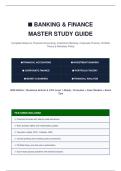
■ BANKING & FINANCE
MASTER STUDY GUIDE
Complete Notes for Financial Accounting, Investment Banking, Corporate Finance, Portfolio
Theory & Monetary Policy
■ FINANCIAL ACCOUNTING ■ INVESTMENT BANKING
■ CORPORATE FINANCE ■ PORTFOLIO THEORY
■ MONEY & BANKING ■ FINANCIAL ANALYSIS
2026 Edition | Business School & CFA Level 1 Ready | Formulas + Case Studies + Exam
Tips
FEATURES INCLUDED
✓ Financial formulas with step-by-step derivations
✓ Ratio analysis tables and interpretation guides
✓ Valuation models (DCF, multiples, LBO)
✓ Central banking and monetary policy frameworks
✓ Portfolio theory and risk-return optimization
✓ Exam-style practice problems with worked solutions
,■ TABLE OF CONTENTS
1. Financial Accounting 3
1.1 The Three Financial Statements 3
1.2 Revenue Recognition & Accrual Accounting 4
1.3 Financial Ratio Analysis 5
2. Investment Banking 6
2.1 Valuation Methods 6
2.2 Mergers & Acquisitions 7
2.3 Leveraged Buyouts (LBO) 8
3. Corporate Finance 9
3.1 Capital Budgeting 9
3.2 Cost of Capital & WACC 10
3.3 Capital Structure 11
4. Portfolio Theory & Asset Pricing 12
4.1 Risk & Return 12
4.2 Modern Portfolio Theory 13
4.3 CAPM & Factor Models 14
5. Money & Banking 15
5.1 Central Banking & Monetary Policy 15
5.2 Commercial Banking 16
5.3 Interest Rates & Yield Curves 17
6. Exam Cheat Sheets & Quick Reference 18
, 1. FINANCIAL ACCOUNTING
Financial accounting is the language of business. Understanding the three core financial
statements and how to analyze them is fundamental for every finance professional.
1.1 The Three Financial Statements
The three primary financial statements are the Income Statement, Balance Sheet, and Cash Flow Statement.
Together, they provide a complete picture of a company's financial health.
KEY CONCEPT - The Income Statement (Profit & Loss):
The Income Statement shows a company's revenues, expenses, and profits over a period of time (quarter or
year). It follows the matching principle: revenues are matched with the expenses incurred to generate them.
Income Statement Structure: Revenue (Sales / Turnover) - Cost of Goods Sold (COGS) = Gross Profit -
Operating Expenses (SG&A;, R&D;, Depreciation) = Operating Income (EBIT) - Interest Expense + Interest
Income = Earnings Before Tax (EBT) - Income Tax Expense = Net Income (Net Profit / Earnings) Key
Metrics from Income Statement: - Gross Margin: Gross Profit / Revenue (shows production efficiency) -
Operating Margin: EBIT / Revenue (shows operational efficiency) - Net Margin: Net Income / Revenue (shows
overall profitability) - EBITDA: Earnings Before Interest, Tax, Depreciation & Amortization = EBIT + Depreciation
+ Amortization - Used to compare profitability across companies with different capital structures Non-Recurring
Items: - Discontinued operations, extraordinary items, restructuring charges - Analysts often adjust for these to
get "normalized" earnings
KEY CONCEPT - The Balance Sheet:
The Balance Sheet shows a company's assets, liabilities, and equity at a single point in time. It follows the
fundamental accounting equation: ASSETS = LIABILITIES + SHAREHOLDERS' EQUITY Assets (What the
company owns): - Current Assets: Cash, Accounts Receivable, Inventory, Prepaid Expenses - Expected to be
converted to cash within one year - Non-Current Assets: Property, Plant & Equipment (PP&E;), Intangible
Assets, Goodwill, Long-term Investments - Expected to provide benefit for more than one year Liabilities (What
the company owes): - Current Liabilities: Accounts Payable, Short-term Debt, Accrued Expenses, Deferred
Revenue - Due within one year - Non-Current Liabilities: Long-term Debt, Deferred Tax Liabilities, Pension
Obligations - Due after one year Shareholders' Equity: - Common Stock (at par value) - Additional Paid-in
Capital (APIC) - Retained Earnings (cumulative net income minus dividends) - Treasury Stock (repurchased
shares, contra-equity) - Accumulated Other Comprehensive Income (AOCI) Working Capital: Current Assets -
Current Liabilities - Positive working capital = company can meet short-term obligations - Negative working
capital = potential liquidity crisis
KEY CONCEPT - The Cash Flow Statement:
The Cash Flow Statement shows how cash moved in and out of the business over a period. It reconciles net
income to actual cash generated. Three Sections: 1. Operating Activities (CFO): - Starts with Net Income +
Depreciation & Amortization (non-cash expense) + Changes in Working Capital: - Increase in AR = cash outflow
(negative) - Decrease in AR = cash inflow (positive) - Increase in Inventory = cash outflow (negative) - Decrease
in Inventory = cash inflow (positive) - Increase in AP = cash inflow (positive) - Decrease in AP = cash outflow
(negative) = Cash Flow from Operations - The most important section - shows if the business generates cash
MASTER STUDY GUIDE
Complete Notes for Financial Accounting, Investment Banking, Corporate Finance, Portfolio
Theory & Monetary Policy
■ FINANCIAL ACCOUNTING ■ INVESTMENT BANKING
■ CORPORATE FINANCE ■ PORTFOLIO THEORY
■ MONEY & BANKING ■ FINANCIAL ANALYSIS
2026 Edition | Business School & CFA Level 1 Ready | Formulas + Case Studies + Exam
Tips
FEATURES INCLUDED
✓ Financial formulas with step-by-step derivations
✓ Ratio analysis tables and interpretation guides
✓ Valuation models (DCF, multiples, LBO)
✓ Central banking and monetary policy frameworks
✓ Portfolio theory and risk-return optimization
✓ Exam-style practice problems with worked solutions
,■ TABLE OF CONTENTS
1. Financial Accounting 3
1.1 The Three Financial Statements 3
1.2 Revenue Recognition & Accrual Accounting 4
1.3 Financial Ratio Analysis 5
2. Investment Banking 6
2.1 Valuation Methods 6
2.2 Mergers & Acquisitions 7
2.3 Leveraged Buyouts (LBO) 8
3. Corporate Finance 9
3.1 Capital Budgeting 9
3.2 Cost of Capital & WACC 10
3.3 Capital Structure 11
4. Portfolio Theory & Asset Pricing 12
4.1 Risk & Return 12
4.2 Modern Portfolio Theory 13
4.3 CAPM & Factor Models 14
5. Money & Banking 15
5.1 Central Banking & Monetary Policy 15
5.2 Commercial Banking 16
5.3 Interest Rates & Yield Curves 17
6. Exam Cheat Sheets & Quick Reference 18
, 1. FINANCIAL ACCOUNTING
Financial accounting is the language of business. Understanding the three core financial
statements and how to analyze them is fundamental for every finance professional.
1.1 The Three Financial Statements
The three primary financial statements are the Income Statement, Balance Sheet, and Cash Flow Statement.
Together, they provide a complete picture of a company's financial health.
KEY CONCEPT - The Income Statement (Profit & Loss):
The Income Statement shows a company's revenues, expenses, and profits over a period of time (quarter or
year). It follows the matching principle: revenues are matched with the expenses incurred to generate them.
Income Statement Structure: Revenue (Sales / Turnover) - Cost of Goods Sold (COGS) = Gross Profit -
Operating Expenses (SG&A;, R&D;, Depreciation) = Operating Income (EBIT) - Interest Expense + Interest
Income = Earnings Before Tax (EBT) - Income Tax Expense = Net Income (Net Profit / Earnings) Key
Metrics from Income Statement: - Gross Margin: Gross Profit / Revenue (shows production efficiency) -
Operating Margin: EBIT / Revenue (shows operational efficiency) - Net Margin: Net Income / Revenue (shows
overall profitability) - EBITDA: Earnings Before Interest, Tax, Depreciation & Amortization = EBIT + Depreciation
+ Amortization - Used to compare profitability across companies with different capital structures Non-Recurring
Items: - Discontinued operations, extraordinary items, restructuring charges - Analysts often adjust for these to
get "normalized" earnings
KEY CONCEPT - The Balance Sheet:
The Balance Sheet shows a company's assets, liabilities, and equity at a single point in time. It follows the
fundamental accounting equation: ASSETS = LIABILITIES + SHAREHOLDERS' EQUITY Assets (What the
company owns): - Current Assets: Cash, Accounts Receivable, Inventory, Prepaid Expenses - Expected to be
converted to cash within one year - Non-Current Assets: Property, Plant & Equipment (PP&E;), Intangible
Assets, Goodwill, Long-term Investments - Expected to provide benefit for more than one year Liabilities (What
the company owes): - Current Liabilities: Accounts Payable, Short-term Debt, Accrued Expenses, Deferred
Revenue - Due within one year - Non-Current Liabilities: Long-term Debt, Deferred Tax Liabilities, Pension
Obligations - Due after one year Shareholders' Equity: - Common Stock (at par value) - Additional Paid-in
Capital (APIC) - Retained Earnings (cumulative net income minus dividends) - Treasury Stock (repurchased
shares, contra-equity) - Accumulated Other Comprehensive Income (AOCI) Working Capital: Current Assets -
Current Liabilities - Positive working capital = company can meet short-term obligations - Negative working
capital = potential liquidity crisis
KEY CONCEPT - The Cash Flow Statement:
The Cash Flow Statement shows how cash moved in and out of the business over a period. It reconciles net
income to actual cash generated. Three Sections: 1. Operating Activities (CFO): - Starts with Net Income +
Depreciation & Amortization (non-cash expense) + Changes in Working Capital: - Increase in AR = cash outflow
(negative) - Decrease in AR = cash inflow (positive) - Increase in Inventory = cash outflow (negative) - Decrease
in Inventory = cash inflow (positive) - Increase in AP = cash inflow (positive) - Decrease in AP = cash outflow
(negative) = Cash Flow from Operations - The most important section - shows if the business generates cash

