

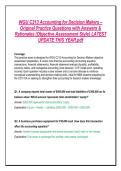
WGU C213 Accounting for Decision Makers –
Original Practice Questions with Answers &
Rationales (Objective Assessment Style) LATEST
UPDATE THIS YEAR.pdf
Coverage:
This practice exam is designed for WGU C213 Accounting for Decision Makers objective
assessment preparation. It covers core financial accounting (accounting equation,
transactions, financial statements), financial statement analysis (liquidity, profitability,
solvency ratios), and managerial accounting (cost behavior, CVP, break-even, operating
income). Each question includes a clear answer and a concise rationale to reinforce
conceptual understanding and decision-making skills. Ideal for MBA students preparing for
the C213 OA or seeking to strengthen their accounting for decision makers knowledge.
Q1. A company reports total assets of $500,000 and total liabilities of $300,000 on its
balance sheet. Which amount represents total stockholders’ equity?*
Answer: $200,000 represents total stockholders’ equity.
Explanation: Equity = Assets − Liabilities; $500,000 − $300,000 = $200,000.
Q2. A business purchases equipment for $10,000 cash. How does this transaction
affect the accounting equation?*
Answer: Assets increase (equipment) and assets decrease (cash) with no net change.
Explanation: One asset is exchanged for another; total assets unchanged.
,Q3. A firm reports revenues of $80,000 and expenses of $65,000 for the period. Which
amount represents net income?*
Answer: $15,000 represents net income.
Explanation: Net income = Revenues − Expenses; $80,000 − $65,000 = $15,000.
Q4. A company collects $5,000 from a customer on account. How does this
transaction affect the accounting equation?*
Answer: Assets increase (cash) and assets decrease (accounts receivable) with no net
change.
Explanation: Collection converts receivable to cash; total assets unchanged.
Q5. A business pays $2,000 for utilities incurred this month. How does this
transaction affect the accounting equation?*
Answer: Assets decrease (cash) and equity decreases (expense reduces retained
earnings).
Explanation: Expense reduces net income and thus retained earnings.
Q6. A firm issues common stock for $20,000 cash. How does this transaction affect
the accounting equation?*
Answer: Assets increase (cash) and equity increases (common stock).
Explanation: Stock issuance increases both assets and contributed capital.
Q7. A company borrows $15,000 from a bank by signing a note payable. How does
this transaction affect the accounting equation?*
,Answer: Assets increase (cash) and liabilities increase (notes payable).
Explanation: Borrowing increases cash and creates a liability.
Q8. A business declares and pays $3,000 in cash dividends to shareholders. How
does this transaction affect the accounting equation?*
Answer: Assets decrease (cash) and equity decreases (dividends reduce retained
earnings).
Explanation: Dividends reduce retained earnings and cash.
Q9. A firm purchases $4,000 of supplies on account. How does this transaction affect
the accounting equation?*
Answer: Assets increase (supplies) and liabilities increase (accounts payable).
Explanation: Buying on credit increases assets and liabilities.
Q10. A company performs services for $6,000 cash. How does this transaction affect
the accounting equation?*
Answer: Assets increase (cash) and equity increases (revenue increases retained
earnings).
Explanation: Revenue increases net income and thus retained earnings.
Q11. A business provides services for $8,000 on account. How does this transaction
affect the accounting equation?*
Answer: Assets increase (accounts receivable) and equity increases (revenue increases
, retained earnings).
Explanation: Accrued revenue increases assets and equity.
Q12. A firm pays $1,500 for rent in advance for the next three months. How does this
transaction affect the accounting equation?*
Answer: Assets increase (prepaid rent) and assets decrease (cash) with no net change.
Explanation: Prepayment converts cash to prepaid asset.
Q13. A company accrues $2,000 of wages expense at period end. How does this
transaction affect the accounting equation?*
Answer: Liabilities increase (wages payable) and equity decreases (expense reduces
retained earnings).
Explanation: Accrued expense increases liabilities and reduces equity.
Q14. A business receives $3,000 cash from a customer for services to be performed
next month. How does this transaction affect the accounting equation?*
Answer: Assets increase (cash) and liabilities increase (unearned revenue).
Explanation: Advance payment creates a liability until service is performed.
Q15. A firm uses $500 of supplies during the period. How does this transaction affect
the accounting equation?*
Answer: Assets decrease (supplies) and equity decreases (expense reduces retained
earnings).
Explanation: Supplies used are expensed, reducing assets and equity.
Original Practice Questions with Answers &
Rationales (Objective Assessment Style) LATEST
UPDATE THIS YEAR.pdf
Coverage:
This practice exam is designed for WGU C213 Accounting for Decision Makers objective
assessment preparation. It covers core financial accounting (accounting equation,
transactions, financial statements), financial statement analysis (liquidity, profitability,
solvency ratios), and managerial accounting (cost behavior, CVP, break-even, operating
income). Each question includes a clear answer and a concise rationale to reinforce
conceptual understanding and decision-making skills. Ideal for MBA students preparing for
the C213 OA or seeking to strengthen their accounting for decision makers knowledge.
Q1. A company reports total assets of $500,000 and total liabilities of $300,000 on its
balance sheet. Which amount represents total stockholders’ equity?*
Answer: $200,000 represents total stockholders’ equity.
Explanation: Equity = Assets − Liabilities; $500,000 − $300,000 = $200,000.
Q2. A business purchases equipment for $10,000 cash. How does this transaction
affect the accounting equation?*
Answer: Assets increase (equipment) and assets decrease (cash) with no net change.
Explanation: One asset is exchanged for another; total assets unchanged.
,Q3. A firm reports revenues of $80,000 and expenses of $65,000 for the period. Which
amount represents net income?*
Answer: $15,000 represents net income.
Explanation: Net income = Revenues − Expenses; $80,000 − $65,000 = $15,000.
Q4. A company collects $5,000 from a customer on account. How does this
transaction affect the accounting equation?*
Answer: Assets increase (cash) and assets decrease (accounts receivable) with no net
change.
Explanation: Collection converts receivable to cash; total assets unchanged.
Q5. A business pays $2,000 for utilities incurred this month. How does this
transaction affect the accounting equation?*
Answer: Assets decrease (cash) and equity decreases (expense reduces retained
earnings).
Explanation: Expense reduces net income and thus retained earnings.
Q6. A firm issues common stock for $20,000 cash. How does this transaction affect
the accounting equation?*
Answer: Assets increase (cash) and equity increases (common stock).
Explanation: Stock issuance increases both assets and contributed capital.
Q7. A company borrows $15,000 from a bank by signing a note payable. How does
this transaction affect the accounting equation?*
,Answer: Assets increase (cash) and liabilities increase (notes payable).
Explanation: Borrowing increases cash and creates a liability.
Q8. A business declares and pays $3,000 in cash dividends to shareholders. How
does this transaction affect the accounting equation?*
Answer: Assets decrease (cash) and equity decreases (dividends reduce retained
earnings).
Explanation: Dividends reduce retained earnings and cash.
Q9. A firm purchases $4,000 of supplies on account. How does this transaction affect
the accounting equation?*
Answer: Assets increase (supplies) and liabilities increase (accounts payable).
Explanation: Buying on credit increases assets and liabilities.
Q10. A company performs services for $6,000 cash. How does this transaction affect
the accounting equation?*
Answer: Assets increase (cash) and equity increases (revenue increases retained
earnings).
Explanation: Revenue increases net income and thus retained earnings.
Q11. A business provides services for $8,000 on account. How does this transaction
affect the accounting equation?*
Answer: Assets increase (accounts receivable) and equity increases (revenue increases
, retained earnings).
Explanation: Accrued revenue increases assets and equity.
Q12. A firm pays $1,500 for rent in advance for the next three months. How does this
transaction affect the accounting equation?*
Answer: Assets increase (prepaid rent) and assets decrease (cash) with no net change.
Explanation: Prepayment converts cash to prepaid asset.
Q13. A company accrues $2,000 of wages expense at period end. How does this
transaction affect the accounting equation?*
Answer: Liabilities increase (wages payable) and equity decreases (expense reduces
retained earnings).
Explanation: Accrued expense increases liabilities and reduces equity.
Q14. A business receives $3,000 cash from a customer for services to be performed
next month. How does this transaction affect the accounting equation?*
Answer: Assets increase (cash) and liabilities increase (unearned revenue).
Explanation: Advance payment creates a liability until service is performed.
Q15. A firm uses $500 of supplies during the period. How does this transaction affect
the accounting equation?*
Answer: Assets decrease (supplies) and equity decreases (expense reduces retained
earnings).
Explanation: Supplies used are expensed, reducing assets and equity.

