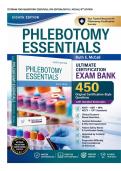
TESTBANK FOR PHLEBOTOMY ESSENTIALS, 8TH EDITION (RUTH E. MCCALL) 8TH EDITION
,PHLEBOTOMY ESSENTIALS, 8TH EDITION
Ultimate Certification Exam Bank
450 Original Certification-Style Questions with Detailed Rationales
Based on Phlebotomy Essentials, 8th Edition by Ruth E. McCall
TABLE OF CONTENTS
UNIT I — The Healthcare Setting
Chapter Topic Questions
Chapter 1 Phlebotomy: Past and Present and the Healthcare Setting 1–25
Chapter 2 Quality Assurance and Legal Issues in Healthcare 26–60
Chapter 3 Infection Control, Safety, First Aid, and Personal Wellness 61–90
Chapter 4 Medical Terminology 91–120
UNIT II — Overview of the Human Body
Chapter Topic Questions
Chapter 5 Anatomy and Physiology 121–180
Chapter 6 The Circulatory System 181–210
UNIT III — Blood Collection Procedures
Chapter Topic Questions
Chapter 7 Blood Collection Equipment, Additives, and Order of Draw 211–240
Chapter 8 Venipuncture Procedures 241–270
Chapter 9 Preexamination (Preanalytical) Considerations 271–300
Chapter 10 Capillary Puncture Equipment, Principles, and Procedures 301–330
UNIT IV — Specimen Collection and Processing
,Chapter Topic Questions
Chapter 11 Special Collections and Point-of-Care Testing 331–360
Chapter 12 Computers and Specimen Handling and Processing 361–390
Chapter 13 Urine and Other Nonblood Specimens and Tests 391–420
UNIT V — Advanced Blood Collection Procedures
Chapter Topic Questions
Chapter 14 Arterial Puncture Procedures 421–450
EXAM BANK FEATURES
• 450 Original Certification-Style Questions
• Based on the Latest Phlebotomy Essentials, 8th Edition
• Organized by Textbook Chapter
• ASCP, AMT, NHA, NCCT & CPT Certification Standards
• Progressive Difficulty (Foundational to Advanced)
• Clinical Scenario–Based Questions
• Application & Critical Thinking Focus
• Randomized Answer Distribution (A–D)
• Detailed Rationales for Every Question
• Why the Other Options Are Incorrect
• Clinical Insights
• Certification Pearls
• Patient Safety Alerts
• Designed for National Phlebotomy Certification Success
Question Distribution Summary
,Unit Questions
Unit I – The Healthcare Setting 1–120 (120 Questions)
Unit II – Overview of the Human Body 121–210 (90 Questions)
Unit III – Blood Collection Procedures 211–330 (120 Questions)
Unit IV – Specimen Collection and Processing 331–420 (90 Questions)
Unit V – Advanced Blood Collection Procedures 421–450 (30 Questions)
TOTAL 450 Original Certification-Style Questions
UNIT I — The Healthcare Setting
Chapter 1 – Phlebotomy: Past and Present and the Healthcare Setting
Question 1
Clinical Scenario
On her first day in the outpatient laboratory, Emma, a newly hired phlebotomist, is assigned to collect blood
from an elderly patient scheduled for several diagnostic tests. Before preparing the collection equipment, she
asks the patient to state their full name and date of birth and compares the information with the wristband
and laboratory request. A nursing student watching the interaction remarks that the verification process seems
unnecessary because the patient has visited the clinic many times before.
Which response by Emma best explains why patient identification must always be completed before
specimen collection?
A. It allows laboratory staff to determine which tests should be performed.
B. It ensures the specimen belongs to the correct patient, preventing diagnostic and treatment errors.
C. It reduces the amount of blood required for laboratory analysis.
D. It is performed mainly to satisfy hospital documentation requirements.
Correct Answer
B. It ensures the specimen belongs to the correct patient, preventing diagnostic and treatment errors.
Rationale
Patient identification is the most critical step in the specimen collection process. Correctly identifying the
patient before collection helps prevent specimen mix-ups, incorrect diagnoses, inappropriate treatment, and
repeat collections. Every specimen must be accurately linked to the individual from whom it was collected.
Why the Other Options Are Incorrect
,A. Test selection is determined by the healthcare provider, not the identification process.
C. Identification has no effect on the amount of blood collected.
D. Documentation is important, but patient safety—not paperwork—is the primary reason for identification.
Clinical Insight
Most preventable laboratory errors begin before the specimen reaches the laboratory, making patient
identification a vital quality assurance step.
Certification Pearl
Always identify the patient before preparing equipment or performing a venipuncture.
Patient Safety Alert
Never collect a specimen if the patient's identity cannot be confirmed using approved identifiers.
Question 2
Clinical Scenario
A physician explains to a patient that laboratory test results will guide decisions about medication and further
treatment. The patient asks the phlebotomist why collecting a blood specimen correctly is so important if
sophisticated laboratory analyzers perform the testing afterward.
Which response by the phlebotomist is the most appropriate?
A. Modern analyzers automatically correct errors made during specimen collection.
B. Proper specimen collection and handling are essential because laboratory accuracy depends on specimen
quality.
C. Blood collection mainly serves administrative purposes before testing.
D. Laboratory professionals can always identify and correct mislabeled specimens.
Correct Answer
B. Proper specimen collection and handling are essential because laboratory accuracy depends on specimen
quality.
Rationale
Laboratory instruments can only analyze the specimen they receive. If a specimen is collected, labeled, or
handled incorrectly, the results may be inaccurate regardless of the technology used. Proper collection is
essential for reliable patient care.
Why the Other Options Are Incorrect
A. Instruments cannot correct preanalytical collection errors.
,C. Blood collection directly supports diagnosis and treatment, not administrative tasks.
D. Misidentified specimens usually require recollection because their accuracy cannot be guaranteed.
Clinical Insight
Quality laboratory testing begins with quality specimen collection.
Certification Pearl
The preanalytical phase is responsible for most laboratory errors.
Patient Safety Alert
Improper specimen collection may delay diagnosis and require another venipuncture.
Question 3
Clinical Scenario
During orientation, students compare the history of bloodletting with the responsibilities of today's
professional phlebotomists. One student comments that both involve drawing blood, so they are essentially
the same practice.
Which statement best distinguishes modern phlebotomy from historical bloodletting?
A. Modern phlebotomy removes blood to restore the body's balance.
B. Modern phlebotomy follows evidence-based procedures to obtain diagnostic specimens safely.
C. Modern phlebotomy is performed only in emergency departments.
D. Modern phlebotomy replaces physical examination during diagnosis.
Correct Answer
B. Modern phlebotomy follows evidence-based procedures to obtain diagnostic specimens safely.
Rationale
Historical bloodletting was intended as a treatment based on outdated medical theories. Modern phlebotomy
focuses on collecting high-quality specimens for laboratory analysis using standardized procedures that
prioritize patient safety and diagnostic accuracy.
Why the Other Options Are Incorrect
A. Routine therapeutic bloodletting is no longer standard medical practice.
C. Phlebotomy is performed in many healthcare settings.
D. Laboratory testing complements, rather than replaces, clinical assessment.
Clinical Insight
,Today's phlebotomist contributes to evidence-based healthcare through accurate specimen collection.
Certification Pearl
Modern phlebotomy is a diagnostic service, not a routine therapeutic procedure.
Patient Safety Alert
Following standardized procedures helps ensure reliable laboratory results.
Question 4
Clinical Scenario
A newly employed phlebotomist is asked to describe their responsibilities during a hospital orientation session.
One attendee believes the phlebotomist's only responsibility is drawing blood quickly.
Which statement most accurately describes the professional role of a phlebotomist?
A. Diagnosing diseases using laboratory findings.
B. Collecting, identifying, handling, and transporting specimens while promoting patient safety.
C. Prescribing laboratory tests according to patient symptoms.
D. Interpreting laboratory reports before physician review.
Correct Answer
B. Collecting, identifying, handling, and transporting specimens while promoting patient safety.
Rationale
Professional phlebotomy includes much more than venipuncture. Responsibilities include patient
identification, infection prevention, specimen labeling, transportation, documentation, communication, and
maintaining specimen integrity throughout the collection process.
Why the Other Options Are Incorrect
A. Diagnosis is outside the phlebotomist's scope of practice.
C. Test ordering is performed by authorized healthcare providers.
D. Laboratory interpretation belongs to qualified clinicians.
Clinical Insight
Successful specimen collection combines technical skill with professionalism and communication.
Certification Pearl
A phlebotomist protects both the patient and the integrity of every specimen collected.
, Patient Safety Alert
Proper specimen handling is just as important as successful venipuncture.
Question 5
Clinical Scenario
A busy outpatient clinic is running behind schedule. A coworker suggests skipping a few verification steps to
reduce patient waiting times. You recognize that doing so could compromise patient safety.
What is the BEST course of action?
A. Skip identification for patients who are familiar to the staff.
B. Continue following all identification procedures despite the busy schedule.
C. Collect the specimen first and verify the patient afterward.
D. Ask another patient to confirm the individual's identity.
Correct Answer
B. Continue following all identification procedures despite the busy schedule.
Rationale
Patient safety always takes priority over speed. Identification procedures must be followed consistently for
every patient regardless of workload, staffing levels, or time constraints.
Why the Other Options Are Incorrect
A. Familiarity never replaces proper identification.
C. Verification must occur before specimen collection.
D. Patient identity should never be confirmed by another patient.
Clinical Insight
Most identification errors occur when staff take shortcuts during busy periods.
Certification Pearl
Consistency is one of the strongest safeguards against specimen identification errors.
Patient Safety Alert
Never compromise safety to improve workflow efficiency.
Question 6
,Clinical Scenario
A patient with suspected sepsis requires blood cultures, a complete blood count, and a metabolic panel. The
physician, nurse, laboratory scientist, and phlebotomist each contribute to the patient's care.
Which statement best describes the phlebotomist's role within the healthcare team?
A. Independently diagnosing infectious diseases.
B. Collaborating with the healthcare team by obtaining quality specimens that support accurate diagnosis and
treatment.
C. Determining which antibiotics the patient should receive.
D. Interpreting laboratory findings before reporting them.
Correct Answer
B. Collaborating with the healthcare team by obtaining quality specimens that support accurate diagnosis
and treatment.
Rationale
The phlebotomist is an essential member of the healthcare team. Accurate specimen collection supports
reliable laboratory testing, allowing other healthcare professionals to make informed clinical decisions and
provide appropriate patient care.
Why the Other Options Are Incorrect
A. Diagnosis is the responsibility of qualified healthcare providers.
C. Medication decisions are made by authorized clinicians.
D. Laboratory interpretation is outside the phlebotomist's scope of practice.
Clinical Insight
Effective patient care depends on collaboration among all healthcare professionals.
Certification Pearl
Every accurate laboratory result begins with a properly collected specimen.
Patient Safety Alert
Poor specimen quality can affect every clinical decision that follows.
Question 7
Clinical Scenario
, A newly certified phlebotomist begins working in a regional medical center that includes an emergency
department, intensive care unit, outpatient clinics, and a diagnostic laboratory. During orientation, the
laboratory manager emphasizes that every department depends on accurate specimen collection to support
timely patient care. Later that day, the phlebotomist is asked why laboratory medicine is often described as the
foundation of modern healthcare.
Which statement best explains the relationship between laboratory medicine and patient care?
A. Laboratory testing replaces the need for physical examinations in most patients.
B. Laboratory results provide objective clinical information that assists healthcare providers in diagnosing,
monitoring, and treating disease.
C. Laboratory professionals determine treatment plans independently after reviewing test results.
D. Laboratory testing is primarily used to confirm insurance eligibility before treatment.
Correct Answer
B. Laboratory results provide objective clinical information that assists healthcare providers in diagnosing,
monitoring, and treating disease.
Rationale
Laboratory medicine plays a vital role in healthcare by providing objective data that supports diagnosis,
monitors disease progression, evaluates treatment effectiveness, and aids preventive care. Because laboratory
decisions depend on specimen quality, phlebotomists contribute directly to the accuracy of patient
management.
Why the Other Options Are Incorrect
A. Laboratory testing complements, rather than replaces, clinical assessment.
C. Treatment decisions remain the responsibility of licensed healthcare providers.
D. Laboratory testing is performed for clinical purposes, not insurance verification.
Clinical Insight
Accurate laboratory results often influence critical medical decisions across every healthcare specialty.
Certification Pearl
A high-quality specimen is the foundation of reliable laboratory testing.
Patient Safety Alert
Specimen collection errors can delay diagnosis and compromise patient outcomes.
Question 8
,PHLEBOTOMY ESSENTIALS, 8TH EDITION
Ultimate Certification Exam Bank
450 Original Certification-Style Questions with Detailed Rationales
Based on Phlebotomy Essentials, 8th Edition by Ruth E. McCall
TABLE OF CONTENTS
UNIT I — The Healthcare Setting
Chapter Topic Questions
Chapter 1 Phlebotomy: Past and Present and the Healthcare Setting 1–25
Chapter 2 Quality Assurance and Legal Issues in Healthcare 26–60
Chapter 3 Infection Control, Safety, First Aid, and Personal Wellness 61–90
Chapter 4 Medical Terminology 91–120
UNIT II — Overview of the Human Body
Chapter Topic Questions
Chapter 5 Anatomy and Physiology 121–180
Chapter 6 The Circulatory System 181–210
UNIT III — Blood Collection Procedures
Chapter Topic Questions
Chapter 7 Blood Collection Equipment, Additives, and Order of Draw 211–240
Chapter 8 Venipuncture Procedures 241–270
Chapter 9 Preexamination (Preanalytical) Considerations 271–300
Chapter 10 Capillary Puncture Equipment, Principles, and Procedures 301–330
UNIT IV — Specimen Collection and Processing
,Chapter Topic Questions
Chapter 11 Special Collections and Point-of-Care Testing 331–360
Chapter 12 Computers and Specimen Handling and Processing 361–390
Chapter 13 Urine and Other Nonblood Specimens and Tests 391–420
UNIT V — Advanced Blood Collection Procedures
Chapter Topic Questions
Chapter 14 Arterial Puncture Procedures 421–450
EXAM BANK FEATURES
• 450 Original Certification-Style Questions
• Based on the Latest Phlebotomy Essentials, 8th Edition
• Organized by Textbook Chapter
• ASCP, AMT, NHA, NCCT & CPT Certification Standards
• Progressive Difficulty (Foundational to Advanced)
• Clinical Scenario–Based Questions
• Application & Critical Thinking Focus
• Randomized Answer Distribution (A–D)
• Detailed Rationales for Every Question
• Why the Other Options Are Incorrect
• Clinical Insights
• Certification Pearls
• Patient Safety Alerts
• Designed for National Phlebotomy Certification Success
Question Distribution Summary
,Unit Questions
Unit I – The Healthcare Setting 1–120 (120 Questions)
Unit II – Overview of the Human Body 121–210 (90 Questions)
Unit III – Blood Collection Procedures 211–330 (120 Questions)
Unit IV – Specimen Collection and Processing 331–420 (90 Questions)
Unit V – Advanced Blood Collection Procedures 421–450 (30 Questions)
TOTAL 450 Original Certification-Style Questions
UNIT I — The Healthcare Setting
Chapter 1 – Phlebotomy: Past and Present and the Healthcare Setting
Question 1
Clinical Scenario
On her first day in the outpatient laboratory, Emma, a newly hired phlebotomist, is assigned to collect blood
from an elderly patient scheduled for several diagnostic tests. Before preparing the collection equipment, she
asks the patient to state their full name and date of birth and compares the information with the wristband
and laboratory request. A nursing student watching the interaction remarks that the verification process seems
unnecessary because the patient has visited the clinic many times before.
Which response by Emma best explains why patient identification must always be completed before
specimen collection?
A. It allows laboratory staff to determine which tests should be performed.
B. It ensures the specimen belongs to the correct patient, preventing diagnostic and treatment errors.
C. It reduces the amount of blood required for laboratory analysis.
D. It is performed mainly to satisfy hospital documentation requirements.
Correct Answer
B. It ensures the specimen belongs to the correct patient, preventing diagnostic and treatment errors.
Rationale
Patient identification is the most critical step in the specimen collection process. Correctly identifying the
patient before collection helps prevent specimen mix-ups, incorrect diagnoses, inappropriate treatment, and
repeat collections. Every specimen must be accurately linked to the individual from whom it was collected.
Why the Other Options Are Incorrect
,A. Test selection is determined by the healthcare provider, not the identification process.
C. Identification has no effect on the amount of blood collected.
D. Documentation is important, but patient safety—not paperwork—is the primary reason for identification.
Clinical Insight
Most preventable laboratory errors begin before the specimen reaches the laboratory, making patient
identification a vital quality assurance step.
Certification Pearl
Always identify the patient before preparing equipment or performing a venipuncture.
Patient Safety Alert
Never collect a specimen if the patient's identity cannot be confirmed using approved identifiers.
Question 2
Clinical Scenario
A physician explains to a patient that laboratory test results will guide decisions about medication and further
treatment. The patient asks the phlebotomist why collecting a blood specimen correctly is so important if
sophisticated laboratory analyzers perform the testing afterward.
Which response by the phlebotomist is the most appropriate?
A. Modern analyzers automatically correct errors made during specimen collection.
B. Proper specimen collection and handling are essential because laboratory accuracy depends on specimen
quality.
C. Blood collection mainly serves administrative purposes before testing.
D. Laboratory professionals can always identify and correct mislabeled specimens.
Correct Answer
B. Proper specimen collection and handling are essential because laboratory accuracy depends on specimen
quality.
Rationale
Laboratory instruments can only analyze the specimen they receive. If a specimen is collected, labeled, or
handled incorrectly, the results may be inaccurate regardless of the technology used. Proper collection is
essential for reliable patient care.
Why the Other Options Are Incorrect
A. Instruments cannot correct preanalytical collection errors.
,C. Blood collection directly supports diagnosis and treatment, not administrative tasks.
D. Misidentified specimens usually require recollection because their accuracy cannot be guaranteed.
Clinical Insight
Quality laboratory testing begins with quality specimen collection.
Certification Pearl
The preanalytical phase is responsible for most laboratory errors.
Patient Safety Alert
Improper specimen collection may delay diagnosis and require another venipuncture.
Question 3
Clinical Scenario
During orientation, students compare the history of bloodletting with the responsibilities of today's
professional phlebotomists. One student comments that both involve drawing blood, so they are essentially
the same practice.
Which statement best distinguishes modern phlebotomy from historical bloodletting?
A. Modern phlebotomy removes blood to restore the body's balance.
B. Modern phlebotomy follows evidence-based procedures to obtain diagnostic specimens safely.
C. Modern phlebotomy is performed only in emergency departments.
D. Modern phlebotomy replaces physical examination during diagnosis.
Correct Answer
B. Modern phlebotomy follows evidence-based procedures to obtain diagnostic specimens safely.
Rationale
Historical bloodletting was intended as a treatment based on outdated medical theories. Modern phlebotomy
focuses on collecting high-quality specimens for laboratory analysis using standardized procedures that
prioritize patient safety and diagnostic accuracy.
Why the Other Options Are Incorrect
A. Routine therapeutic bloodletting is no longer standard medical practice.
C. Phlebotomy is performed in many healthcare settings.
D. Laboratory testing complements, rather than replaces, clinical assessment.
Clinical Insight
,Today's phlebotomist contributes to evidence-based healthcare through accurate specimen collection.
Certification Pearl
Modern phlebotomy is a diagnostic service, not a routine therapeutic procedure.
Patient Safety Alert
Following standardized procedures helps ensure reliable laboratory results.
Question 4
Clinical Scenario
A newly employed phlebotomist is asked to describe their responsibilities during a hospital orientation session.
One attendee believes the phlebotomist's only responsibility is drawing blood quickly.
Which statement most accurately describes the professional role of a phlebotomist?
A. Diagnosing diseases using laboratory findings.
B. Collecting, identifying, handling, and transporting specimens while promoting patient safety.
C. Prescribing laboratory tests according to patient symptoms.
D. Interpreting laboratory reports before physician review.
Correct Answer
B. Collecting, identifying, handling, and transporting specimens while promoting patient safety.
Rationale
Professional phlebotomy includes much more than venipuncture. Responsibilities include patient
identification, infection prevention, specimen labeling, transportation, documentation, communication, and
maintaining specimen integrity throughout the collection process.
Why the Other Options Are Incorrect
A. Diagnosis is outside the phlebotomist's scope of practice.
C. Test ordering is performed by authorized healthcare providers.
D. Laboratory interpretation belongs to qualified clinicians.
Clinical Insight
Successful specimen collection combines technical skill with professionalism and communication.
Certification Pearl
A phlebotomist protects both the patient and the integrity of every specimen collected.
, Patient Safety Alert
Proper specimen handling is just as important as successful venipuncture.
Question 5
Clinical Scenario
A busy outpatient clinic is running behind schedule. A coworker suggests skipping a few verification steps to
reduce patient waiting times. You recognize that doing so could compromise patient safety.
What is the BEST course of action?
A. Skip identification for patients who are familiar to the staff.
B. Continue following all identification procedures despite the busy schedule.
C. Collect the specimen first and verify the patient afterward.
D. Ask another patient to confirm the individual's identity.
Correct Answer
B. Continue following all identification procedures despite the busy schedule.
Rationale
Patient safety always takes priority over speed. Identification procedures must be followed consistently for
every patient regardless of workload, staffing levels, or time constraints.
Why the Other Options Are Incorrect
A. Familiarity never replaces proper identification.
C. Verification must occur before specimen collection.
D. Patient identity should never be confirmed by another patient.
Clinical Insight
Most identification errors occur when staff take shortcuts during busy periods.
Certification Pearl
Consistency is one of the strongest safeguards against specimen identification errors.
Patient Safety Alert
Never compromise safety to improve workflow efficiency.
Question 6
,Clinical Scenario
A patient with suspected sepsis requires blood cultures, a complete blood count, and a metabolic panel. The
physician, nurse, laboratory scientist, and phlebotomist each contribute to the patient's care.
Which statement best describes the phlebotomist's role within the healthcare team?
A. Independently diagnosing infectious diseases.
B. Collaborating with the healthcare team by obtaining quality specimens that support accurate diagnosis and
treatment.
C. Determining which antibiotics the patient should receive.
D. Interpreting laboratory findings before reporting them.
Correct Answer
B. Collaborating with the healthcare team by obtaining quality specimens that support accurate diagnosis
and treatment.
Rationale
The phlebotomist is an essential member of the healthcare team. Accurate specimen collection supports
reliable laboratory testing, allowing other healthcare professionals to make informed clinical decisions and
provide appropriate patient care.
Why the Other Options Are Incorrect
A. Diagnosis is the responsibility of qualified healthcare providers.
C. Medication decisions are made by authorized clinicians.
D. Laboratory interpretation is outside the phlebotomist's scope of practice.
Clinical Insight
Effective patient care depends on collaboration among all healthcare professionals.
Certification Pearl
Every accurate laboratory result begins with a properly collected specimen.
Patient Safety Alert
Poor specimen quality can affect every clinical decision that follows.
Question 7
Clinical Scenario
, A newly certified phlebotomist begins working in a regional medical center that includes an emergency
department, intensive care unit, outpatient clinics, and a diagnostic laboratory. During orientation, the
laboratory manager emphasizes that every department depends on accurate specimen collection to support
timely patient care. Later that day, the phlebotomist is asked why laboratory medicine is often described as the
foundation of modern healthcare.
Which statement best explains the relationship between laboratory medicine and patient care?
A. Laboratory testing replaces the need for physical examinations in most patients.
B. Laboratory results provide objective clinical information that assists healthcare providers in diagnosing,
monitoring, and treating disease.
C. Laboratory professionals determine treatment plans independently after reviewing test results.
D. Laboratory testing is primarily used to confirm insurance eligibility before treatment.
Correct Answer
B. Laboratory results provide objective clinical information that assists healthcare providers in diagnosing,
monitoring, and treating disease.
Rationale
Laboratory medicine plays a vital role in healthcare by providing objective data that supports diagnosis,
monitors disease progression, evaluates treatment effectiveness, and aids preventive care. Because laboratory
decisions depend on specimen quality, phlebotomists contribute directly to the accuracy of patient
management.
Why the Other Options Are Incorrect
A. Laboratory testing complements, rather than replaces, clinical assessment.
C. Treatment decisions remain the responsibility of licensed healthcare providers.
D. Laboratory testing is performed for clinical purposes, not insurance verification.
Clinical Insight
Accurate laboratory results often influence critical medical decisions across every healthcare specialty.
Certification Pearl
A high-quality specimen is the foundation of reliable laboratory testing.
Patient Safety Alert
Specimen collection errors can delay diagnosis and compromise patient outcomes.
Question 8