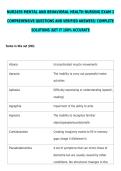
NUR2459 MENTAL AND BEHAVIORAL HEALTH NURSING EXAM 2
COMPREHENSIVE QUESTIONS AND VERIFIED ANSWERS/ COMPLETE
SOLUTIONS |GET IT 100% ACCURATE
Terms in this set (293)
Ataxia Uncoordinated muscle movements
Apraxia The inability to carry out purposeful motor
activities
Aphasia Difficulty expressing or understanding (speech,
reading)
Agraphia Impairment of the ability to write
Agnosia The inability to recognize familiar
objects/people/sounds/smells
Confabulation Creating imaginary events to fill in memory
gaps (stage 4 Alzheimer's)
Pseudodementia A set of symptoms that can mimic those of
dementia but are usually caused by other
conditions. No structural changes in the
, brain.
Sundowning A state of confusion that occurs in the late
afternoon and lasts into the night (stage 6
Alzheimer's)
Neurocognitive Disorder A clinical deficit in cognition or memory,
(NCD) causing a change from a previous level of
function.
Tolerance The need to use more of a substance over
time to achieve the same effect. Tolerance
increases overdose risk.
Dependence A physical or psychological reliance on the
substance, leading to withdrawal symptoms
when it is reduced or stopped.
, Withdrawal Syndrome A group of predictable symptoms that occur
when substance use is reduced after prolonged
use. These vary by substance and can
range from mild to life-
threatening.
Therapeutic Use open-ended, non-judgmental questions
Communication during assessments, such as 'Tell me about
your current drug and alcohol use.'
Alcohol A CNS depressant
Intoxication Blood concentration of 80 or 100mg ethanol per
deciliter or 0.08-0.1g/dL
Wernicke-Korsakoff Most serious form of thiamine deficiency in
Syndrome alcoholics
Wernicke's Acute, short-term, and life-threatening phase
Encephalopathy with a triad of symptoms: confusion, ataxia,
and ophthalmoplegia (abnormal eye
movements)
Korsakoff's Psychosis Chronic, long-term, and often permanent phase
with severe
COMPREHENSIVE QUESTIONS AND VERIFIED ANSWERS/ COMPLETE
SOLUTIONS |GET IT 100% ACCURATE
Terms in this set (293)
Ataxia Uncoordinated muscle movements
Apraxia The inability to carry out purposeful motor
activities
Aphasia Difficulty expressing or understanding (speech,
reading)
Agraphia Impairment of the ability to write
Agnosia The inability to recognize familiar
objects/people/sounds/smells
Confabulation Creating imaginary events to fill in memory
gaps (stage 4 Alzheimer's)
Pseudodementia A set of symptoms that can mimic those of
dementia but are usually caused by other
conditions. No structural changes in the
, brain.
Sundowning A state of confusion that occurs in the late
afternoon and lasts into the night (stage 6
Alzheimer's)
Neurocognitive Disorder A clinical deficit in cognition or memory,
(NCD) causing a change from a previous level of
function.
Tolerance The need to use more of a substance over
time to achieve the same effect. Tolerance
increases overdose risk.
Dependence A physical or psychological reliance on the
substance, leading to withdrawal symptoms
when it is reduced or stopped.
, Withdrawal Syndrome A group of predictable symptoms that occur
when substance use is reduced after prolonged
use. These vary by substance and can
range from mild to life-
threatening.
Therapeutic Use open-ended, non-judgmental questions
Communication during assessments, such as 'Tell me about
your current drug and alcohol use.'
Alcohol A CNS depressant
Intoxication Blood concentration of 80 or 100mg ethanol per
deciliter or 0.08-0.1g/dL
Wernicke-Korsakoff Most serious form of thiamine deficiency in
Syndrome alcoholics
Wernicke's Acute, short-term, and life-threatening phase
Encephalopathy with a triad of symptoms: confusion, ataxia,
and ophthalmoplegia (abnormal eye
movements)
Korsakoff's Psychosis Chronic, long-term, and often permanent phase
with severe