

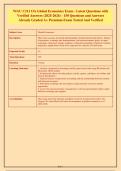
WGU C211 OA Global Economics Exam - Latest Questions with
Verified Answers (2025-2026) - 150 Questions and Answers
Already Graded A+ Premium Exam Tested And Verified
Subject Area Global Economics
Description This exam assesses advanced understanding of international trade theory, balance
of payments, exchange rate determination, and macroeconomic policy in open
economies. Questions require synthesis of theoretical models, empirical evidence,
and policy implications at the level expected for a top-tier US university.
Expected Grade A+
Total Questions 150
Duration 3 hours
Learning Outcomes 1. Analyze comparative advantage and the gains from trade using Ricardian and
Heckscher-Ohlin models
2. Evaluate the effects of trade policies (tariffs, quotas, subsidies) on welfare and
income distribution
3. Explain balance of payments accounting and the relationship between current
and financial accounts
4. Determine exchange rate movements using monetary and asset market
approaches
5. Assess the macroeconomic consequences of fiscal and monetary policy under
different exchange rate regimes
Accreditation This exam meets the rigorous standards of top US research universities (Ivy
League, R1) and reflects the latest developments in global economics as of
2025-2026.
Page 1
,1. Consider two countries, Home and Foreign, producing two goods, cloth and wine,
using labor only. Home has 1000 hours of labor, Foreign has 2000 hours. Unit labor
requirements: Home: a_LC = 5, a_LW = 10; Foreign: a_LC* = 10, a_LW* = 5.
Which of the following statements about the pattern of trade and the relative wage is
correct?
A. Home exports cloth, Foreign exports wine; the relative wage w/w* lies between 0.5 and 2.
B. Home exports wine, Foreign exports cloth; the relative wage w/w* equals 1 in
equilibrium.
C. Both countries export both goods due to equal labor productivity differences.
D. Trade is not beneficial because Home has absolute advantage in both goods.
Answer: A. Home exports cloth, Foreign exports wine; the relative wage w/w* lies
between 0.5 and 2.
Home has lower unit labor requirement in cloth (5 vs 10), so comparative advantage in
cloth; Foreign in wine. The relative wage w/w* must be between the ratios of unit labor
requirements (a_LC*/a_LC = 2 and a_LW*/a_LW = 0.5) for both countries to have a
cost advantage in their export good. Thus A is correct.
2. In the Heckscher-Ohlin model, suppose the US is capital-abundant and India is
labor-abundant. Both produce steel (capital-intensive) and textiles (labor-intensive).
According to the Stolper-Samuelson theorem, if the US imposes a tariff on steel
imports, which of the following is the most likely long-run effect on factor incomes in
the US?
A. Real wages rise and real rental rates fall.
B. Real wages fall and real rental rates rise.
C. Both real wages and real rental rates rise.
D. Both real wages and real rental rates fall.
Answer: B. Real wages fall and real rental rates rise.
The tariff protects the US steel industry, which is capital-intensive. This raises the
relative price of steel, leading to an increase in the return to the factor used intensively
in steel (capital) and a decrease in the return to the other factor (labor), as predicted by
the Stolper-Samuelson theorem. Thus B is correct.
Page 2
,3. A country's balance of payments accounts show: current account balance = -$50
billion, financial account balance = +$60 billion, and capital account balance = -$5
billion. What is the official settlements balance (or net change in official reserve
assets), assuming no errors and omissions?
A. +$5 billion
B. -$5 billion
C. +$15 billion
D. -$15 billion
Answer: B. -$5 billion
The sum of current, financial, and capital accounts plus official settlements must equal
zero. So official settlements = - (CA + FA + KA) = -(-50 + 60 -5) = -5. A negative official
settlements balance indicates an increase in official reserve assets (since it's a debit).
Thus B is correct.
4. Under the monetary approach to exchange rates, with flexible prices and full
employment, if the home country's money supply grows by 10% and its real income
grows by 3%, while the foreign country's money supply grows by 5% and its real
income grows by 2%, what is the expected percentage change in the home currency's
exchange rate (defined as home currency per unit of foreign currency)?
A. Depreciation of 4%
B. Depreciation of 6%
C. Appreciation of 4%
D. Appreciation of 6%
Answer: A. Depreciation of 4%
The monetary approach predicts %E = %Ms - %Ms* - (%y - %y*) = 10 - 5 - (3 - 2) =
4%. Since E is home currency per foreign currency, a positive change means home
currency depreciation. Thus A is correct.
Page 3
, 5. Consider a small open economy with perfect capital mobility and a fixed exchange
rate. The central bank pegs the currency at a certain level. If the government
increases government spending, what is the ultimate effect on output and the money
supply, assuming no sterilization?
A. Output rises, money supply remains unchanged.
B. Output rises, money supply increases.
C. Output remains unchanged, money supply increases.
D. Output remains unchanged, money supply remains unchanged.
Answer: B. Output rises, money supply increases.
Under fixed exchange rates and perfect capital mobility, fiscal expansion increases
aggregate demand, putting upward pressure on the exchange rate. To maintain the peg,
the central bank must buy foreign assets, increasing the money supply. The monetary
expansion further boosts output. Thus B is correct.
6. According to the J-curve effect, a real depreciation of a country's currency will
initially worsen its trade balance before improving it. Which of the following is the
most likely explanation for this phenomenon?
A. Contracts signed before the depreciation fix prices in domestic currency, so import values
rise immediately while export volumes adjust slowly.
B. Exporters immediately raise prices in foreign currency, causing a sharp drop in export
volumes.
C. Importers immediately reduce quantities, causing a sharp drop in import values.
D. The Marshall-Lerner condition fails in the short run because the sum of export and import
demand elasticities is less than one.
Answer: A. Contracts signed before the depreciation fix prices in domestic
currency, so import values rise immediately while export volumes adjust slowly.
The J-curve arises because trade volumes adjust slowly due to pre-existing contracts
and recognition lags. Immediately after depreciation, import prices in domestic
currency rise, increasing the import bill, while export prices in domestic currency may
not change, so export revenues initially fall. Over time, volumes adjust, improving the
trade balance. A is correct.
Page 4
Verified Answers (2025-2026) - 150 Questions and Answers
Already Graded A+ Premium Exam Tested And Verified
Subject Area Global Economics
Description This exam assesses advanced understanding of international trade theory, balance
of payments, exchange rate determination, and macroeconomic policy in open
economies. Questions require synthesis of theoretical models, empirical evidence,
and policy implications at the level expected for a top-tier US university.
Expected Grade A+
Total Questions 150
Duration 3 hours
Learning Outcomes 1. Analyze comparative advantage and the gains from trade using Ricardian and
Heckscher-Ohlin models
2. Evaluate the effects of trade policies (tariffs, quotas, subsidies) on welfare and
income distribution
3. Explain balance of payments accounting and the relationship between current
and financial accounts
4. Determine exchange rate movements using monetary and asset market
approaches
5. Assess the macroeconomic consequences of fiscal and monetary policy under
different exchange rate regimes
Accreditation This exam meets the rigorous standards of top US research universities (Ivy
League, R1) and reflects the latest developments in global economics as of
2025-2026.
Page 1
,1. Consider two countries, Home and Foreign, producing two goods, cloth and wine,
using labor only. Home has 1000 hours of labor, Foreign has 2000 hours. Unit labor
requirements: Home: a_LC = 5, a_LW = 10; Foreign: a_LC* = 10, a_LW* = 5.
Which of the following statements about the pattern of trade and the relative wage is
correct?
A. Home exports cloth, Foreign exports wine; the relative wage w/w* lies between 0.5 and 2.
B. Home exports wine, Foreign exports cloth; the relative wage w/w* equals 1 in
equilibrium.
C. Both countries export both goods due to equal labor productivity differences.
D. Trade is not beneficial because Home has absolute advantage in both goods.
Answer: A. Home exports cloth, Foreign exports wine; the relative wage w/w* lies
between 0.5 and 2.
Home has lower unit labor requirement in cloth (5 vs 10), so comparative advantage in
cloth; Foreign in wine. The relative wage w/w* must be between the ratios of unit labor
requirements (a_LC*/a_LC = 2 and a_LW*/a_LW = 0.5) for both countries to have a
cost advantage in their export good. Thus A is correct.
2. In the Heckscher-Ohlin model, suppose the US is capital-abundant and India is
labor-abundant. Both produce steel (capital-intensive) and textiles (labor-intensive).
According to the Stolper-Samuelson theorem, if the US imposes a tariff on steel
imports, which of the following is the most likely long-run effect on factor incomes in
the US?
A. Real wages rise and real rental rates fall.
B. Real wages fall and real rental rates rise.
C. Both real wages and real rental rates rise.
D. Both real wages and real rental rates fall.
Answer: B. Real wages fall and real rental rates rise.
The tariff protects the US steel industry, which is capital-intensive. This raises the
relative price of steel, leading to an increase in the return to the factor used intensively
in steel (capital) and a decrease in the return to the other factor (labor), as predicted by
the Stolper-Samuelson theorem. Thus B is correct.
Page 2
,3. A country's balance of payments accounts show: current account balance = -$50
billion, financial account balance = +$60 billion, and capital account balance = -$5
billion. What is the official settlements balance (or net change in official reserve
assets), assuming no errors and omissions?
A. +$5 billion
B. -$5 billion
C. +$15 billion
D. -$15 billion
Answer: B. -$5 billion
The sum of current, financial, and capital accounts plus official settlements must equal
zero. So official settlements = - (CA + FA + KA) = -(-50 + 60 -5) = -5. A negative official
settlements balance indicates an increase in official reserve assets (since it's a debit).
Thus B is correct.
4. Under the monetary approach to exchange rates, with flexible prices and full
employment, if the home country's money supply grows by 10% and its real income
grows by 3%, while the foreign country's money supply grows by 5% and its real
income grows by 2%, what is the expected percentage change in the home currency's
exchange rate (defined as home currency per unit of foreign currency)?
A. Depreciation of 4%
B. Depreciation of 6%
C. Appreciation of 4%
D. Appreciation of 6%
Answer: A. Depreciation of 4%
The monetary approach predicts %E = %Ms - %Ms* - (%y - %y*) = 10 - 5 - (3 - 2) =
4%. Since E is home currency per foreign currency, a positive change means home
currency depreciation. Thus A is correct.
Page 3
, 5. Consider a small open economy with perfect capital mobility and a fixed exchange
rate. The central bank pegs the currency at a certain level. If the government
increases government spending, what is the ultimate effect on output and the money
supply, assuming no sterilization?
A. Output rises, money supply remains unchanged.
B. Output rises, money supply increases.
C. Output remains unchanged, money supply increases.
D. Output remains unchanged, money supply remains unchanged.
Answer: B. Output rises, money supply increases.
Under fixed exchange rates and perfect capital mobility, fiscal expansion increases
aggregate demand, putting upward pressure on the exchange rate. To maintain the peg,
the central bank must buy foreign assets, increasing the money supply. The monetary
expansion further boosts output. Thus B is correct.
6. According to the J-curve effect, a real depreciation of a country's currency will
initially worsen its trade balance before improving it. Which of the following is the
most likely explanation for this phenomenon?
A. Contracts signed before the depreciation fix prices in domestic currency, so import values
rise immediately while export volumes adjust slowly.
B. Exporters immediately raise prices in foreign currency, causing a sharp drop in export
volumes.
C. Importers immediately reduce quantities, causing a sharp drop in import values.
D. The Marshall-Lerner condition fails in the short run because the sum of export and import
demand elasticities is less than one.
Answer: A. Contracts signed before the depreciation fix prices in domestic
currency, so import values rise immediately while export volumes adjust slowly.
The J-curve arises because trade volumes adjust slowly due to pre-existing contracts
and recognition lags. Immediately after depreciation, import prices in domestic
currency rise, increasing the import bill, while export prices in domestic currency may
not change, so export revenues initially fall. Over time, volumes adjust, improving the
trade balance. A is correct.
Page 4

