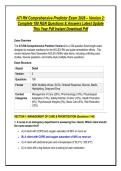
ATI RN Comprehensive Predictor Exam 2026 – Version 2:
Complete 180 NGN Questions & Answers Latest Update
This Year Pdf Instant Download Pdf
Exam Overview
The ATI RN Comprehensive Predictor Version 2 is a 180-question fixed-length exam
designed to evaluate readiness for the NCLEX-RN and guide remediation efforts . This
version features Next Generation NCLEX (NGN)-style items, including unfolding case
studies, bow-tie questions, and matrix-style multiple-choice questions .
Exam Structure:
Aspect Detail
Version 2
Questions 180
Format NGN: Multiple-choice, SATA, Ordered Response, Bow-tie, Matrix,
Highlighting, Drag-and-Drop
Content Management of Care (20%), Pharmacology (18%), Physiological
Categories Adaptation (14%), Safety/Infection Control (12%), Health Promotion
(9%), Psychosocial Integrity (9%), Basic Care (6%), Risk Reduction
(12%)
SECTION 1: MANAGEMENT OF CARE & PRIORITIZATION (Questions 1-40)
1. A nurse in an emergency department is assessing four clients. Which client should
the nurse assess first?
A) A client with COPD and oxygen saturation of 88% on room air
B) A client with COPD and oxygen saturation of 88% on room air
C) A client with abdominal pain and a temperature of 38.3°C (100.9°F)
D) A client with a leg fracture who is asking for pain medication
,Rationale: A client with SpO₂ of 88% is hypoxemic and requires immediate intervention to
prevent respiratory failure. The ABC (Airway, Breathing, Circulation) framework guides
prioritization; oxygenation is a breathing priority before chest pain evaluation or other stable
clients .
2. A charge nurse is teaching newly licensed nurses about the correct use of
restraints. Which instruction should the nurse include?
A) Place a belt restraint on a school-age child who has seizures
B) Secure wrist restraints to the bed rails for an adolescent
C) Apply elbow immobilizers for an infant receiving cleft lip repair
D) Keep the side rails of a toddler's crib elevated
Rationale: Elbow immobilizers prevent infants from touching surgical sites (cleft lip/palate
repair). Restraints should never be secured to bed rails (risk of entrapment); belt restraints
are contraindicated for seizure clients; side rails elevated on cribs is standard but not a
restraint .
3. A nurse is preparing to administer medications. Which client should the nurse see
first?
A) A client with a new prescription for enoxaparin who needs teaching
B) A client with type 1 diabetes who has a blood glucose of 55 mg/dL
C) A client with hypertension who requests a refill of lisinopril
D) A client with osteoarthritis who requests PRN acetaminophen
Rationale: Hypoglycemia (blood glucose 55 mg/dL) is a life-threatening emergency
requiring immediate treatment. This client must be seen before any stable or routine
requests .
4. A nurse is caring for a client who is on fall precautions. Which action should the
nurse take?
A) Place the bed in the lowest position
, B) Raise all four side rails
C) Keep the room dark at night
D) Use restraints while the client is in bed
Rationale: Low bed position reduces injury risk if the client falls. Side rails should not all be
raised (this can be considered a restraint); the room should have adequate lighting;
restraints are a last resort .
5. A nurse manager is planning to teach staff about critical pathways. Which
information should the nurse include?
A) Critical pathways have an unlimited timeframe for completion
B) Critical pathways decrease healthcare costs
C) Critical pathways include variances
D) All of the above
Rationale: Critical pathways are multidisciplinary care plans with specific timeframes for
completion. Variances are documented when outcomes are not met. They decrease
healthcare costs by standardizing care and reducing unnecessary interventions .
6. A nurse is participating in a disaster drill. Which client should be tagged as
"immediate" (red tag)?
A) A client with a minor laceration and stable vital signs
B) A client with an open femur fracture and weak pulse
C) A client with a head injury who is not breathing
D) A client with a sprained ankle who is walking
Rationale: Red tag clients have life-threatening injuries but are salvageable with immediate
treatment. An open femur fracture with weak pulse indicates possible hemorrhage and
shock. Non-breathing clients are black tag; minor injuries are green tag .
Complete 180 NGN Questions & Answers Latest Update
This Year Pdf Instant Download Pdf
Exam Overview
The ATI RN Comprehensive Predictor Version 2 is a 180-question fixed-length exam
designed to evaluate readiness for the NCLEX-RN and guide remediation efforts . This
version features Next Generation NCLEX (NGN)-style items, including unfolding case
studies, bow-tie questions, and matrix-style multiple-choice questions .
Exam Structure:
Aspect Detail
Version 2
Questions 180
Format NGN: Multiple-choice, SATA, Ordered Response, Bow-tie, Matrix,
Highlighting, Drag-and-Drop
Content Management of Care (20%), Pharmacology (18%), Physiological
Categories Adaptation (14%), Safety/Infection Control (12%), Health Promotion
(9%), Psychosocial Integrity (9%), Basic Care (6%), Risk Reduction
(12%)
SECTION 1: MANAGEMENT OF CARE & PRIORITIZATION (Questions 1-40)
1. A nurse in an emergency department is assessing four clients. Which client should
the nurse assess first?
A) A client with COPD and oxygen saturation of 88% on room air
B) A client with COPD and oxygen saturation of 88% on room air
C) A client with abdominal pain and a temperature of 38.3°C (100.9°F)
D) A client with a leg fracture who is asking for pain medication
,Rationale: A client with SpO₂ of 88% is hypoxemic and requires immediate intervention to
prevent respiratory failure. The ABC (Airway, Breathing, Circulation) framework guides
prioritization; oxygenation is a breathing priority before chest pain evaluation or other stable
clients .
2. A charge nurse is teaching newly licensed nurses about the correct use of
restraints. Which instruction should the nurse include?
A) Place a belt restraint on a school-age child who has seizures
B) Secure wrist restraints to the bed rails for an adolescent
C) Apply elbow immobilizers for an infant receiving cleft lip repair
D) Keep the side rails of a toddler's crib elevated
Rationale: Elbow immobilizers prevent infants from touching surgical sites (cleft lip/palate
repair). Restraints should never be secured to bed rails (risk of entrapment); belt restraints
are contraindicated for seizure clients; side rails elevated on cribs is standard but not a
restraint .
3. A nurse is preparing to administer medications. Which client should the nurse see
first?
A) A client with a new prescription for enoxaparin who needs teaching
B) A client with type 1 diabetes who has a blood glucose of 55 mg/dL
C) A client with hypertension who requests a refill of lisinopril
D) A client with osteoarthritis who requests PRN acetaminophen
Rationale: Hypoglycemia (blood glucose 55 mg/dL) is a life-threatening emergency
requiring immediate treatment. This client must be seen before any stable or routine
requests .
4. A nurse is caring for a client who is on fall precautions. Which action should the
nurse take?
A) Place the bed in the lowest position
, B) Raise all four side rails
C) Keep the room dark at night
D) Use restraints while the client is in bed
Rationale: Low bed position reduces injury risk if the client falls. Side rails should not all be
raised (this can be considered a restraint); the room should have adequate lighting;
restraints are a last resort .
5. A nurse manager is planning to teach staff about critical pathways. Which
information should the nurse include?
A) Critical pathways have an unlimited timeframe for completion
B) Critical pathways decrease healthcare costs
C) Critical pathways include variances
D) All of the above
Rationale: Critical pathways are multidisciplinary care plans with specific timeframes for
completion. Variances are documented when outcomes are not met. They decrease
healthcare costs by standardizing care and reducing unnecessary interventions .
6. A nurse is participating in a disaster drill. Which client should be tagged as
"immediate" (red tag)?
A) A client with a minor laceration and stable vital signs
B) A client with an open femur fracture and weak pulse
C) A client with a head injury who is not breathing
D) A client with a sprained ankle who is walking
Rationale: Red tag clients have life-threatening injuries but are salvageable with immediate
treatment. An open femur fracture with weak pulse indicates possible hemorrhage and
shock. Non-breathing clients are black tag; minor injuries are green tag .