

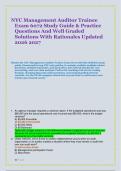
NYC Management Auditor Trainee
Exam 6072 Study Guide & Practice
Questions And Well Graded
Solutions With Rationales Updated
2026 2027
Master the NYC Management Auditor Trainee Exam 6072 with this definitive prep
guide. Structured for top NYC universities, it contains realistic multiple-choice
questions, detailed rationales, and deep-dives into GAGAS standards, cost
accounting, and core data analysis. Perfect for tracking civil service testing
formats, checking financial audit assertions, and understanding internal
controls. Ace the DCAS computer-based test on your first try and secure your
trainee government career.
1. An agency manager requests a variance report. If the budgeted operational cost was
$80,000 and the actual operational cost incurred was $85,000, what is the budget
variance?
A) $5,000 Favorable
B) $5,000 Unfavorable
C) $5,000 Static
D) $0 Balanced
Rationale: Budget variance is the difference between budgeted and actual amounts.
Because the actual expenditures exceeded the budgeted allocation by $5,000, it
represents an unfavorable variance.
2. Under GAGAS, which threat to auditor independence occurs when an audit
organization or an auditor creates a situation where they must review or audit their
own non-audit work?
A) Self-review threat
B) Management participation threat
C) Bias threat
1|Page
, D) Familiarity threat
Rationale: A self-review threat arises when an auditor or audit organization has
provided non-audit services that are subsequently evaluated during the performance
of an audit.
3. If an auditor wants to test the operating effectiveness of a control that requires two
signatures on checks over $10,000, which audit procedure is most appropriate?
A) Analytical procedures
B) Inspection of documents
C) Confirmation
D) Recalculation
Rationale: Inspection involves examining internal or external records or documents.
Checking physical or electronic signatures on canceled checks directly tests if the
control is functioning.
4. A city department purchases office supplies on account for $4,500. Which journal
entry correctly records this operational transaction?
A) Debit Cash $4,500; Credit Supplies Expense $4,500
B) Debit Supplies $4,500; Credit Accounts Payable $4,500
C) Debit Accounts Payable $4,500; Credit Supplies $4,500
D) Debit Supplies Expense $4,500; Credit Cash $4,500
Rationale: Purchasing items "on account" increases an asset or expense account
(via a debit) and simultaneously increases a liability account (via a credit to Accounts
Payable).
5. An auditor selects a sample of transactions by choosing every 15th voucher from a
sequential population ledger after a random initial starting point. What sampling
methodology is being applied?
A) Haphazard sampling
B) Block sampling
C) Systematic sampling
D) Stratified sampling
Rationale: Systematic sampling involves selecting items at a uniform interval (the
sampling interval) throughout the entire population framework.
6. What is the fundamental purpose of an audit working paper index system?
A) To provide a logical order and cross-referencing structure for evidence
B) To list the names of all agency personnel interviewed
C) To calculate the final materiality threshold mathematically
D) To summarize the city agency's annual fiscal budget
Rationale: An index system organizes documentation systematically, ensuring that
evidence is easily retrievable and cross-referenced to support audit findings.
7. Under the modified accrual basis of accounting used by municipal governments,
when are revenues generally recognized?
A) When cash is physically collected
B) When they become measurable and available
C) When the annual budget ordinance is passed
D) When services are completely rendered regardless of collection timeline
Rationale: Modified accrual accounting recognizes revenues when they are both
measurable (the amount can be determined) and available (collectible within the
current period or soon after).
8. If a city asset has a historical cost of $120,000 and accumulated depreciation of
$45,000, what is its net book value?
A) $120,000
2|Page
, B) $165,000
C) $75,000
D) $45,000
Rationale: Net book value is calculated by subtracting accumulated depreciation
from the asset's historical cost ($120,000 - $45,000 = $75,000).
9. Which type of control is designed to identify and correct errors or irregularities after
they have already occurred?
A) Preventive control
B) Detective control
C) Directive control
D) Compensating control
Rationale: Detective controls operate after a transaction has taken place to catch
and expose errors, variances, or unauthorized actions (e.g., bank reconciliations).
10. During an audit, a trainee notices a mathematical discrepancy in a ledger. The
variance shows $12,400 recorded as $21,400. This error is an example of what
accounting phenomenon?
A) Transposition error
B) Slide error
C) Omission error
D) Principle error
Rationale: A transposition error occurs when two consecutive digits are accidentally
reversed or swapped during manual data entry.
11. What type of audit risk represents the susceptibility of an assertion to a material
misstatement assuming that there are no related internal controls in place?
A) Control risk
B) Detection risk
C) Inherent risk
D) Sampling risk
Rationale: Inherent risk is the raw risk level present in an environment or transaction
category before considering the mitigating effects of internal control systems.
12. A department has a beginning balance of $12,000 in its prepaid insurance account.
During the fiscal year, insurance policies costing $24,000 were purchased. If the
ending balance is $8,000, what was the insurance expense for the period?
A) $24,000
B) $28,000
C) $16,000
D) $20,000
Rationale: The formula is Beginning Balance + Purchases - Ending Balance =
Expense. Therefore, $12,000 + $24,000 - $8,000 = $28,000.
13. According to GAGAS, which of the following is an ethical principle that guides public
sector auditors?
A) The public interest
B) Professional maximization
C) Absolute assurance
D) Strict commercial value
Rationale: GAGAS emphasizes ethical principles including the public interest,
professional behavior, integrity, objectivity, and proper utilization of government
information.
14. Which document is typically prepared by an auditor at the conclusion of an internal
control interview to map out operational transaction flows visually?
3|Page
, A) Engagement letter
B) Management representation letter
C) Process flowchart
D) Statistical sampling frame
Rationale: Flowcharts provide a visual step-by-step representation of a process,
making it easier to evaluate potential gaps or breakdowns in controls.
15. If a population of 1,000 invoices has a total value of $500,000, what is the mean
invoice value?
A) $50
B) $500
C) $5,000
D) $250
Rationale: The mean is calculated by dividing the total population value by the total
number of items ($500,,000 = $500).
16. Which accounting concept states that an organization should record expenses in the
same period as the revenues they help to generate?
A) Going concern concept
B) Matching principle
C) Conservatism principle
D) Consistency principle
Rationale: The matching principle requires expenses to be recognized and reported
alongside their corresponding revenue streams to maintain accurate periodic
profitability metrics.
17. If an auditor increases the planned reliance on internal controls, what effect does this
have on the level of substantive testing required?
A) Substantive testing must increase
B) Substantive testing can decrease
C) Substantive testing remains entirely unchanged
D) Substantive testing becomes completely obsolete
Rationale: When internal controls are determined to be highly reliable, the auditor
can accept a higher level of detection risk, which allows for a reduced scope of
substantive testing.
18. A city fleet division uses 50 gallons of fuel per vehicle each week. If the division
manages 120 vehicles, how many gallons are used in a 4-week operational period?
A) 6,000 gallons
B) 12,000 gallons
C) 24,000 gallons
D) 48,000 gallons
Rationale: Weekly consumption is 50 gallons * 120 vehicles = 6,000 gallons. Over 4
weeks, total consumption equals 6,000 * 4 = 24,000 gallons.
19. Under GAGAS, performance audit reports must contain which core element when
reporting deficiencies or irregularities?
A) Criteria, condition, cause, and effect
B) Market comparisons, pricing, revenue, and margins
C) Personnel files, biometric records, and specific home addresses
D) Private corporate board resolutions
Rationale: The "four attributes of a finding" required in government auditing are
criteria (what should be), condition (what is), cause (why it happened), and effect
(the impact).
4|Page
Exam 6072 Study Guide & Practice
Questions And Well Graded
Solutions With Rationales Updated
2026 2027
Master the NYC Management Auditor Trainee Exam 6072 with this definitive prep
guide. Structured for top NYC universities, it contains realistic multiple-choice
questions, detailed rationales, and deep-dives into GAGAS standards, cost
accounting, and core data analysis. Perfect for tracking civil service testing
formats, checking financial audit assertions, and understanding internal
controls. Ace the DCAS computer-based test on your first try and secure your
trainee government career.
1. An agency manager requests a variance report. If the budgeted operational cost was
$80,000 and the actual operational cost incurred was $85,000, what is the budget
variance?
A) $5,000 Favorable
B) $5,000 Unfavorable
C) $5,000 Static
D) $0 Balanced
Rationale: Budget variance is the difference between budgeted and actual amounts.
Because the actual expenditures exceeded the budgeted allocation by $5,000, it
represents an unfavorable variance.
2. Under GAGAS, which threat to auditor independence occurs when an audit
organization or an auditor creates a situation where they must review or audit their
own non-audit work?
A) Self-review threat
B) Management participation threat
C) Bias threat
1|Page
, D) Familiarity threat
Rationale: A self-review threat arises when an auditor or audit organization has
provided non-audit services that are subsequently evaluated during the performance
of an audit.
3. If an auditor wants to test the operating effectiveness of a control that requires two
signatures on checks over $10,000, which audit procedure is most appropriate?
A) Analytical procedures
B) Inspection of documents
C) Confirmation
D) Recalculation
Rationale: Inspection involves examining internal or external records or documents.
Checking physical or electronic signatures on canceled checks directly tests if the
control is functioning.
4. A city department purchases office supplies on account for $4,500. Which journal
entry correctly records this operational transaction?
A) Debit Cash $4,500; Credit Supplies Expense $4,500
B) Debit Supplies $4,500; Credit Accounts Payable $4,500
C) Debit Accounts Payable $4,500; Credit Supplies $4,500
D) Debit Supplies Expense $4,500; Credit Cash $4,500
Rationale: Purchasing items "on account" increases an asset or expense account
(via a debit) and simultaneously increases a liability account (via a credit to Accounts
Payable).
5. An auditor selects a sample of transactions by choosing every 15th voucher from a
sequential population ledger after a random initial starting point. What sampling
methodology is being applied?
A) Haphazard sampling
B) Block sampling
C) Systematic sampling
D) Stratified sampling
Rationale: Systematic sampling involves selecting items at a uniform interval (the
sampling interval) throughout the entire population framework.
6. What is the fundamental purpose of an audit working paper index system?
A) To provide a logical order and cross-referencing structure for evidence
B) To list the names of all agency personnel interviewed
C) To calculate the final materiality threshold mathematically
D) To summarize the city agency's annual fiscal budget
Rationale: An index system organizes documentation systematically, ensuring that
evidence is easily retrievable and cross-referenced to support audit findings.
7. Under the modified accrual basis of accounting used by municipal governments,
when are revenues generally recognized?
A) When cash is physically collected
B) When they become measurable and available
C) When the annual budget ordinance is passed
D) When services are completely rendered regardless of collection timeline
Rationale: Modified accrual accounting recognizes revenues when they are both
measurable (the amount can be determined) and available (collectible within the
current period or soon after).
8. If a city asset has a historical cost of $120,000 and accumulated depreciation of
$45,000, what is its net book value?
A) $120,000
2|Page
, B) $165,000
C) $75,000
D) $45,000
Rationale: Net book value is calculated by subtracting accumulated depreciation
from the asset's historical cost ($120,000 - $45,000 = $75,000).
9. Which type of control is designed to identify and correct errors or irregularities after
they have already occurred?
A) Preventive control
B) Detective control
C) Directive control
D) Compensating control
Rationale: Detective controls operate after a transaction has taken place to catch
and expose errors, variances, or unauthorized actions (e.g., bank reconciliations).
10. During an audit, a trainee notices a mathematical discrepancy in a ledger. The
variance shows $12,400 recorded as $21,400. This error is an example of what
accounting phenomenon?
A) Transposition error
B) Slide error
C) Omission error
D) Principle error
Rationale: A transposition error occurs when two consecutive digits are accidentally
reversed or swapped during manual data entry.
11. What type of audit risk represents the susceptibility of an assertion to a material
misstatement assuming that there are no related internal controls in place?
A) Control risk
B) Detection risk
C) Inherent risk
D) Sampling risk
Rationale: Inherent risk is the raw risk level present in an environment or transaction
category before considering the mitigating effects of internal control systems.
12. A department has a beginning balance of $12,000 in its prepaid insurance account.
During the fiscal year, insurance policies costing $24,000 were purchased. If the
ending balance is $8,000, what was the insurance expense for the period?
A) $24,000
B) $28,000
C) $16,000
D) $20,000
Rationale: The formula is Beginning Balance + Purchases - Ending Balance =
Expense. Therefore, $12,000 + $24,000 - $8,000 = $28,000.
13. According to GAGAS, which of the following is an ethical principle that guides public
sector auditors?
A) The public interest
B) Professional maximization
C) Absolute assurance
D) Strict commercial value
Rationale: GAGAS emphasizes ethical principles including the public interest,
professional behavior, integrity, objectivity, and proper utilization of government
information.
14. Which document is typically prepared by an auditor at the conclusion of an internal
control interview to map out operational transaction flows visually?
3|Page
, A) Engagement letter
B) Management representation letter
C) Process flowchart
D) Statistical sampling frame
Rationale: Flowcharts provide a visual step-by-step representation of a process,
making it easier to evaluate potential gaps or breakdowns in controls.
15. If a population of 1,000 invoices has a total value of $500,000, what is the mean
invoice value?
A) $50
B) $500
C) $5,000
D) $250
Rationale: The mean is calculated by dividing the total population value by the total
number of items ($500,,000 = $500).
16. Which accounting concept states that an organization should record expenses in the
same period as the revenues they help to generate?
A) Going concern concept
B) Matching principle
C) Conservatism principle
D) Consistency principle
Rationale: The matching principle requires expenses to be recognized and reported
alongside their corresponding revenue streams to maintain accurate periodic
profitability metrics.
17. If an auditor increases the planned reliance on internal controls, what effect does this
have on the level of substantive testing required?
A) Substantive testing must increase
B) Substantive testing can decrease
C) Substantive testing remains entirely unchanged
D) Substantive testing becomes completely obsolete
Rationale: When internal controls are determined to be highly reliable, the auditor
can accept a higher level of detection risk, which allows for a reduced scope of
substantive testing.
18. A city fleet division uses 50 gallons of fuel per vehicle each week. If the division
manages 120 vehicles, how many gallons are used in a 4-week operational period?
A) 6,000 gallons
B) 12,000 gallons
C) 24,000 gallons
D) 48,000 gallons
Rationale: Weekly consumption is 50 gallons * 120 vehicles = 6,000 gallons. Over 4
weeks, total consumption equals 6,000 * 4 = 24,000 gallons.
19. Under GAGAS, performance audit reports must contain which core element when
reporting deficiencies or irregularities?
A) Criteria, condition, cause, and effect
B) Market comparisons, pricing, revenue, and margins
C) Personnel files, biometric records, and specific home addresses
D) Private corporate board resolutions
Rationale: The "four attributes of a finding" required in government auditing are
criteria (what should be), condition (what is), cause (why it happened), and effect
(the impact).
4|Page

