Portage Learning Chem 219 Principles of
Organic Chemistry Module 1 Exam
Question 1
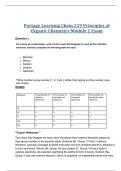
On a piece of scratch paper, write out the Lewis Dot Diagram for each of the indicated
elements and then complete the following table for each:
1. Bromine
2. Silicon
3. Carbon
4. Sodium
5. Selenium
*Write number using number (1, 2, 3 etc.) rather than typing out the number (one,
two, three).
Answer
Element Total Number of The number of The number of The number of
Valence lone pairs of Unpaired bonds the atom
Electrons electrons Electrons will form
Br 7 3 1 1
Si 4 0 4 4
C 4 0 4 4
Na 1 0 1 1
Se 6 2 2 2
**Expert Rationale:**
The Lewis Dot Diagram for each atom visualizes their valence electrons based on
their group number in the periodic table. Bromine (Br, Group 17) has 7 valence
electrons, typically arranged as three lone pairs and one unpaired electron, allowing it
to form one bond. Silicon (Si, Group 14) and carbon (C, Group 14) each have 4
valence electrons, all unpaired, signifying the ability to form 4 bonds. Sodium (Na,
Group 1) has one valence electron, which is unpaired, so it generally forms one ionic
, bond. Selenium (Se, Group 16) possesses 6 valence electrons, commonly displayed
as two lone pairs and two unpaired electrons, allowing it to form two bonds.
Question 2
Classify the bonding between the given pairs of atoms as ionic, covalent,
polar covalent, or purely covalent. Use the table of electronegativities shown
below to help with the classification.
Answer
Bond X Classification
O-H 1.4 Polar Covalent
Cl-Br 0.2 Covalent
N-P 0.9 Polar Covalent
N-N 0 Purely Covalent
K-S 1.7 Polar Covalent
**Expert Rationale:**
The classification hinges on the difference in electronegativity (ΔEN) between the two
atoms. Generally, ΔEN < 0.4 corresponds to pure (nonpolar) covalent; 0.4 ≤ ΔEN ≤
1.7 denotes polar covalent bonds, and ΔEN > 1.7 typically indicates ionic character.
However, bonds with ΔEN near the cutoff (like K-S) may display significant covalent
character even if ionic bonding is possible. In these cases, the bonding is described
as polar covalent unless the difference greatly favors electron transfer. For example,
the O-H bond is strongly polar covalent due to the substantial electronegativity
difference, whereas N-N is nonpolar (purely covalent) because the atoms are
identical.
Organic Chemistry Module 1 Exam
Question 1
On a piece of scratch paper, write out the Lewis Dot Diagram for each of the indicated
elements and then complete the following table for each:
1. Bromine
2. Silicon
3. Carbon
4. Sodium
5. Selenium
*Write number using number (1, 2, 3 etc.) rather than typing out the number (one,
two, three).
Answer
Element Total Number of The number of The number of The number of
Valence lone pairs of Unpaired bonds the atom
Electrons electrons Electrons will form
Br 7 3 1 1
Si 4 0 4 4
C 4 0 4 4
Na 1 0 1 1
Se 6 2 2 2
**Expert Rationale:**
The Lewis Dot Diagram for each atom visualizes their valence electrons based on
their group number in the periodic table. Bromine (Br, Group 17) has 7 valence
electrons, typically arranged as three lone pairs and one unpaired electron, allowing it
to form one bond. Silicon (Si, Group 14) and carbon (C, Group 14) each have 4
valence electrons, all unpaired, signifying the ability to form 4 bonds. Sodium (Na,
Group 1) has one valence electron, which is unpaired, so it generally forms one ionic
, bond. Selenium (Se, Group 16) possesses 6 valence electrons, commonly displayed
as two lone pairs and two unpaired electrons, allowing it to form two bonds.
Question 2
Classify the bonding between the given pairs of atoms as ionic, covalent,
polar covalent, or purely covalent. Use the table of electronegativities shown
below to help with the classification.
Answer
Bond X Classification
O-H 1.4 Polar Covalent
Cl-Br 0.2 Covalent
N-P 0.9 Polar Covalent
N-N 0 Purely Covalent
K-S 1.7 Polar Covalent
**Expert Rationale:**
The classification hinges on the difference in electronegativity (ΔEN) between the two
atoms. Generally, ΔEN < 0.4 corresponds to pure (nonpolar) covalent; 0.4 ≤ ΔEN ≤
1.7 denotes polar covalent bonds, and ΔEN > 1.7 typically indicates ionic character.
However, bonds with ΔEN near the cutoff (like K-S) may display significant covalent
character even if ionic bonding is possible. In these cases, the bonding is described
as polar covalent unless the difference greatly favors electron transfer. For example,
the O-H bond is strongly polar covalent due to the substantial electronegativity
difference, whereas N-N is nonpolar (purely covalent) because the atoms are
identical.