

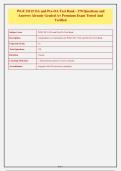
WGU D115 OA and Pre-OA Test Bank - 170 Questions and
Answers Already Graded A+ Premium Exam Tested And
Verified
Subject Area WGU D115 OA and Pre-OA Test Bank
Description Comprehensive examination on WGU D115 OA and Pre-OA Test Bank.
Expected Grade A+
Total Questions 170
Duration 3 hours
Learning Outcomes 1. Demonstrate mastery of core concepts
Accreditation Aligned with US university standards.
Page 1
,1. A patient with a history of recurrent urinary tract infections presents with
acute flank pain and fever. Urinalysis shows pyuria and bacteriuria. A CT scan
reveals a 1.5 cm stone in the renal pelvis with obstruction. Which of the
following is the most appropriate immediate management step?
Answer: Place a percutaneous nephrostomy tube and start intravenous
antibiotics
In an obstructed infected system (obstructive pyelonephritis), immediate
decompression is critical to prevent sepsis. Percutaneous nephrostomy or ureteral
stent placement is indicated. Antibiotics alone are insufficient without drainage.
Shockwave lithotripsy is not urgent and can be delayed after infection clears.
2. A researcher is designing a study to evaluate the efficacy of a new
antihypertensive drug. To minimize confounding, they decide to use a method
that ensures each participant has an equal chance of being assigned to either
the treatment or control group. This method is known as:
Answer: Simple randomization
Simple randomization gives each participant an equal independent chance of
assignment, which is the most straightforward method to achieve balance on
average. Stratified randomization ensures balance within subgroups; block
randomization ensures equal group sizes over time; cluster randomization
assigns groups of participants together.
3. In a patient with suspected pulmonary embolism, a D-dimer test is ordered.
Which of the following scenarios would most likely yield a false-negative
D-dimer result?
Answer: Patient has a subsegmental pulmonary embolism
D-dimer is less sensitive for small, distal clots such as subsegmental PE. False
negatives occur when clot burden is low. Anticoagulation may lower D-dimer but
not typically to false-negative levels. Symptoms of short duration or pregnancy
may elevate D-dimer, increasing sensitivity.
Page 2
,4. A patient with severe sepsis is started on norepinephrine. After 30 minutes,
mean arterial pressure remains below 65 mmHg despite escalating doses.
Which of the following is the most appropriate next step in management?
Answer: Add vasopressin as a second-line vasopressor
When norepinephrine alone fails to achieve target MAP, adding vasopressin (or
epinephrine) is recommended by Surviving Sepsis Campaign guidelines.
Vasopressin is often preferred as a second agent. Fluid resuscitation should be
optimized before escalating vasopressors, but in this case, the patient is already
on high-dose norepinephrine, so adding another agent is appropriate.
5. Which of the following laboratory findings is most consistent with a
diagnosis of primary hyperaldosteronism?
Answer: Low plasma renin activity, high aldosterone, hypokalemia
Primary hyperaldosteronism is characterized by autonomous aldosterone
secretion leading to suppressed renin, high aldosterone, and hypokalemia (though
normokalemia is possible). Low renin with high aldosterone is the hallmark.
Other patterns suggest secondary hyperaldosteronism (B) or hypoaldosteronism
(C, D).
6. A 55-year-old man with a history of type 2 diabetes and hypertension is
found to have a serum creatinine of 2.0 mg/dL and an estimated glomerular
filtration rate of 35 mL/min/1.73m². Urinalysis shows 2+ protein. Which of the
following antihypertensive agents is most likely to slow the progression of his
kidney disease?
Answer: Losartan
Angiotensin receptor blockers (ARBs) like losartan are renoprotective in diabetic
nephropathy by reducing intraglomerular pressure and proteinuria. They are
first-line for hypertension in chronic kidney disease with proteinuria.
Amlodipine, thiazides, and beta-blockers do not have the same proven benefit for
slowing progression.
Page 3
, 7. A patient with a history of chronic obstructive pulmonary disease is
admitted with acute dyspnea. Arterial blood gas on room air shows pH 7.25,
PaCO2 60 mm Hg, PaO2 55 mm Hg, HCO3 26 mEq/L. Which of the following
acid-base disorders is present?
Answer: Acute respiratory acidosis without metabolic compensation
The pH is acidic (7.25) with elevated PaCO2 (60 mm Hg) indicating respiratory
acidosis. HCO3 is normal (26 mEq/L), suggesting no metabolic compensation,
which occurs over days. In acute respiratory acidosis, HCO3 increases only
minimally (1 mEq/L per 10 mm Hg PaCO2 rise). This is acute, uncompensated.
8. A patient is diagnosed with Clostridioides difficile infection and is started on
oral vancomycin. After 5 days, symptoms have not improved. Which of the
following is the most likely cause of treatment failure?
Answer: Infection with a hypervirulent strain (NAP1/BI/027)
Hypervirulent strains (e.g., NAP1/BI/027) produce more toxins and are
associated with more severe disease and higher rates of treatment failure.
Vancomycin resistance in C. difficile is extremely rare. PPIs are a risk factor for
initial infection but not a direct cause of treatment failure. Standard dosing is
usually adequate.
9. A 40-year-old woman presents with fatigue, weight gain, and cold
intolerance. Thyroid function tests show TSH 15 mIU/L (normal 0.5-4.5), free
T4 0.6 ng/dL (normal 0.8-1.8). Anti-thyroid peroxidase antibodies are elevated.
Which of the following is the most likely diagnosis?
Answer: Hashimoto thyroiditis with overt hypothyroidism
Elevated TSH with low free T4 indicates overt hypothyroidism. Positive
anti-TPO antibodies suggest autoimmune etiology (Hashimoto thyroiditis).
Subclinical hypothyroidism would have elevated TSH but normal free T4.
Central hypothyroidism would have low or inappropriately normal TSH with
low T4. Euthyroid sick syndrome occurs in nonthyroidal illness.
Page 4
Answers Already Graded A+ Premium Exam Tested And
Verified
Subject Area WGU D115 OA and Pre-OA Test Bank
Description Comprehensive examination on WGU D115 OA and Pre-OA Test Bank.
Expected Grade A+
Total Questions 170
Duration 3 hours
Learning Outcomes 1. Demonstrate mastery of core concepts
Accreditation Aligned with US university standards.
Page 1
,1. A patient with a history of recurrent urinary tract infections presents with
acute flank pain and fever. Urinalysis shows pyuria and bacteriuria. A CT scan
reveals a 1.5 cm stone in the renal pelvis with obstruction. Which of the
following is the most appropriate immediate management step?
Answer: Place a percutaneous nephrostomy tube and start intravenous
antibiotics
In an obstructed infected system (obstructive pyelonephritis), immediate
decompression is critical to prevent sepsis. Percutaneous nephrostomy or ureteral
stent placement is indicated. Antibiotics alone are insufficient without drainage.
Shockwave lithotripsy is not urgent and can be delayed after infection clears.
2. A researcher is designing a study to evaluate the efficacy of a new
antihypertensive drug. To minimize confounding, they decide to use a method
that ensures each participant has an equal chance of being assigned to either
the treatment or control group. This method is known as:
Answer: Simple randomization
Simple randomization gives each participant an equal independent chance of
assignment, which is the most straightforward method to achieve balance on
average. Stratified randomization ensures balance within subgroups; block
randomization ensures equal group sizes over time; cluster randomization
assigns groups of participants together.
3. In a patient with suspected pulmonary embolism, a D-dimer test is ordered.
Which of the following scenarios would most likely yield a false-negative
D-dimer result?
Answer: Patient has a subsegmental pulmonary embolism
D-dimer is less sensitive for small, distal clots such as subsegmental PE. False
negatives occur when clot burden is low. Anticoagulation may lower D-dimer but
not typically to false-negative levels. Symptoms of short duration or pregnancy
may elevate D-dimer, increasing sensitivity.
Page 2
,4. A patient with severe sepsis is started on norepinephrine. After 30 minutes,
mean arterial pressure remains below 65 mmHg despite escalating doses.
Which of the following is the most appropriate next step in management?
Answer: Add vasopressin as a second-line vasopressor
When norepinephrine alone fails to achieve target MAP, adding vasopressin (or
epinephrine) is recommended by Surviving Sepsis Campaign guidelines.
Vasopressin is often preferred as a second agent. Fluid resuscitation should be
optimized before escalating vasopressors, but in this case, the patient is already
on high-dose norepinephrine, so adding another agent is appropriate.
5. Which of the following laboratory findings is most consistent with a
diagnosis of primary hyperaldosteronism?
Answer: Low plasma renin activity, high aldosterone, hypokalemia
Primary hyperaldosteronism is characterized by autonomous aldosterone
secretion leading to suppressed renin, high aldosterone, and hypokalemia (though
normokalemia is possible). Low renin with high aldosterone is the hallmark.
Other patterns suggest secondary hyperaldosteronism (B) or hypoaldosteronism
(C, D).
6. A 55-year-old man with a history of type 2 diabetes and hypertension is
found to have a serum creatinine of 2.0 mg/dL and an estimated glomerular
filtration rate of 35 mL/min/1.73m². Urinalysis shows 2+ protein. Which of the
following antihypertensive agents is most likely to slow the progression of his
kidney disease?
Answer: Losartan
Angiotensin receptor blockers (ARBs) like losartan are renoprotective in diabetic
nephropathy by reducing intraglomerular pressure and proteinuria. They are
first-line for hypertension in chronic kidney disease with proteinuria.
Amlodipine, thiazides, and beta-blockers do not have the same proven benefit for
slowing progression.
Page 3
, 7. A patient with a history of chronic obstructive pulmonary disease is
admitted with acute dyspnea. Arterial blood gas on room air shows pH 7.25,
PaCO2 60 mm Hg, PaO2 55 mm Hg, HCO3 26 mEq/L. Which of the following
acid-base disorders is present?
Answer: Acute respiratory acidosis without metabolic compensation
The pH is acidic (7.25) with elevated PaCO2 (60 mm Hg) indicating respiratory
acidosis. HCO3 is normal (26 mEq/L), suggesting no metabolic compensation,
which occurs over days. In acute respiratory acidosis, HCO3 increases only
minimally (1 mEq/L per 10 mm Hg PaCO2 rise). This is acute, uncompensated.
8. A patient is diagnosed with Clostridioides difficile infection and is started on
oral vancomycin. After 5 days, symptoms have not improved. Which of the
following is the most likely cause of treatment failure?
Answer: Infection with a hypervirulent strain (NAP1/BI/027)
Hypervirulent strains (e.g., NAP1/BI/027) produce more toxins and are
associated with more severe disease and higher rates of treatment failure.
Vancomycin resistance in C. difficile is extremely rare. PPIs are a risk factor for
initial infection but not a direct cause of treatment failure. Standard dosing is
usually adequate.
9. A 40-year-old woman presents with fatigue, weight gain, and cold
intolerance. Thyroid function tests show TSH 15 mIU/L (normal 0.5-4.5), free
T4 0.6 ng/dL (normal 0.8-1.8). Anti-thyroid peroxidase antibodies are elevated.
Which of the following is the most likely diagnosis?
Answer: Hashimoto thyroiditis with overt hypothyroidism
Elevated TSH with low free T4 indicates overt hypothyroidism. Positive
anti-TPO antibodies suggest autoimmune etiology (Hashimoto thyroiditis).
Subclinical hypothyroidism would have elevated TSH but normal free T4.
Central hypothyroidism would have low or inappropriately normal TSH with
low T4. Euthyroid sick syndrome occurs in nonthyroidal illness.
Page 4

