

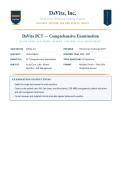
D DaVita, Inc.
MAXE · TCP
★ ★
DaVita Patient Care Technician Training Program
EST. 1999
PROVIDER, PARTNER, AND EMPLOYER OF CHOICE
DaVita PCT — Comprehensive Examination
ACU T E C A R E · L A B D RA W S · A L A R M S · C K D - M B D · S E L F - M A N AG E M E N T
INSTITUTION DaVita, Inc. PROGRAM Patient Care Technician (PCT)
SPECIALTY Hemodialysis ACADEMIC YEAR
EXAM TITLE PCT Comprehensive Examination TOTAL QUESTIONS 80 Questions
SUBJECT Acute Care · Labs · Alarms · FORMAT Multiple Choice — Select the
Nutrition · Self-Management Single Best Answer
EXAMINATION INSTRUCTIONS
▸ Select the single best answer for each question.
▸ Covers acute patient care, Kt/V, lab draws, machine alarms, CKD-MBD management, patient education,
and self-management principles.
▸ Correct answers and detailed clinical rationales appear below each question.
, ACUTE CARE · LABS · ALARMS · NUTRITION · SELF-
Questions 1 – 80
MANAGEMENT
1. What is important when monitoring weight and BP for acute patients?
A. Remove as much fluid as possible to reach dry weight quickly
B. Keep patients wet to avoid hypotensive episodes
C. Match the UF goal to chronic patient protocols
D. Disregard BP changes during treatment
CORRECT ANSWER B — Keep patients wet to avoid hypotensive episodes
RATIONALE Acute (AKI) patients are hemodynamically unstable. Keeping them slightly above
target weight (wet) helps prevent hypovolemia and hypotensive episodes during
treatment. Aggressive fluid removal can worsen renal injury.
2. What do you need to consider regarding acute patients' vascular access?
A. They always have mature AV fistulas
B. They usually have a CVC — follow policy and procedure to prevent infections
C. They can use any access without special precautions
D. They only require peripheral IV access
CORRECT ANSWER B — They usually have a CVC — follow policy and procedure to prevent
infections
RATIONALE Acute patients typically have central venous catheters, which carry the highest
infection risk. Strict adherence to CVC care policies — including dressing changes,
hub scrubbing, and mask protocols — is essential to prevent catheter-related
bloodstream infections.
,3. Why is it important to know what caused your patient's CKD?
A. It has no impact on dialysis treatment
B. To inquire about possible problems during data collection and assessments
C. Only for billing purposes
D. It only matters for medication dosing
CORRECT ANSWER B — To inquire about possible problems during data collection and
assessments
RATIONALE Understanding CKD etiology helps the PCT anticipate complications — diabetic
patients may have blood sugar issues and neuropathy, hypertensive patients may
have BP fluctuations, and patients with glomerulonephritis may have different
clinical presentations.
4. In Kt/V, what does "K" represent?
A. Potassium clearance
B. Clearance of urea
C. Kidney function percentage
D. Dialyzer surface area
CORRECT ANSWER B — Clearance of urea
RATIONALE In Kt/V: K = urea clearance of the dialyzer (mL/min), t = treatment time (minutes),
V = patient's urea distribution volume (mL). Kt/V is the standard measure of
dialysis adequacy. Target is ≥1.2.
, 5. What treatment factor decreases K (clearance)?
A. Increasing blood flow rate
B. Not waiting 3–5 minutes after giving heparin before treatment initiation, leading to
clotting
C. Using a larger dialyzer
D. Increasing dialysate flow rate
CORRECT ANSWER B — Not waiting 3–5 minutes after giving heparin before treatment
initiation, leading to clotting
RATIONALE Inadequate heparin circulation time leads to fiber clotting in the dialyzer,
reducing effective surface area and decreasing urea clearance (K). Heparin must
circulate for 3–5 minutes before treatment begins.
6. What factors influence V (volume) in Kt/V calculation?
A. Dialysate flow rate only
B. Blood flow rate only
C. Sex, age, weight, height, and amputations
D. Dialyzer brand only
CORRECT ANSWER C — Sex, age, weight, height, and amputations
RATIONALE V represents the patient's total body water (urea distribution volume). It is
calculated from anthropometric data: sex, age, weight, height, and presence of
amputations. Accurate weight and height are essential for correct Kt/V
calculation.
MAXE · TCP
★ ★
DaVita Patient Care Technician Training Program
EST. 1999
PROVIDER, PARTNER, AND EMPLOYER OF CHOICE
DaVita PCT — Comprehensive Examination
ACU T E C A R E · L A B D RA W S · A L A R M S · C K D - M B D · S E L F - M A N AG E M E N T
INSTITUTION DaVita, Inc. PROGRAM Patient Care Technician (PCT)
SPECIALTY Hemodialysis ACADEMIC YEAR
EXAM TITLE PCT Comprehensive Examination TOTAL QUESTIONS 80 Questions
SUBJECT Acute Care · Labs · Alarms · FORMAT Multiple Choice — Select the
Nutrition · Self-Management Single Best Answer
EXAMINATION INSTRUCTIONS
▸ Select the single best answer for each question.
▸ Covers acute patient care, Kt/V, lab draws, machine alarms, CKD-MBD management, patient education,
and self-management principles.
▸ Correct answers and detailed clinical rationales appear below each question.
, ACUTE CARE · LABS · ALARMS · NUTRITION · SELF-
Questions 1 – 80
MANAGEMENT
1. What is important when monitoring weight and BP for acute patients?
A. Remove as much fluid as possible to reach dry weight quickly
B. Keep patients wet to avoid hypotensive episodes
C. Match the UF goal to chronic patient protocols
D. Disregard BP changes during treatment
CORRECT ANSWER B — Keep patients wet to avoid hypotensive episodes
RATIONALE Acute (AKI) patients are hemodynamically unstable. Keeping them slightly above
target weight (wet) helps prevent hypovolemia and hypotensive episodes during
treatment. Aggressive fluid removal can worsen renal injury.
2. What do you need to consider regarding acute patients' vascular access?
A. They always have mature AV fistulas
B. They usually have a CVC — follow policy and procedure to prevent infections
C. They can use any access without special precautions
D. They only require peripheral IV access
CORRECT ANSWER B — They usually have a CVC — follow policy and procedure to prevent
infections
RATIONALE Acute patients typically have central venous catheters, which carry the highest
infection risk. Strict adherence to CVC care policies — including dressing changes,
hub scrubbing, and mask protocols — is essential to prevent catheter-related
bloodstream infections.
,3. Why is it important to know what caused your patient's CKD?
A. It has no impact on dialysis treatment
B. To inquire about possible problems during data collection and assessments
C. Only for billing purposes
D. It only matters for medication dosing
CORRECT ANSWER B — To inquire about possible problems during data collection and
assessments
RATIONALE Understanding CKD etiology helps the PCT anticipate complications — diabetic
patients may have blood sugar issues and neuropathy, hypertensive patients may
have BP fluctuations, and patients with glomerulonephritis may have different
clinical presentations.
4. In Kt/V, what does "K" represent?
A. Potassium clearance
B. Clearance of urea
C. Kidney function percentage
D. Dialyzer surface area
CORRECT ANSWER B — Clearance of urea
RATIONALE In Kt/V: K = urea clearance of the dialyzer (mL/min), t = treatment time (minutes),
V = patient's urea distribution volume (mL). Kt/V is the standard measure of
dialysis adequacy. Target is ≥1.2.
, 5. What treatment factor decreases K (clearance)?
A. Increasing blood flow rate
B. Not waiting 3–5 minutes after giving heparin before treatment initiation, leading to
clotting
C. Using a larger dialyzer
D. Increasing dialysate flow rate
CORRECT ANSWER B — Not waiting 3–5 minutes after giving heparin before treatment
initiation, leading to clotting
RATIONALE Inadequate heparin circulation time leads to fiber clotting in the dialyzer,
reducing effective surface area and decreasing urea clearance (K). Heparin must
circulate for 3–5 minutes before treatment begins.
6. What factors influence V (volume) in Kt/V calculation?
A. Dialysate flow rate only
B. Blood flow rate only
C. Sex, age, weight, height, and amputations
D. Dialyzer brand only
CORRECT ANSWER C — Sex, age, weight, height, and amputations
RATIONALE V represents the patient's total body water (urea distribution volume). It is
calculated from anthropometric data: sex, age, weight, height, and presence of
amputations. Accurate weight and height are essential for correct Kt/V
calculation.

