

FRACTURE OF THE CLAVICLE
The term clavicle (Fig. 1) is derived from the Latin root Clavis meaning Key.
Clavicle is ‘S’ shaped and is linked to the music symbol ‘clavicula’, hence the
name.
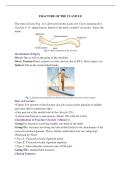
Fig. 1: Bony anatomy of the clavicle
Mechanism of Injury
Direct- Due to fall on the point of the shoulder.
Direct Trauma-Direct trauma over the clavicle due to RTA, direct injury, etc.
Indirect fall on the outstretched hands.
Fig. 2: Recklessness like this can break your clavicle bone due to direct injury
Sites of Fracture
• Eighty-five percent of the fracture clavicle occurs at the junction of middle
and outer third (commonest site).
• One percent at the medial end of the clavicle (5%).
• Lateral end fracture is uncommon (About 10%) (Distal 1/3rd).
Classification of Fracture Clavicle (Allman’s)
Group I is fractures involving middle one-third of the shaft.
Group II is fractures involving the lateral third distal to the attachment of the
coracoclavicular ligament. This is further subdivided into two subgroups
(Proposed by Neer):
• Type A: Coracoclavicular ligament intact.
• Type B: Coracoclavicular ligament ruptured.
• Type C: Intra-articular extension into ACM joint.
Group III is medial third fractures.
Clinical Features
The term clavicle (Fig. 1) is derived from the Latin root Clavis meaning Key.
Clavicle is ‘S’ shaped and is linked to the music symbol ‘clavicula’, hence the
name.
Fig. 1: Bony anatomy of the clavicle
Mechanism of Injury
Direct- Due to fall on the point of the shoulder.
Direct Trauma-Direct trauma over the clavicle due to RTA, direct injury, etc.
Indirect fall on the outstretched hands.
Fig. 2: Recklessness like this can break your clavicle bone due to direct injury
Sites of Fracture
• Eighty-five percent of the fracture clavicle occurs at the junction of middle
and outer third (commonest site).
• One percent at the medial end of the clavicle (5%).
• Lateral end fracture is uncommon (About 10%) (Distal 1/3rd).
Classification of Fracture Clavicle (Allman’s)
Group I is fractures involving middle one-third of the shaft.
Group II is fractures involving the lateral third distal to the attachment of the
coracoclavicular ligament. This is further subdivided into two subgroups
(Proposed by Neer):
• Type A: Coracoclavicular ligament intact.
• Type B: Coracoclavicular ligament ruptured.
• Type C: Intra-articular extension into ACM joint.
Group III is medial third fractures.
Clinical Features

