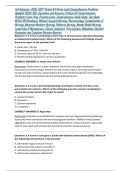
Fall Semester 2026–2027 Virtual ATI Green Light Comprehensive
Predictor Updated 2026 | 190+ Questions and Answers | Virtual ATI
Comprehensive Predictor Exam Prep, Practice Exam, Comprehensive
Study Guide, Test Bank, NCLEX-RN Readiness, Medical-Surgical Nursing,
Pharmacology, Fundamentals of Nursing, Maternal-Newborn Nursing,
Pediatric Nursing, Mental Health Nursing, Leadership & Management,
Clinical Judgment, Prioritization, Delegation, Detailed Rationales and
Complete Revision Material
Question 1: A nurse is providing discharge teaching to a client who has a new
prescription for warfarin. Which of the following statements by the client indicates
an understanding of the teaching?
A. "I will increase my intake of dark green leafy vegetables."
B. "I will take aspirin for headaches instead of acetaminophen."
C. "I will use a soft-bristled toothbrush to brush my teeth."
D. "I will expect my urine to be orange in color."
CORRECT ANSWER: C. I will use a soft-bristled toothbrush to brush my teeth.
Rationale: Warfarin is an anticoagulant that increases the risk of bleeding. Using a soft-
bristled toothbrush minimizes trauma to the gums, reducing the risk of bleeding. Clients
should avoid aspirin due to increased bleeding risk, maintain a consistent intake of
vitamin K-rich foods rather than increasing them, and monitor for signs of bleeding such
as dark, tarry stools or hematuria, not orange urine (which is associated with rifampin).
Question 2: A nurse is caring for a client who is 2 hours post-cesarean delivery.
Which of the following assessment findings should the nurse report to the provider
immediately?
A. Heart rate 88/min
B. Respiratory rate 18/min
C. Blood pressure 100/60 mm Hg
D. Saturation of two perineal pads in 1 hour
CORRECT ANSWER: D. Saturation of two perineal pads in 1 hour
Rationale: Saturation of two perineal pads in 1 hour indicates excessive bleeding
(postpartum hemorrhage) and requires immediate notification of the provider. The other
vital signs are within normal limits for a postoperative client.
Question 3: A nurse is preparing to administer a tuberculin skin test to a client.
Which of the following actions should the nurse take?
A. Insert the needle at a 45-degree angle.
B. Administer the injection intradermally on the inner forearm.
,C. Massage the site after injection to distribute the antigen.
D. Use a 22-gauge needle for administration.
CORRECT ANSWER: B. Administer the injection intradermally on the inner forearm.
Rationale: The tuberculin skin test (Mantoux test) is administered intradermally on the
inner forearm. The needle should be inserted at a 5- to 15-degree angle with a 27-gauge
needle. The site should not be massaged as it can interfere with results.
Question 4: A nurse is assessing a client who has heart failure and is taking
furosemide. Which of the following findings indicates the medication is effective?
A. Decreased peripheral edema
B. Increased blood pressure
C. Increased heart rate
D. Decreased urine output
CORRECT ANSWER: A. Decreased peripheral edema
Rationale: Furosemide is a loop diuretic used to reduce fluid volume overload in heart
failure. Effectiveness is indicated by decreased peripheral edema, decreased dyspnea,
and increased urine output. Blood pressure should decrease, and heart rate should
decrease as fluid volume normalizes.
Question 5: A nurse is teaching a client about dietary management of celiac
disease. Which of the following foods should the nurse instruct the client to avoid?
A. Grilled chicken breast
B. White rice
C. Oatmeal
D. Fresh fruits
CORRECT ANSWER: C. Oatmeal
Rationale: Clients with celiac disease must avoid gluten, which is found in wheat,
barley, rye, and oats (unless specifically labeled gluten-free). Oatmeal is often cross-
contaminated with gluten. Grilled chicken, white rice, and fresh fruits are naturally
gluten-free.
Question 6: A nurse is caring for a client with a new diagnosis of type 1 diabetes
mellitus. Which of the following is the priority nursing action?
A. Teach the client how to monitor blood glucose levels.
B. Administer insulin as prescribed.
,C. Assess the client's knowledge of the disease process.
D. Refer the client to a diabetes support group.
CORRECT ANSWER: B. Administer insulin as prescribed.
Rationale: Clients with type 1 diabetes require exogenous insulin for survival. While
teaching, assessment, and referrals are important, the priority action is to administer
insulin to prevent diabetic ketoacidosis. The nurse should use the ABCs or Maslow's
hierarchy to prioritize.
Question 7: A nurse is reviewing laboratory values for a client who has chronic
kidney disease. Which of the following values should the nurse report to the
provider?
A. Potassium 5.2 mEq/L
B. Hemoglobin 13.5 g/dL
C. Calcium 9.5 mg/dL
D. Sodium 138 mEq/L
CORRECT ANSWER: A. Potassium 5.2 mEq/L
Rationale: In chronic kidney disease, potassium levels may become elevated due to
decreased excretion. Normal potassium is 3.5-5.0 mEq/L. A level of 5.2 mEq/L is above
normal and should be reported as it can lead to cardiac dysrhythmias. The other values
are within normal limits.
Question 8: A nurse is preparing to insert a nasogastric tube for a client. In which of
the following positions should the nurse place the client?
A. Supine with the head of the bed flat
B. High-Fowler's position
C. Trendelenburg position
D. Left lateral recumbent position
CORRECT ANSWER: B. High-Fowler's position
Rationale: The client should be placed in High-Fowler's position (head of bed elevated
90 degrees) to facilitate passage of the nasogastric tube and reduce the risk of
aspiration. The sitting position aligns the esophagus and makes swallowing easier.
Question 9: A nurse is assessing a client who is postoperative following a right hip
arthroplasty. Which of the following findings is a manifestation of a pulmonary
embolism?
, A. Decreased respiratory rate
B. Chest pain and dyspnea
C. Hypertension
D. Bradycardia
CORRECT ANSWER: B. Chest pain and dyspnea
Rationale: A pulmonary embolism (PE) is a complication of hip surgery due to
immobility. Classic manifestations include sudden chest pain, dyspnea, tachypnea,
tachycardia, and hypoxia. Respiratory rate increases and blood pressure decreases with
a PE.
Question 10: A nurse is caring for a client who is receiving total parenteral nutrition
(TPN). Which of the following actions should the nurse take to prevent infection?
A. Change the IV tubing every 72 hours.
B. Use a micron filter for all TPN solutions.
C. Check the TPN solution for cloudiness or particulates.
D. Wear sterile gloves when changing the TPN dressing.
CORRECT ANSWER: D. Wear sterile gloves when changing the TPN dressing.
Rationale: The TPN central line dressing should be changed using sterile technique,
including wearing sterile gloves, to prevent infection. Tubing is typically changed every
24 hours with a new bag, and filters are used for specific formulations. Checking for
cloudiness ensures solution integrity, not infection prevention.
Question 11: A nurse is providing education to a client who is starting metformin.
Which of the following side effects should the nurse include in the teaching?
A. Weight gain
B. Hypoglycemia
C. Gastrointestinal distress
D. Tachycardia
CORRECT ANSWER: C. Gastrointestinal distress
Rationale: Metformin commonly causes gastrointestinal side effects such as nausea,
diarrhea, and abdominal cramping, which often subside over time. It is weight-neutral
or causes weight loss and does not typically cause hypoglycemia unless combined with
other agents. Tachycardia is not a common side effect.
Question 12: A nurse is assessing a client who has pneumonia. Which of the
following findings should the nurse expect?
Predictor Updated 2026 | 190+ Questions and Answers | Virtual ATI
Comprehensive Predictor Exam Prep, Practice Exam, Comprehensive
Study Guide, Test Bank, NCLEX-RN Readiness, Medical-Surgical Nursing,
Pharmacology, Fundamentals of Nursing, Maternal-Newborn Nursing,
Pediatric Nursing, Mental Health Nursing, Leadership & Management,
Clinical Judgment, Prioritization, Delegation, Detailed Rationales and
Complete Revision Material
Question 1: A nurse is providing discharge teaching to a client who has a new
prescription for warfarin. Which of the following statements by the client indicates
an understanding of the teaching?
A. "I will increase my intake of dark green leafy vegetables."
B. "I will take aspirin for headaches instead of acetaminophen."
C. "I will use a soft-bristled toothbrush to brush my teeth."
D. "I will expect my urine to be orange in color."
CORRECT ANSWER: C. I will use a soft-bristled toothbrush to brush my teeth.
Rationale: Warfarin is an anticoagulant that increases the risk of bleeding. Using a soft-
bristled toothbrush minimizes trauma to the gums, reducing the risk of bleeding. Clients
should avoid aspirin due to increased bleeding risk, maintain a consistent intake of
vitamin K-rich foods rather than increasing them, and monitor for signs of bleeding such
as dark, tarry stools or hematuria, not orange urine (which is associated with rifampin).
Question 2: A nurse is caring for a client who is 2 hours post-cesarean delivery.
Which of the following assessment findings should the nurse report to the provider
immediately?
A. Heart rate 88/min
B. Respiratory rate 18/min
C. Blood pressure 100/60 mm Hg
D. Saturation of two perineal pads in 1 hour
CORRECT ANSWER: D. Saturation of two perineal pads in 1 hour
Rationale: Saturation of two perineal pads in 1 hour indicates excessive bleeding
(postpartum hemorrhage) and requires immediate notification of the provider. The other
vital signs are within normal limits for a postoperative client.
Question 3: A nurse is preparing to administer a tuberculin skin test to a client.
Which of the following actions should the nurse take?
A. Insert the needle at a 45-degree angle.
B. Administer the injection intradermally on the inner forearm.
,C. Massage the site after injection to distribute the antigen.
D. Use a 22-gauge needle for administration.
CORRECT ANSWER: B. Administer the injection intradermally on the inner forearm.
Rationale: The tuberculin skin test (Mantoux test) is administered intradermally on the
inner forearm. The needle should be inserted at a 5- to 15-degree angle with a 27-gauge
needle. The site should not be massaged as it can interfere with results.
Question 4: A nurse is assessing a client who has heart failure and is taking
furosemide. Which of the following findings indicates the medication is effective?
A. Decreased peripheral edema
B. Increased blood pressure
C. Increased heart rate
D. Decreased urine output
CORRECT ANSWER: A. Decreased peripheral edema
Rationale: Furosemide is a loop diuretic used to reduce fluid volume overload in heart
failure. Effectiveness is indicated by decreased peripheral edema, decreased dyspnea,
and increased urine output. Blood pressure should decrease, and heart rate should
decrease as fluid volume normalizes.
Question 5: A nurse is teaching a client about dietary management of celiac
disease. Which of the following foods should the nurse instruct the client to avoid?
A. Grilled chicken breast
B. White rice
C. Oatmeal
D. Fresh fruits
CORRECT ANSWER: C. Oatmeal
Rationale: Clients with celiac disease must avoid gluten, which is found in wheat,
barley, rye, and oats (unless specifically labeled gluten-free). Oatmeal is often cross-
contaminated with gluten. Grilled chicken, white rice, and fresh fruits are naturally
gluten-free.
Question 6: A nurse is caring for a client with a new diagnosis of type 1 diabetes
mellitus. Which of the following is the priority nursing action?
A. Teach the client how to monitor blood glucose levels.
B. Administer insulin as prescribed.
,C. Assess the client's knowledge of the disease process.
D. Refer the client to a diabetes support group.
CORRECT ANSWER: B. Administer insulin as prescribed.
Rationale: Clients with type 1 diabetes require exogenous insulin for survival. While
teaching, assessment, and referrals are important, the priority action is to administer
insulin to prevent diabetic ketoacidosis. The nurse should use the ABCs or Maslow's
hierarchy to prioritize.
Question 7: A nurse is reviewing laboratory values for a client who has chronic
kidney disease. Which of the following values should the nurse report to the
provider?
A. Potassium 5.2 mEq/L
B. Hemoglobin 13.5 g/dL
C. Calcium 9.5 mg/dL
D. Sodium 138 mEq/L
CORRECT ANSWER: A. Potassium 5.2 mEq/L
Rationale: In chronic kidney disease, potassium levels may become elevated due to
decreased excretion. Normal potassium is 3.5-5.0 mEq/L. A level of 5.2 mEq/L is above
normal and should be reported as it can lead to cardiac dysrhythmias. The other values
are within normal limits.
Question 8: A nurse is preparing to insert a nasogastric tube for a client. In which of
the following positions should the nurse place the client?
A. Supine with the head of the bed flat
B. High-Fowler's position
C. Trendelenburg position
D. Left lateral recumbent position
CORRECT ANSWER: B. High-Fowler's position
Rationale: The client should be placed in High-Fowler's position (head of bed elevated
90 degrees) to facilitate passage of the nasogastric tube and reduce the risk of
aspiration. The sitting position aligns the esophagus and makes swallowing easier.
Question 9: A nurse is assessing a client who is postoperative following a right hip
arthroplasty. Which of the following findings is a manifestation of a pulmonary
embolism?
, A. Decreased respiratory rate
B. Chest pain and dyspnea
C. Hypertension
D. Bradycardia
CORRECT ANSWER: B. Chest pain and dyspnea
Rationale: A pulmonary embolism (PE) is a complication of hip surgery due to
immobility. Classic manifestations include sudden chest pain, dyspnea, tachypnea,
tachycardia, and hypoxia. Respiratory rate increases and blood pressure decreases with
a PE.
Question 10: A nurse is caring for a client who is receiving total parenteral nutrition
(TPN). Which of the following actions should the nurse take to prevent infection?
A. Change the IV tubing every 72 hours.
B. Use a micron filter for all TPN solutions.
C. Check the TPN solution for cloudiness or particulates.
D. Wear sterile gloves when changing the TPN dressing.
CORRECT ANSWER: D. Wear sterile gloves when changing the TPN dressing.
Rationale: The TPN central line dressing should be changed using sterile technique,
including wearing sterile gloves, to prevent infection. Tubing is typically changed every
24 hours with a new bag, and filters are used for specific formulations. Checking for
cloudiness ensures solution integrity, not infection prevention.
Question 11: A nurse is providing education to a client who is starting metformin.
Which of the following side effects should the nurse include in the teaching?
A. Weight gain
B. Hypoglycemia
C. Gastrointestinal distress
D. Tachycardia
CORRECT ANSWER: C. Gastrointestinal distress
Rationale: Metformin commonly causes gastrointestinal side effects such as nausea,
diarrhea, and abdominal cramping, which often subside over time. It is weight-neutral
or causes weight loss and does not typically cause hypoglycemia unless combined with
other agents. Tachycardia is not a common side effect.
Question 12: A nurse is assessing a client who has pneumonia. Which of the
following findings should the nurse expect?