Escrito por estudiantes que aprobaron Inmediatamente disponible después del pago Leer en línea o como PDF ¿Documento equivocado? Cámbialo gratis 4,6 TrustPilot
logo-home
Examen

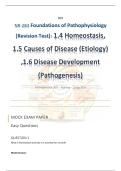
NR-283 Foundations of Pathophysiology Quiz Pack | Homeostasis, Etiology & Pathogenesis Comprehensive Revision Guide (2026)

Puntuación
-
Vendido
-
Páginas
6
Grado
A+
Subido en
02-07-2026
Escrito en
2025/2026

Ensure complete mastery of the foundational mechanics of disease progression with the NR-283 Foundations of Pathophysiology Revision Quiz Pack (2026). Tailored strictly for nursing students navigating the early diagnostic phases of pathology, this ultimate revision text translates complex biological feedback and cell stress cascades into direct, high-yield examination model questions and verified answers. This study pack functions as an immediate tactical companion to "Pathophysiology_lecture_.pdf" and "Foundations_of_Pathophysiology__Revision_Test____Introduction_to_Pathophysiology__Relationship_Between_Anatomy__Physiology__and_Pathophysiology__Levels_of_Biological_Organization_study_", specifically testing your comprehension of how cellular stress translates into visible clinical manifestations. Core Revision Modules Covered:Advanced Homeostatic Control Systems: Deconstruct the three crucial components of a homeostatic loop: the Receptor/Sensor (e.g., cutaneous thermoreceptors), the Control Center (e.g., hypothalamic integration), and the Effector systems (e.g., vascular dilation and sweat gland activation). Feedback Mechanism Bifurcation: Analyze the fundamental differences between system-stabilizing Negative Feedback Loops (such as the antagonistic balance of insulin/glucagon or the integrated parathyroid hormone (PTH) and thyroid calcitonin loop regulating blood calcium at $10text{ mg/dL}$) versus explosive Positive Feedback Loops (such as the amplification of oxytocin during uterine labor contractions). Multifactorial Etiology (Causes of Disease): Evaluate how disease states emerge from overlapping internal and external triggers. Reviews inherited or spontaneous DNA mutations (Genetic like sickle cell $beta$-globin defects), in-utero developmental impacts (Congenital like fetal alcohol syndrome), and toxin or heavy metal interactions (Environmental). Learn how these factors combine to trigger complex conditions like hypertension. The Step-by-Step Pathogenesis Sequence: Master the chronological chain reaction of clinical decline: Causative Exposure: Initial encounter with an external pathogen or toxic stimulus. Cellular Response: Cellular adaptations (hypertrophy, apoptosis) giving way to injury under severe stress. Tissue Dysfunction: Loss of specialized tissue coordination. Organ Dysfunction: Impaired structural performance, such as diminished liver detoxification. Clinical Manifestations: The emergence of objective signs and subjective symptoms like fever or pain. Outcomes: Tracking trajectories ranging from complete resolution to chronic progression or death. Clinical Diagnostic Application: Explore how mapping pathogenesis shapes medical management—allowing clinicians to anticipate tissue complications, select targeted therapeutic interventions (such as anti-inflammatories for arthritis), and predict patient prognosis

Mostrar más Leer menos
Institución
NR-283
Grado
NR-283

Vista previa del contenido

QUIZ


NR-283 Foundations of Pathophysiology

[Revision Test]: 1.4 Homeostasis,

1.5 Causes of Disease (Etiology)
,1.6 Disease Development
(Pathogenesis)
PATHOPHYSIOLOGY · Nursing · 2 July 2026


MOCK EXAM PAPER
Easy Questions

QUESTION 1
What is homeostasis and why is it essential for survival?


Model Answer:

, Homeostasis is the body's ability to maintain a relatively stable internal environment despite
external and internal changes. It is essential for survival because it ensures that vital bodily
functions such as temperature regulation, blood pressure, and electrolyte balance remain within
optimal ranges. For example, maintaining body temperature is crucial for enzymatic reactions, and
if body temperature deviates significantly from the normal range, it can lead to dysfunction and
ultimately, death.


QUESTION 2
What are the three components of a homeostatic control system?


Model Answer:
The three components of a homeostatic control system are:


1. Receptor (Sensor): Detects changes in the internal environment. For instance, thermoreceptors
in the skin detect temperature changes.


2. Control Center: Interprets the information received from the receptor and decides the
appropriate response. The hypothalamus serves as the control center for temperature regulation.


3. Effector: Executes the response to restore balance. For example, in response to increased body
temperature, sweat glands increase sweating, and blood vessels in the skin dilate to release heat.


QUESTION 3
What is negative feedback and how does it function in homeostasis?


Model Answer:

Escuela, estudio y materia

Institución
NR-283
Grado
NR-283

Información del documento

Subido en
2 de julio de 2026
Número de páginas
6
Escrito en
2025/2026
Tipo
Examen
Contiene
Preguntas y respuestas

Temas

$9.69
Accede al documento completo:

¿Documento equivocado? Cámbialo gratis Dentro de los 14 días posteriores a la compra y antes de descargarlo, puedes elegir otro documento. Puedes gastar el importe de nuevo.
Escrito por estudiantes que aprobaron
Inmediatamente disponible después del pago
Leer en línea o como PDF

Conoce al vendedor
Seller avatar
furahahive

Documento también disponible en un lote

Conoce al vendedor

Seller avatar
furahahive Harvard University
Seguir Necesitas iniciar sesión para seguir a otros usuarios o asignaturas
Vendido
-
Miembro desde
1 mes
Número de seguidores
1
Documentos
27
Última venta
-

Stop drowning in hundreds of textbook pages. Whether you are trying to catch up or aiming to secure that top A+, these study materials are engineered to deliver maximum results in minimum time. Crafted by an experienced educator, this comprehensive collection cuts through the noise to give you the exact tools you need to dominate your courses.

0.0

0 reseñas

5
0
4
0
3
0
2
0
1
0

Recientemente visto por ti

Por qué los estudiantes eligen Stuvia

Creado por compañeros estudiantes, verificado por reseñas

Calidad en la que puedes confiar: escrito por estudiantes que aprobaron y evaluado por otros que han usado estos resúmenes.

¿No estás satisfecho? Elige otro documento

¡No te preocupes! Puedes elegir directamente otro documento que se ajuste mejor a lo que buscas.

Paga como quieras, empieza a estudiar al instante

Sin suscripción, sin compromisos. Paga como estés acostumbrado con tarjeta de crédito y descarga tu documento PDF inmediatamente.

Student with book image

“Comprado, descargado y aprobado. Así de fácil puede ser.”

Alisha Student

Preguntas frecuentes