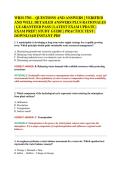
NEW JERSEY WATER TREATMENT OPERATOR T1 EXAM
Complete Practice Examination - 2026 Edition
Questions with Detailed ANSWERs and Rationales REAL
QUESTION 1
A water system has a free chlorine residual of 0.2 mg/L entering the distribution system. The water
temperature is 10°C and pH is 7.0. According to NJAC 7:10, what is the minimum contact time required
before the first customer to achieve adequate disinfection?
A) 15 minutes
B) 30 minutes
C) 60 minutes
D) 120 minutes
Correct ANSWER✔✨-: B) 30 minutes
Rationale for Option A: 15 minutes is incorrect because at 10°C with a chlorine residual of 0.2 mg/L and
pH 7.0, this contact time would not provide adequate CT value (concentration × time) to meet the
required disinfection standards for Giardia and virus inactivation as specified in NJAC 7:10 surface water
treatment requirements. The CT value would only be 3 mg-min/L (0.2 × 15), which is insufficient.
Rationale for Option B: 30 minutes is correct because according to NJAC 7:10 and EPA Surface Water
Treatment Rules, for groundwater under the direct influence of surface water or surface water systems,
a minimum contact time of 30 minutes is required when maintaining a free chlorine residual of at least
0.2 mg/L. This provides a CT value of 6 mg-min/L (0.2 mg/L × 30 min), which meets minimum
disinfection requirements at 10°C and pH 7.0.
smallwatersystemsbc.ca
Rationale for Option C: 60 minutes is incorrect because while this would provide adequate disinfection
(CT = 12 mg-min/L), it exceeds the minimum requirement specified in NJAC 7:10. The regulation requires
a minimum of 30 minutes contact time with 0.2 mg/L free chlorine residual, not 60 minutes. While
longer contact times provide additional safety margin, they are not the minimum required.
,Rationale for Option D: 120 minutes is incorrect because this significantly exceeds the minimum contact
time requirement. While 120 minutes would provide excellent disinfection (CT = 24 mg-min/L), NJAC
7:10 specifies 30 minutes as the minimum contact time before the first customer when maintaining 0.2
mg/L free chlorine residual. This ANSWER✔✨- represents over-design rather than regulatory
minimum.
QUESTION 2
What is the Maximum Contaminant Level (MCL) for arsenic in drinking water according to current NJDEP
regulations?
A) 0.005 mg/L (5 ppb)
B) 0.010 mg/L (10 ppb)
C) 0.050 mg/L (50 ppb)
D) 0.100 mg/L (100 ppb)
Correct ANSWER✔✨-: B) 0.010 mg/L (10 ppb)
Rationale for Option A: 0.005 mg/L (5 ppb) is incorrect because while this level would provide additional
public health protection, it is not the current enforceable MCL. Some states and health organizations
have recommended this lower level, but NJDEP and EPA have established 10 ppb as the enforceable
standard based on technical feasibility and cost-benefit analysis.
Rationale for Option B: 0.010 mg/L (10 ppb) is correct because this is the current EPA and NJDEP
Maximum Contaminant Level for arsenic in drinking water, established in 2006 and still in effect in 2026.
This standard applies to all public water systems and represents the highest level of arsenic allowed in
drinking water while considering both health protection and treatment feasibility.
open-exam-prep.com
Rationale for Option C: 0.050 mg/L (50 ppb) is incorrect because this was the original MCL established in
1942 and was in effect until 2006. The standard was lowered to 10 ppb based on new health risk
assessments showing increased cancer risks at lower concentrations. Water systems must now meet the
more stringent 10 ppb standard.
Rationale for Option D: 0.100 mg/L (100 ppb) is incorrect because this level has never been the federal
or New Jersey MCL for arsenic. This concentration would pose significant health risks including increased
cancer risk and cardiovascular effects. The current standard of 10 ppb is ten times more stringent than
this option.
QUESTION 3
Which of the following represents the correct breakpoint chlorination formula when combined chlorine
(chloramines) concentration is known?
A) Add chlorine equal to the combined chlorine concentration
B) Add chlorine equal to 5 times the combined chlorine concentration
,C) Add chlorine equal to 10 times the combined chlorine concentration
D) Add chlorine equal to 15 times the combined chlorine concentration
Correct ANSWER✔✨-: C) Add chlorine equal to 10 times the combined chlorine concentration
Rationale for Option A: Adding chlorine equal to the combined chlorine concentration (1:1 ratio) is
incorrect because this would only maintain the existing chloramine level, not achieve breakpoint. At this
ratio, chlorine would simply react with ammonia to form more chloramines without destroying them or
achieving free chlorine residual.
Rationale for Option B: Adding chlorine at 5 times the combined chlorine concentration is incorrect
because this ratio falls short of the breakpoint. At this level, some chloramines would be destroyed, but
not all, and free chlorine residual would not be established. The water would still contain objectionable
combined chlorine compounds.
Rationale for Option C: Adding chlorine equal to 10 times the combined chlorine concentration is correct
because the breakpoint chlorination formula requires approximately 10:1 ratio of chlorine to ammonia-
nitrogen (or combined chlorine) to completely oxidize chloramines and establish free chlorine residual.
This is the generally accepted formula: Required FC = (Combined Chlorine × 10) - Current Free Chlorine.
pooldial.com
www.intheswim.com
Rationale for Option D: Adding chlorine at 15 times the combined chlorine concentration is incorrect
because while this would achieve breakpoint and provide free chlorine residual, it represents excessive
chlorine addition beyond what is necessary. This wastes chemicals, increases costs, and may create
excessive disinfection byproducts without additional benefit.
QUESTION 4
What is the Secondary Maximum Contaminant Level (SMCL) for iron in drinking water?
A) 0.1 mg/L
B) 0.3 mg/L
C) 1.0 mg/L
D) 3.0 mg/L
Correct ANSWER✔✨-: B) 0.3 mg/L
Rationale for Option A: 0.1 mg/L is incorrect because while some sensitive individuals may detect iron at
this concentration, it is below the EPA and NJDEP secondary standard. This level might be used as an
aesthetic objective in some treatment facilities, but it is not the regulatory SMCL.
Rationale for Option B: 0.3 mg/L is correct because this is the EPA and NJDEP Secondary Maximum
Contaminant Level for iron. Secondary standards are non-enforceable guidelines regulating
contaminants that may cause cosmetic effects (such as skin or tooth discoloration) or aesthetic effects
, (such as taste, odor, or color) in drinking water. Iron at concentrations above 0.3 mg/L causes staining of
laundry and plumbing fixtures.
open-exam-prep.com
Rationale for Option C: 1.0 mg/L is incorrect because this concentration significantly exceeds the
secondary standard. At 1.0 mg/L, iron would cause severe staining, metallic taste, and promote growth
of iron bacteria. Water at this concentration would be unacceptable for most domestic uses.
Rationale for Option D: 3.0 mg/L is incorrect because this concentration is ten times the secondary
standard and would make water virtually unusable for domestic purposes. Such high iron concentrations
cause severe staining, unpleasant taste and odor, and support excessive iron bacteria growth.
QUESTION 5
In a water treatment plant, coagulation is typically followed by which process?
A) Filtration
B) Sedimentation
C) Flocculation
D) Disinfection
Correct ANSWER✔✨-: C) Flocculation
Rationale for Option A: Filtration is incorrect as the immediate next step after coagulation because
particles must first be aggregated into larger, settleable flocs. Filtration comes later in the treatment
train, typically after sedimentation, to remove remaining suspended particles that did not settle.
Rationale for Option B: Sedimentation is incorrect as the immediate next step because coagulated
particles are too small to settle efficiently. The particles must first undergo flocculation to form larger,
heavier flocs that can settle effectively in the sedimentation basin.
Rationale for Option C: Flocculation is correct because it immediately follows coagulation in the
conventional water treatment process. Coagulation destabilizes particles by neutralizing their electrical
charges through chemical addition (alum, ferric sulfate), while flocculation gently mixes the water to
encourage destabilized particles to collide and aggregate into larger, settleable flocs. This sequence is
essential for effective particle removal.
www.stuvia.com
Rationale for Option D: Disinfection is incorrect as the next step after coagulation because disinfection is
typically the final treatment step before distribution. Performing disinfection before particle removal
would be inefficient, as suspended particles can shield microorganisms from disinfectants and increase
disinfectant demand.
QUESTION 6
What is the maximum allowable turbidity level for filtered water according to NJAC 7:10?
Complete Practice Examination - 2026 Edition
Questions with Detailed ANSWERs and Rationales REAL
QUESTION 1
A water system has a free chlorine residual of 0.2 mg/L entering the distribution system. The water
temperature is 10°C and pH is 7.0. According to NJAC 7:10, what is the minimum contact time required
before the first customer to achieve adequate disinfection?
A) 15 minutes
B) 30 minutes
C) 60 minutes
D) 120 minutes
Correct ANSWER✔✨-: B) 30 minutes
Rationale for Option A: 15 minutes is incorrect because at 10°C with a chlorine residual of 0.2 mg/L and
pH 7.0, this contact time would not provide adequate CT value (concentration × time) to meet the
required disinfection standards for Giardia and virus inactivation as specified in NJAC 7:10 surface water
treatment requirements. The CT value would only be 3 mg-min/L (0.2 × 15), which is insufficient.
Rationale for Option B: 30 minutes is correct because according to NJAC 7:10 and EPA Surface Water
Treatment Rules, for groundwater under the direct influence of surface water or surface water systems,
a minimum contact time of 30 minutes is required when maintaining a free chlorine residual of at least
0.2 mg/L. This provides a CT value of 6 mg-min/L (0.2 mg/L × 30 min), which meets minimum
disinfection requirements at 10°C and pH 7.0.
smallwatersystemsbc.ca
Rationale for Option C: 60 minutes is incorrect because while this would provide adequate disinfection
(CT = 12 mg-min/L), it exceeds the minimum requirement specified in NJAC 7:10. The regulation requires
a minimum of 30 minutes contact time with 0.2 mg/L free chlorine residual, not 60 minutes. While
longer contact times provide additional safety margin, they are not the minimum required.
,Rationale for Option D: 120 minutes is incorrect because this significantly exceeds the minimum contact
time requirement. While 120 minutes would provide excellent disinfection (CT = 24 mg-min/L), NJAC
7:10 specifies 30 minutes as the minimum contact time before the first customer when maintaining 0.2
mg/L free chlorine residual. This ANSWER✔✨- represents over-design rather than regulatory
minimum.
QUESTION 2
What is the Maximum Contaminant Level (MCL) for arsenic in drinking water according to current NJDEP
regulations?
A) 0.005 mg/L (5 ppb)
B) 0.010 mg/L (10 ppb)
C) 0.050 mg/L (50 ppb)
D) 0.100 mg/L (100 ppb)
Correct ANSWER✔✨-: B) 0.010 mg/L (10 ppb)
Rationale for Option A: 0.005 mg/L (5 ppb) is incorrect because while this level would provide additional
public health protection, it is not the current enforceable MCL. Some states and health organizations
have recommended this lower level, but NJDEP and EPA have established 10 ppb as the enforceable
standard based on technical feasibility and cost-benefit analysis.
Rationale for Option B: 0.010 mg/L (10 ppb) is correct because this is the current EPA and NJDEP
Maximum Contaminant Level for arsenic in drinking water, established in 2006 and still in effect in 2026.
This standard applies to all public water systems and represents the highest level of arsenic allowed in
drinking water while considering both health protection and treatment feasibility.
open-exam-prep.com
Rationale for Option C: 0.050 mg/L (50 ppb) is incorrect because this was the original MCL established in
1942 and was in effect until 2006. The standard was lowered to 10 ppb based on new health risk
assessments showing increased cancer risks at lower concentrations. Water systems must now meet the
more stringent 10 ppb standard.
Rationale for Option D: 0.100 mg/L (100 ppb) is incorrect because this level has never been the federal
or New Jersey MCL for arsenic. This concentration would pose significant health risks including increased
cancer risk and cardiovascular effects. The current standard of 10 ppb is ten times more stringent than
this option.
QUESTION 3
Which of the following represents the correct breakpoint chlorination formula when combined chlorine
(chloramines) concentration is known?
A) Add chlorine equal to the combined chlorine concentration
B) Add chlorine equal to 5 times the combined chlorine concentration
,C) Add chlorine equal to 10 times the combined chlorine concentration
D) Add chlorine equal to 15 times the combined chlorine concentration
Correct ANSWER✔✨-: C) Add chlorine equal to 10 times the combined chlorine concentration
Rationale for Option A: Adding chlorine equal to the combined chlorine concentration (1:1 ratio) is
incorrect because this would only maintain the existing chloramine level, not achieve breakpoint. At this
ratio, chlorine would simply react with ammonia to form more chloramines without destroying them or
achieving free chlorine residual.
Rationale for Option B: Adding chlorine at 5 times the combined chlorine concentration is incorrect
because this ratio falls short of the breakpoint. At this level, some chloramines would be destroyed, but
not all, and free chlorine residual would not be established. The water would still contain objectionable
combined chlorine compounds.
Rationale for Option C: Adding chlorine equal to 10 times the combined chlorine concentration is correct
because the breakpoint chlorination formula requires approximately 10:1 ratio of chlorine to ammonia-
nitrogen (or combined chlorine) to completely oxidize chloramines and establish free chlorine residual.
This is the generally accepted formula: Required FC = (Combined Chlorine × 10) - Current Free Chlorine.
pooldial.com
www.intheswim.com
Rationale for Option D: Adding chlorine at 15 times the combined chlorine concentration is incorrect
because while this would achieve breakpoint and provide free chlorine residual, it represents excessive
chlorine addition beyond what is necessary. This wastes chemicals, increases costs, and may create
excessive disinfection byproducts without additional benefit.
QUESTION 4
What is the Secondary Maximum Contaminant Level (SMCL) for iron in drinking water?
A) 0.1 mg/L
B) 0.3 mg/L
C) 1.0 mg/L
D) 3.0 mg/L
Correct ANSWER✔✨-: B) 0.3 mg/L
Rationale for Option A: 0.1 mg/L is incorrect because while some sensitive individuals may detect iron at
this concentration, it is below the EPA and NJDEP secondary standard. This level might be used as an
aesthetic objective in some treatment facilities, but it is not the regulatory SMCL.
Rationale for Option B: 0.3 mg/L is correct because this is the EPA and NJDEP Secondary Maximum
Contaminant Level for iron. Secondary standards are non-enforceable guidelines regulating
contaminants that may cause cosmetic effects (such as skin or tooth discoloration) or aesthetic effects
, (such as taste, odor, or color) in drinking water. Iron at concentrations above 0.3 mg/L causes staining of
laundry and plumbing fixtures.
open-exam-prep.com
Rationale for Option C: 1.0 mg/L is incorrect because this concentration significantly exceeds the
secondary standard. At 1.0 mg/L, iron would cause severe staining, metallic taste, and promote growth
of iron bacteria. Water at this concentration would be unacceptable for most domestic uses.
Rationale for Option D: 3.0 mg/L is incorrect because this concentration is ten times the secondary
standard and would make water virtually unusable for domestic purposes. Such high iron concentrations
cause severe staining, unpleasant taste and odor, and support excessive iron bacteria growth.
QUESTION 5
In a water treatment plant, coagulation is typically followed by which process?
A) Filtration
B) Sedimentation
C) Flocculation
D) Disinfection
Correct ANSWER✔✨-: C) Flocculation
Rationale for Option A: Filtration is incorrect as the immediate next step after coagulation because
particles must first be aggregated into larger, settleable flocs. Filtration comes later in the treatment
train, typically after sedimentation, to remove remaining suspended particles that did not settle.
Rationale for Option B: Sedimentation is incorrect as the immediate next step because coagulated
particles are too small to settle efficiently. The particles must first undergo flocculation to form larger,
heavier flocs that can settle effectively in the sedimentation basin.
Rationale for Option C: Flocculation is correct because it immediately follows coagulation in the
conventional water treatment process. Coagulation destabilizes particles by neutralizing their electrical
charges through chemical addition (alum, ferric sulfate), while flocculation gently mixes the water to
encourage destabilized particles to collide and aggregate into larger, settleable flocs. This sequence is
essential for effective particle removal.
www.stuvia.com
Rationale for Option D: Disinfection is incorrect as the next step after coagulation because disinfection is
typically the final treatment step before distribution. Performing disinfection before particle removal
would be inefficient, as suspended particles can shield microorganisms from disinfectants and increase
disinfectant demand.
QUESTION 6
What is the maximum allowable turbidity level for filtered water according to NJAC 7:10?