SUMMARY NOTES
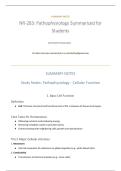
NR-283: Pathophysiology Summarized for
Students
PATHOPHYSIOLOGY ·
For More Accurate content find us on
SUMMARY NOTES
Study Notes: Pathophysiology - Cellular Function
1. Basic Cell Function
Definition
● Cell: The basic structural and functional unit of life. Composes all tissues and organs.
Core Tasks for Homeostasis
● Obtaining nutrients and producing energy.
● Removing metabolic waste to prevent toxicity.
● Communicating with neighboring cells; growth and reproduction.
The 5 Major Cellular Activities
1. Movement
● Internal movement of substances or global migration (e.g., white blood cells).
2. Conductivity
● Transmission of electrical impulses (e.g., nerve cells).
, 3. Metabolic Absorption
● Consuming nutrients to build structures and synthesize ATP.
4. Secretion
● Manufacturing and releasing chemical messengers (e.g., hormones).
5. Excretion
● Eliminating metabolic waste (e.g., carbon dioxide).
2. Exchanging Material & Cellular Transport
Plasma Membrane
● A selectively permeable lipid bilayer isolating intracellular environments.
Methods of Cellular Transport
● Passive Transport (No ATP, Down Gradient)
● Simple Diffusion: Solutes move from higher to lower concentration.
● Example: Water permeability influences faster diffusion.
● Facilitated Diffusion: Movement with carrier proteins (e.g., glucose transport).
● Clinical Example: Insulin transports glucose into cells.
● Osmosis: Movement of water toward higher solute concentration.
● Terms:
● *Osmotic Pressure*: Power of a solution to attract water.
NR-283: Pathophysiology Summarized for
Students
PATHOPHYSIOLOGY ·
For More Accurate content find us on
SUMMARY NOTES
Study Notes: Pathophysiology - Cellular Function
1. Basic Cell Function
Definition
● Cell: The basic structural and functional unit of life. Composes all tissues and organs.
Core Tasks for Homeostasis
● Obtaining nutrients and producing energy.
● Removing metabolic waste to prevent toxicity.
● Communicating with neighboring cells; growth and reproduction.
The 5 Major Cellular Activities
1. Movement
● Internal movement of substances or global migration (e.g., white blood cells).
2. Conductivity
● Transmission of electrical impulses (e.g., nerve cells).
, 3. Metabolic Absorption
● Consuming nutrients to build structures and synthesize ATP.
4. Secretion
● Manufacturing and releasing chemical messengers (e.g., hormones).
5. Excretion
● Eliminating metabolic waste (e.g., carbon dioxide).
2. Exchanging Material & Cellular Transport
Plasma Membrane
● A selectively permeable lipid bilayer isolating intracellular environments.
Methods of Cellular Transport
● Passive Transport (No ATP, Down Gradient)
● Simple Diffusion: Solutes move from higher to lower concentration.
● Example: Water permeability influences faster diffusion.
● Facilitated Diffusion: Movement with carrier proteins (e.g., glucose transport).
● Clinical Example: Insulin transports glucose into cells.
● Osmosis: Movement of water toward higher solute concentration.
● Terms:
● *Osmotic Pressure*: Power of a solution to attract water.