HED4810 ASSIGNMENT 2 2026
DUE 16 JULY 2026
QUESTION 1
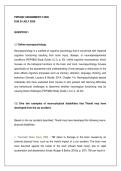
Compose a 300-word essay discussing the problem of educational exclusion
despite inclusive policies. Provide five arguments to support your position and
cite three recent academic sources.
South Africa has made significant progress in creating laws and policies that support
inclusive education since the end of apartheid in 1994. The Constitution (1996)
guarantees equal rights for all citizens, including the right to basic education. The South
African Schools Act (1996) made education compulsory for all children. White Paper 6
(2001) was a ground-breaking policy that introduced inclusive education as the way
forward for South African schools. More recently, the SIAS Policy (2014) was introduced
to help schools identify and support learners who need extra help. Despite all these
positive policy developments, the reality is that many learners continue to be excluded
from education. Research shows that more than 50% of children with disabilities in
South Africa are still not attending school. This shows a serious gap between what the
policies promise and what actually happens in practice.
, There are five main reasons why exclusion continues to happen despite these good
policies. Firstly, the legacy of apartheid continues to affect our education system. For
many years, learners were separated according to race and ability. According to Mkhize
and Muthukrishna (2024), these old patterns are deeply embedded in the system and
are very difficult to change. The apartheid system created special schools for learners
with disabilities and ordinary schools for those without, and this separation has been
hard to undo.
There is a big gap between policy and what happens in the classroom. Mosala and
Sefotho (2026) explain that policies are often written in unclear language and are not
properly enforced. Many teachers do not understand what inclusive education means in
practice. The policies also use a medical way of thinking about disability, which means
they focus on the learner's problem instead of changing the school to meet the learner's
needs.
Teachers are not trained well enough to implement inclusive education. Nel and Tlale
(2025) found that many teachers leave university without the skills they need to teach
diverse groups of learners. They do not know how to adapt their teaching methods, how
to use different materials, or how to support learners with conditions like dyslexia,
ADHD, or autism. This lack of training leaves teachers feeling unprepared and
frustrated.
Schools do not have enough resources. Many classrooms are overcrowded with 40 or
more learners. Schools lack assistive devices like braille machines, hearing aids, and
special computer programs. Buildings often do not have ramps or accessible toilets.
Isaacs et al. (2025) point out that these resource shortages are a major barrier to
implementing inclusive education.
DUE 16 JULY 2026
QUESTION 1
Compose a 300-word essay discussing the problem of educational exclusion
despite inclusive policies. Provide five arguments to support your position and
cite three recent academic sources.
South Africa has made significant progress in creating laws and policies that support
inclusive education since the end of apartheid in 1994. The Constitution (1996)
guarantees equal rights for all citizens, including the right to basic education. The South
African Schools Act (1996) made education compulsory for all children. White Paper 6
(2001) was a ground-breaking policy that introduced inclusive education as the way
forward for South African schools. More recently, the SIAS Policy (2014) was introduced
to help schools identify and support learners who need extra help. Despite all these
positive policy developments, the reality is that many learners continue to be excluded
from education. Research shows that more than 50% of children with disabilities in
South Africa are still not attending school. This shows a serious gap between what the
policies promise and what actually happens in practice.
, There are five main reasons why exclusion continues to happen despite these good
policies. Firstly, the legacy of apartheid continues to affect our education system. For
many years, learners were separated according to race and ability. According to Mkhize
and Muthukrishna (2024), these old patterns are deeply embedded in the system and
are very difficult to change. The apartheid system created special schools for learners
with disabilities and ordinary schools for those without, and this separation has been
hard to undo.
There is a big gap between policy and what happens in the classroom. Mosala and
Sefotho (2026) explain that policies are often written in unclear language and are not
properly enforced. Many teachers do not understand what inclusive education means in
practice. The policies also use a medical way of thinking about disability, which means
they focus on the learner's problem instead of changing the school to meet the learner's
needs.
Teachers are not trained well enough to implement inclusive education. Nel and Tlale
(2025) found that many teachers leave university without the skills they need to teach
diverse groups of learners. They do not know how to adapt their teaching methods, how
to use different materials, or how to support learners with conditions like dyslexia,
ADHD, or autism. This lack of training leaves teachers feeling unprepared and
frustrated.
Schools do not have enough resources. Many classrooms are overcrowded with 40 or
more learners. Schools lack assistive devices like braille machines, hearing aids, and
special computer programs. Buildings often do not have ramps or accessible toilets.
Isaacs et al. (2025) point out that these resource shortages are a major barrier to
implementing inclusive education.