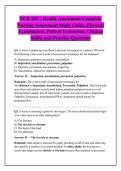
NUR 103 – Health Assessment Complete
Nursing Assessment Study Guide, Physical
Examination, Patient Evaluation, Clinical
Skills, and Practice Questions
Q1. A nurse is preparing to perform a physical assessment on a patient. Which of
the following is the correct order of assessment techniques for the abdomen?
A) Inspection, palpation, percussion, auscultation
B) Inspection, auscultation, percussion, palpation
C) Palpation, percussion, auscultation, inspection
D) Auscultation, inspection, palpation, percussion
Answer: B — Inspection, auscultation, percussion, palpation
Rationale: The correct order of assessment techniques for
the abdomen is Inspection, Auscultation, Percussion, Palpation. This is the only
area where auscultation is performed before palpation and percussion to avoid
altering bowel sounds. For all other body systems, the correct order is Inspection,
Palpation, Percussion, Auscultation (IPPA). Inspection should always be
performed first.
Q2. A nurse is assessing a patient's skin turgor. The nurse should assess skin turgor
over which area in an older adult patient?
A) The forearm
B) The clavicle or sternum
C) The back of the hand
D) The abdomen
Answer: B — The clavicle or sternum
Rationale: Skin turgor is assessed by gently pinching a fold of skin and observing
how quickly it returns to its normal position. In older adults, the best areas to
assess skin turgor are the clavicle or sternum because skin elasticity is decreased
,in the hands and forearms. Poor turgor (skin tenting) indicates dehydration. The
back of the hand and forearm are less reliable in older adults due to normal age-
related loss of skin elasticity.
Q3. A nurse is performing percussion on a patient's chest. Which of the following
percussion sounds is considered normal over healthy lung tissue?
A) Tympany
B) Resonance
C) Dullness
D) Flatness
Answer: B — Resonance
Rationale: Resonance is the normal percussion sound heard over healthy lung
tissue. It is a low-pitched, hollow sound. Tympany is a drum-like sound heard
over air-filled structures like the stomach or bowel. Dullness is heard over solid
organs (liver, spleen) or fluid-filled areas (pleural effusion). Flatness is heard over
bone or muscle.
Q4. A nurse is assessing a patient's level of consciousness using the Glasgow
Coma Scale (GCS). The patient opens eyes to pain, makes incomprehensible
sounds, and withdraws from pain. What is the GCS score?
A) 7
B) 8
C) 9
D) 10
Answer: B — 8
Rationale: The GCS assesses three components: Eye opening (E), Verbal
response (V), and Motor response (M). Scores range from 3 (deep coma) to 15
(fully alert). Eye opening to pain = 2 points. Incomprehensible sounds = 2 points.
Withdrawal to pain = 4 points. Total = 2 + 2 + 4 = 8. A GCS score of 8 or less
indicates severe neurological impairment and the need for airway protection.
,Q5. A nurse is assessing a patient's peripheral pulses. Which pulse site is located
behind the knee?
A) Dorsalis pedis
B) Posterior tibial
C) Popliteal
D) Femoral
Answer: C — Popliteal
Rationale: The popliteal pulse is located behind the knee (popliteal fossa).
The dorsalis pedis pulse is on the top of the foot. The posterior tibial pulse is
behind the medial malleolus. The femoral pulse is in the groin area. The popliteal
pulse can be difficult to palpate and is often assessed in patients with peripheral
vascular disease or after trauma.
Q6. A nurse is assessing a patient's pain using the PQRST mnemonic. What does
the "R" in PQRST stand for?
A) Relief
B) Radiation/Region
C) Rating
D) Rest
Answer: B — Radiation/Region
Rationale: The PQRST mnemonic is used for pain
assessment: P (Provocation/Palliation), Q (Quality), R (Radiation/Region), S (Seve
rity), and T (Timing). The "R" assesses whether the pain radiates to other areas and
the region of the pain. This helps differentiate types of pain and identify referred
pain patterns.
Q7. A nurse is assessing a patient's capillary refill time. The nurse presses on the
nail bed and notes that color returns after 4 seconds. This finding indicates:
A) Normal perfusion
B) Decreased peripheral perfusion
C) Increased peripheral perfusion
D) Normal arterial pressure
, Answer: B — Decreased peripheral perfusion
Rationale: Normal capillary refill time is < 2 seconds. A refill time of 4
seconds indicates decreased peripheral perfusion (e.g., shock, dehydration,
peripheral vascular disease, hypothermia). Capillary refill is assessed by pressing
on the nail bed and observing how quickly color returns. It is a simple, non-
invasive indicator of perfusion status.
Q8. A nurse is assessing a patient's height and weight. The patient's BMI is
calculated as 26.5 kg/m². The nurse should classify this patient as:
A) Underweight
B) Normal weight
C) Overweight
D) Obese
Answer: C — Overweight
Rationale: BMI classifications: Underweight (< 18.5), Normal (18.5–
24.9), Overweight (25.0–29.9), Obese Class I (30.0–34.9), Obese Class II (35.0–
39.9), Obese Class III (≥ 40). A BMI of 26.5 kg/m² is in the overweight range.
BMI is a screening tool that does not account for muscle mass, body composition,
or fat distribution.
Q9. A nurse is preparing to assess a patient's blood pressure. Which of the
following is the correct size of the blood pressure cuff for an average adult?
A) The cuff bladder should cover 40% of the arm circumference
B) The cuff bladder should cover 80% of the arm circumference
C) The cuff bladder should cover 100% of the arm circumference
D) The cuff bladder should cover 50% of the arm circumference
Answer: B — The cuff bladder should cover 80% of the arm circumference
Rationale: The correct size of the blood pressure cuff is critical for an accurate
reading. The cuff bladder should cover 80% of the arm circumference and 40%
of the length of the upper arm. A cuff that is too small will give a falsely high
reading; a cuff that is too large will give a falsely low reading. Using the correct
cuff size is essential for accurate blood pressure measurement.
Nursing Assessment Study Guide, Physical
Examination, Patient Evaluation, Clinical
Skills, and Practice Questions
Q1. A nurse is preparing to perform a physical assessment on a patient. Which of
the following is the correct order of assessment techniques for the abdomen?
A) Inspection, palpation, percussion, auscultation
B) Inspection, auscultation, percussion, palpation
C) Palpation, percussion, auscultation, inspection
D) Auscultation, inspection, palpation, percussion
Answer: B — Inspection, auscultation, percussion, palpation
Rationale: The correct order of assessment techniques for
the abdomen is Inspection, Auscultation, Percussion, Palpation. This is the only
area where auscultation is performed before palpation and percussion to avoid
altering bowel sounds. For all other body systems, the correct order is Inspection,
Palpation, Percussion, Auscultation (IPPA). Inspection should always be
performed first.
Q2. A nurse is assessing a patient's skin turgor. The nurse should assess skin turgor
over which area in an older adult patient?
A) The forearm
B) The clavicle or sternum
C) The back of the hand
D) The abdomen
Answer: B — The clavicle or sternum
Rationale: Skin turgor is assessed by gently pinching a fold of skin and observing
how quickly it returns to its normal position. In older adults, the best areas to
assess skin turgor are the clavicle or sternum because skin elasticity is decreased
,in the hands and forearms. Poor turgor (skin tenting) indicates dehydration. The
back of the hand and forearm are less reliable in older adults due to normal age-
related loss of skin elasticity.
Q3. A nurse is performing percussion on a patient's chest. Which of the following
percussion sounds is considered normal over healthy lung tissue?
A) Tympany
B) Resonance
C) Dullness
D) Flatness
Answer: B — Resonance
Rationale: Resonance is the normal percussion sound heard over healthy lung
tissue. It is a low-pitched, hollow sound. Tympany is a drum-like sound heard
over air-filled structures like the stomach or bowel. Dullness is heard over solid
organs (liver, spleen) or fluid-filled areas (pleural effusion). Flatness is heard over
bone or muscle.
Q4. A nurse is assessing a patient's level of consciousness using the Glasgow
Coma Scale (GCS). The patient opens eyes to pain, makes incomprehensible
sounds, and withdraws from pain. What is the GCS score?
A) 7
B) 8
C) 9
D) 10
Answer: B — 8
Rationale: The GCS assesses three components: Eye opening (E), Verbal
response (V), and Motor response (M). Scores range from 3 (deep coma) to 15
(fully alert). Eye opening to pain = 2 points. Incomprehensible sounds = 2 points.
Withdrawal to pain = 4 points. Total = 2 + 2 + 4 = 8. A GCS score of 8 or less
indicates severe neurological impairment and the need for airway protection.
,Q5. A nurse is assessing a patient's peripheral pulses. Which pulse site is located
behind the knee?
A) Dorsalis pedis
B) Posterior tibial
C) Popliteal
D) Femoral
Answer: C — Popliteal
Rationale: The popliteal pulse is located behind the knee (popliteal fossa).
The dorsalis pedis pulse is on the top of the foot. The posterior tibial pulse is
behind the medial malleolus. The femoral pulse is in the groin area. The popliteal
pulse can be difficult to palpate and is often assessed in patients with peripheral
vascular disease or after trauma.
Q6. A nurse is assessing a patient's pain using the PQRST mnemonic. What does
the "R" in PQRST stand for?
A) Relief
B) Radiation/Region
C) Rating
D) Rest
Answer: B — Radiation/Region
Rationale: The PQRST mnemonic is used for pain
assessment: P (Provocation/Palliation), Q (Quality), R (Radiation/Region), S (Seve
rity), and T (Timing). The "R" assesses whether the pain radiates to other areas and
the region of the pain. This helps differentiate types of pain and identify referred
pain patterns.
Q7. A nurse is assessing a patient's capillary refill time. The nurse presses on the
nail bed and notes that color returns after 4 seconds. This finding indicates:
A) Normal perfusion
B) Decreased peripheral perfusion
C) Increased peripheral perfusion
D) Normal arterial pressure
, Answer: B — Decreased peripheral perfusion
Rationale: Normal capillary refill time is < 2 seconds. A refill time of 4
seconds indicates decreased peripheral perfusion (e.g., shock, dehydration,
peripheral vascular disease, hypothermia). Capillary refill is assessed by pressing
on the nail bed and observing how quickly color returns. It is a simple, non-
invasive indicator of perfusion status.
Q8. A nurse is assessing a patient's height and weight. The patient's BMI is
calculated as 26.5 kg/m². The nurse should classify this patient as:
A) Underweight
B) Normal weight
C) Overweight
D) Obese
Answer: C — Overweight
Rationale: BMI classifications: Underweight (< 18.5), Normal (18.5–
24.9), Overweight (25.0–29.9), Obese Class I (30.0–34.9), Obese Class II (35.0–
39.9), Obese Class III (≥ 40). A BMI of 26.5 kg/m² is in the overweight range.
BMI is a screening tool that does not account for muscle mass, body composition,
or fat distribution.
Q9. A nurse is preparing to assess a patient's blood pressure. Which of the
following is the correct size of the blood pressure cuff for an average adult?
A) The cuff bladder should cover 40% of the arm circumference
B) The cuff bladder should cover 80% of the arm circumference
C) The cuff bladder should cover 100% of the arm circumference
D) The cuff bladder should cover 50% of the arm circumference
Answer: B — The cuff bladder should cover 80% of the arm circumference
Rationale: The correct size of the blood pressure cuff is critical for an accurate
reading. The cuff bladder should cover 80% of the arm circumference and 40%
of the length of the upper arm. A cuff that is too small will give a falsely high
reading; a cuff that is too large will give a falsely low reading. Using the correct
cuff size is essential for accurate blood pressure measurement.