

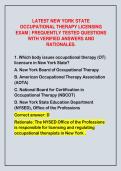
LATEST NEW YORK STATE
OCCUPATIONAL THERAPY LICENSING
EXAM | FREQUENTLY TESTED QUESTIONS
WITH VERIFIED ANSWERS AND
RATIONALES.
1. Which body issues occupational therapy (OT)
licensure in New York State?
A. New York Board of Occupational Therapy
B. American Occupational Therapy Association
(AOTA)
C. National Board for Certification in
Occupational Therapy (NBCOT)
D. New York State Education Department
(NYSED), Office of the Professions
Correct answer: D
Rationale: The NYSED Office of the Professions
is responsible for licensing and regulating
occupational therapists in New York .
,2. Which national certification is required for OT
licensure in New York?
A. AOTA credentialing
B. ACOTE certification
C. NBCOT certification
D. WHO rehabilitation certification
Correct answer: C
Rationale: New York requires passing the
NBCOT exam as part of standard OT licensure.
Both NBCOT certification and state licensure
are required to practice legally .
3. How often must New York OT licenses be
renewed?
A. Every year
B. Every two years
C. Every three years
D. Every four years
Correct answer: B
,Rationale: OT licenses in New York are renewed
biennially (every two years) with continuing
education .
4. How does New York require licensees to
maintain continuing competency?
A. Mandatory workshops selected by NYSED
B. Participation in clinical research
C. Completion of approved continuing
education contact hours
D. Annual board examinations
Correct answer: C
Rationale: OTs must complete approved
continuing education hours to maintain
licensure .
5. The New York State Education Law governing
occupational therapy practice is primarily found
in:
A. Article 28
B. Article 131
, C. Article 156
D. Article 33
Correct answer: B
Rationale: Article 131 of the New York
Education Law governs the practice of
occupational therapy and related professions .
6. Under New York law, what does the term
"unprofessional conduct" include?
A. Performing evidence-based interventions
B. Documenting after each session
C. Delegating treatment beyond an OTA's scope
D. Using standardized assessments
Correct answer: C
Rationale: OTs must not assign tasks to
personnel lacking proper training or scope; this
is defined as unprofessional conduct in NYS
Regents Rules Part 29 .
7. A supervising OT for an OTA in New York
must:
OCCUPATIONAL THERAPY LICENSING
EXAM | FREQUENTLY TESTED QUESTIONS
WITH VERIFIED ANSWERS AND
RATIONALES.
1. Which body issues occupational therapy (OT)
licensure in New York State?
A. New York Board of Occupational Therapy
B. American Occupational Therapy Association
(AOTA)
C. National Board for Certification in
Occupational Therapy (NBCOT)
D. New York State Education Department
(NYSED), Office of the Professions
Correct answer: D
Rationale: The NYSED Office of the Professions
is responsible for licensing and regulating
occupational therapists in New York .
,2. Which national certification is required for OT
licensure in New York?
A. AOTA credentialing
B. ACOTE certification
C. NBCOT certification
D. WHO rehabilitation certification
Correct answer: C
Rationale: New York requires passing the
NBCOT exam as part of standard OT licensure.
Both NBCOT certification and state licensure
are required to practice legally .
3. How often must New York OT licenses be
renewed?
A. Every year
B. Every two years
C. Every three years
D. Every four years
Correct answer: B
,Rationale: OT licenses in New York are renewed
biennially (every two years) with continuing
education .
4. How does New York require licensees to
maintain continuing competency?
A. Mandatory workshops selected by NYSED
B. Participation in clinical research
C. Completion of approved continuing
education contact hours
D. Annual board examinations
Correct answer: C
Rationale: OTs must complete approved
continuing education hours to maintain
licensure .
5. The New York State Education Law governing
occupational therapy practice is primarily found
in:
A. Article 28
B. Article 131
, C. Article 156
D. Article 33
Correct answer: B
Rationale: Article 131 of the New York
Education Law governs the practice of
occupational therapy and related professions .
6. Under New York law, what does the term
"unprofessional conduct" include?
A. Performing evidence-based interventions
B. Documenting after each session
C. Delegating treatment beyond an OTA's scope
D. Using standardized assessments
Correct answer: C
Rationale: OTs must not assign tasks to
personnel lacking proper training or scope; this
is defined as unprofessional conduct in NYS
Regents Rules Part 29 .
7. A supervising OT for an OTA in New York
must:

