

CNUR 302: Unit 2 - Growth & Development
and Endocrine Disorders Exam Questions
and Answers with Verified Solutions | Latest
Updated 2026
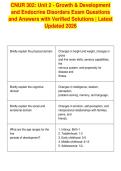
Briefly explain the physical domain Changes in height and weight, changes in
gross
and fine motor skills, sensory capabilities,
the
nervous system, and propensity for
disease and
illness.
Briefly explain the cognitive Changes in intelligence, wisdom,
domain perception,
problem-solving, memory, and language.
Briefly explain the social and Changes in emotion, self-perception, and
emotional domain interpersonal relationships with families,
peers, and
friends.
What are the age ranges for the 1. Infancy: Birth-1
five 2. Toddlerhood: 1-3
periods of development? 3. Early childhood: 3-6
4. Middle childhood: 6-12
5. Adolescence: 12+
, Define directional trends - Growth and development in regular
directions,
reflecting neuromuscular maturation
- Cephalocaudal (head-to-tail)
- Proximodistal (near-to-far)
- Differentiation
Briefly explain cephalocaudal The head end develops first and the lower
trends end
takes shape later.
Briefly explain proximodistal trends Shoulder to hands to fingers
Briefly explain differentiation Simple operations to more complex
trends activities
Define sequential trends Definitie, predictable sequences with each
child
normally passing through each stage.
Define sensitive periods - Limited times during growth where the
child
interacts in a specific manner
- Quality of interactions will determine
beneficence
or harm
- First 3 months of prenatal development
Which of Erikson's stages is - Trust vs mistrust
associated with infancy? - Infant develops trust if needs are
consistently met
(feeding, cleaning, etc.)
and Endocrine Disorders Exam Questions
and Answers with Verified Solutions | Latest
Updated 2026
Briefly explain the physical domain Changes in height and weight, changes in
gross
and fine motor skills, sensory capabilities,
the
nervous system, and propensity for
disease and
illness.
Briefly explain the cognitive Changes in intelligence, wisdom,
domain perception,
problem-solving, memory, and language.
Briefly explain the social and Changes in emotion, self-perception, and
emotional domain interpersonal relationships with families,
peers, and
friends.
What are the age ranges for the 1. Infancy: Birth-1
five 2. Toddlerhood: 1-3
periods of development? 3. Early childhood: 3-6
4. Middle childhood: 6-12
5. Adolescence: 12+
, Define directional trends - Growth and development in regular
directions,
reflecting neuromuscular maturation
- Cephalocaudal (head-to-tail)
- Proximodistal (near-to-far)
- Differentiation
Briefly explain cephalocaudal The head end develops first and the lower
trends end
takes shape later.
Briefly explain proximodistal trends Shoulder to hands to fingers
Briefly explain differentiation Simple operations to more complex
trends activities
Define sequential trends Definitie, predictable sequences with each
child
normally passing through each stage.
Define sensitive periods - Limited times during growth where the
child
interacts in a specific manner
- Quality of interactions will determine
beneficence
or harm
- First 3 months of prenatal development
Which of Erikson's stages is - Trust vs mistrust
associated with infancy? - Infant develops trust if needs are
consistently met
(feeding, cleaning, etc.)

