

CNUR 301: Unit 4 - Managing Teams &
Conflict Exam Questions and Answers with
Verified Solutions | Latest Updated 2026
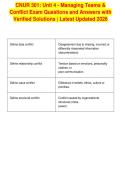
Define data conflict Disagreement due to missing, incorrect or
differently interpreted information
(documentation).
Define relationship conflict Tension based on emotions, personality
clashes, or
poor communication.
Define value conflict Difference in beliefs, ethics, culture or
priorities.
Define structural conflict Conflict caused by organizational
structures (roles,
power).
, What are the five stages of 1. Latent: Conditions for conflict exist, but
conflict? no one is
aware yet
2. Perceived: Parties recognize the conflict
intellectually
3. Felt: Emotional involvement begins
4. Manifest: Conflict becomes visible
through
actions
5. Aftermath: Resolution occurs or conflict
remains
unresolved
Define avoiding conflict - Withdrawing
management - Useful for minor or short-term issues
Define competing conflict - One party wins
management - Appropriate in emergencies
Define accommodating conflict Giving in to preserve relationships.
management
Define compromising conflict Each party gives something up.
management
Define collaborating conflict - Win-win solution
management - Ideal in healthcare teams
What are the four principles of 1. Separate people from the problem
negotiation? 2. Focus on interests, not positions
3. Generate mutual gains
4. Use objective criteria
Conflict Exam Questions and Answers with
Verified Solutions | Latest Updated 2026
Define data conflict Disagreement due to missing, incorrect or
differently interpreted information
(documentation).
Define relationship conflict Tension based on emotions, personality
clashes, or
poor communication.
Define value conflict Difference in beliefs, ethics, culture or
priorities.
Define structural conflict Conflict caused by organizational
structures (roles,
power).
, What are the five stages of 1. Latent: Conditions for conflict exist, but
conflict? no one is
aware yet
2. Perceived: Parties recognize the conflict
intellectually
3. Felt: Emotional involvement begins
4. Manifest: Conflict becomes visible
through
actions
5. Aftermath: Resolution occurs or conflict
remains
unresolved
Define avoiding conflict - Withdrawing
management - Useful for minor or short-term issues
Define competing conflict - One party wins
management - Appropriate in emergencies
Define accommodating conflict Giving in to preserve relationships.
management
Define compromising conflict Each party gives something up.
management
Define collaborating conflict - Win-win solution
management - Ideal in healthcare teams
What are the four principles of 1. Separate people from the problem
negotiation? 2. Focus on interests, not positions
3. Generate mutual gains
4. Use objective criteria

