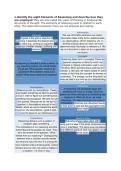
1.Identify the eight Elements of Reasoning and describe how they
are employed They are also called the: parts of thinking or fundamental
structures of thought. The elements of reasoning exist in relation to each
other. The distinctions between them are not absolute but relative.
Information
Purposes We use information whenever we reason.
Purpose is the goal or objective of Information takes many forms: statistical data,
reasoning. It describes the desired outcome our observations, others' testimony, etc. In
or intent (e.g., winning an argument, thinking critically about an issue, we must
grasping a complex concept, justifying one's determine what information is relevant to it. We
behavior). rely on information to direct us to a supportable
conclusion.
Concepts
Reasoning takes form in concepts. These are
Questions
All reasoning is directed at some question. In general categories or ideas by which we
any reasoning context, the critical thinker interpret or classify information used in our
should ask: What question needs to be thinking. When we think about anything (for
answered? What problem needs to be example, a new law), we reason based on some
solved? What issue needs to be resolved? concept of that thing (for example, its fairness or
unfairness). The concept, not the thing itself, is
what we hold in our mind as our understanding
of it.
Inferences
Assumptions
In reasoning, we sometimes begin with
Reasoning with our assumptions. These
something we know (or at least, which we
encompass everything we take for granted
believe we know) and figure out something else
as true in order to figure out something else.
based on it. When we do so, we make
Something we presuppose. We take its truth
inferences. To make inferences is to come to
for granted. Because we do, we don't
conclusions. Inferences are influenced heavily
question it. Assumptions are part of our
by their point of view and the assumptions they
beliefs, which we use to interpret the world
have made.
around us. Our assumptions—good or bad—
are the basis for our inferences
Implications Points of View
Reasoning delivers us to a position or Reasoning always takes place within
viewpoint about something. some point of view. It has some comprehensive
The implications of our reasoning are what focus or orientation. The same issue considered
extend beyond the position we reach. They from different points of view may appear not at
form the answer to the question, "What all the same.
follows from our reasoning?" Distinguishing
between what a situation actually implies
and what we may infer from it is among the
most important critical thinking skills. Critical
thinkers strive to infer only what is implied in
a situation—no more or less.
, Three kinds of implications may be involved
in any situation: Possible, Probable, and
Necessary
2.Identify the nine Standards of Critical Thinking and describe how
they are applied These standards are the criteria against which reasoning is
measured to determine if it is sound and rigorous. These standards are applied to
the elements of reasoning.
Clarity: Our thinking is clear when it is easily understood. We must be clear
in our own mind about what we mean. We must express what we mean
clearly so others understand us
Accuracy: To be accurate is to represent something as it actually is.
Common barriers to accurate reasoning are presuming one's own thoughts
are automatically accurate, presuming others' thoughts are inaccurate
when they disagree with us, and failing to question statements that validate
what we already believe.
Precision: Reasoning is precise when it is specific, exact, and sufficiently
detailed. Precision is related to clarity but distinct from it. Something may
be clear but not precise.
Relevance: Something is relevant when it pertains to the problem we seek
to solve. Thinking is relevant when it focuses on what is important—on
what matters—in understanding or deciding the issue at hand
Depth: Our reasoning is deep when it plumbs beneath the surface of an
issue or problem to identify the underlying complexities; and addresses
those complexities in an intellectually responsible way.
Breadth: Our reasoning is broad when it considers the issue at hand from
every relevant viewpoint. Breadth directs us to look around us, at
alternative or opposing perspectives. Failure to duly consider points of
view pertinent to an issue is to think narrow-mindedly.
Logic: Thinking is logical when thoughts and the order in which they are
organized are mutually supportive and make sense in combination.
Thinking that is internally contradictory or includes conflicting ideas is not
logical.
Significance: Our reasoning should concentrate on the most important
information relevant to the issue at hand. Our thinking falters when we fail
to recognize that not all information that happens to be pertinent to an
issue is equally important
Fairness: Our thinking is fair when it is justified. To be justified is to think
fairly in context. Thinking that satisfies all other fundamental intellectual
standards satisfies the standard of justifiability.
are employed They are also called the: parts of thinking or fundamental
structures of thought. The elements of reasoning exist in relation to each
other. The distinctions between them are not absolute but relative.
Information
Purposes We use information whenever we reason.
Purpose is the goal or objective of Information takes many forms: statistical data,
reasoning. It describes the desired outcome our observations, others' testimony, etc. In
or intent (e.g., winning an argument, thinking critically about an issue, we must
grasping a complex concept, justifying one's determine what information is relevant to it. We
behavior). rely on information to direct us to a supportable
conclusion.
Concepts
Reasoning takes form in concepts. These are
Questions
All reasoning is directed at some question. In general categories or ideas by which we
any reasoning context, the critical thinker interpret or classify information used in our
should ask: What question needs to be thinking. When we think about anything (for
answered? What problem needs to be example, a new law), we reason based on some
solved? What issue needs to be resolved? concept of that thing (for example, its fairness or
unfairness). The concept, not the thing itself, is
what we hold in our mind as our understanding
of it.
Inferences
Assumptions
In reasoning, we sometimes begin with
Reasoning with our assumptions. These
something we know (or at least, which we
encompass everything we take for granted
believe we know) and figure out something else
as true in order to figure out something else.
based on it. When we do so, we make
Something we presuppose. We take its truth
inferences. To make inferences is to come to
for granted. Because we do, we don't
conclusions. Inferences are influenced heavily
question it. Assumptions are part of our
by their point of view and the assumptions they
beliefs, which we use to interpret the world
have made.
around us. Our assumptions—good or bad—
are the basis for our inferences
Implications Points of View
Reasoning delivers us to a position or Reasoning always takes place within
viewpoint about something. some point of view. It has some comprehensive
The implications of our reasoning are what focus or orientation. The same issue considered
extend beyond the position we reach. They from different points of view may appear not at
form the answer to the question, "What all the same.
follows from our reasoning?" Distinguishing
between what a situation actually implies
and what we may infer from it is among the
most important critical thinking skills. Critical
thinkers strive to infer only what is implied in
a situation—no more or less.
, Three kinds of implications may be involved
in any situation: Possible, Probable, and
Necessary
2.Identify the nine Standards of Critical Thinking and describe how
they are applied These standards are the criteria against which reasoning is
measured to determine if it is sound and rigorous. These standards are applied to
the elements of reasoning.
Clarity: Our thinking is clear when it is easily understood. We must be clear
in our own mind about what we mean. We must express what we mean
clearly so others understand us
Accuracy: To be accurate is to represent something as it actually is.
Common barriers to accurate reasoning are presuming one's own thoughts
are automatically accurate, presuming others' thoughts are inaccurate
when they disagree with us, and failing to question statements that validate
what we already believe.
Precision: Reasoning is precise when it is specific, exact, and sufficiently
detailed. Precision is related to clarity but distinct from it. Something may
be clear but not precise.
Relevance: Something is relevant when it pertains to the problem we seek
to solve. Thinking is relevant when it focuses on what is important—on
what matters—in understanding or deciding the issue at hand
Depth: Our reasoning is deep when it plumbs beneath the surface of an
issue or problem to identify the underlying complexities; and addresses
those complexities in an intellectually responsible way.
Breadth: Our reasoning is broad when it considers the issue at hand from
every relevant viewpoint. Breadth directs us to look around us, at
alternative or opposing perspectives. Failure to duly consider points of
view pertinent to an issue is to think narrow-mindedly.
Logic: Thinking is logical when thoughts and the order in which they are
organized are mutually supportive and make sense in combination.
Thinking that is internally contradictory or includes conflicting ideas is not
logical.
Significance: Our reasoning should concentrate on the most important
information relevant to the issue at hand. Our thinking falters when we fail
to recognize that not all information that happens to be pertinent to an
issue is equally important
Fairness: Our thinking is fair when it is justified. To be justified is to think
fairly in context. Thinking that satisfies all other fundamental intellectual
standards satisfies the standard of justifiability.