

CNUR 209: Unit 5 - Qualitative Research
Exam Questions and Answers with Verified
Solutions | Latest Updated 2026
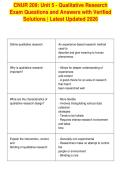
Define qualitative research An experience-based research method
used to
describe and give meaning to human
phenomena.
Why is qualitative research - Allows for deeper understanding of
important? experiences
and context
- A good choice for an area of research
that hasn't
been researched well
What are the characteristics of - More flexible
qualitative research design? - Involves triangulating various data
collection
strategies
- Tends to be holistic
- Requires intense research involvement
and takes
time
Explain the intervention, control, - Generally non-experimental
and - Researchers make no attempt to control
blinding of qualitative research the
people or environment
- Blinding is rare
, Explain comparisons in qualitative Generally, researchers are not attempting
research to make
group comparisons, however, emerging
data may
suggest comparisons.
Explain research settings in - Usually, data is collected in naturalistic
qualitative research settings
- May collect data in the persons home or
place
that is comfortable for the participants and
the
researcher
Explain the time frame of Can use either cross-sectional or
qualitative longitudinal
research designs.
Explain causality in qualitative - Low on the hierarchy of evidence
research - Doesn't try to show causality
- Particularly well suited to understanding
causal
relationships
Explain descriptive - What do we know as people
phenomenology - Describes ordinary experiencing
including
hearing, seeing, believing, feeling, and
remembering
- Four steps (bracketing, intuiting,
analyzing, and
describing)
Exam Questions and Answers with Verified
Solutions | Latest Updated 2026
Define qualitative research An experience-based research method
used to
describe and give meaning to human
phenomena.
Why is qualitative research - Allows for deeper understanding of
important? experiences
and context
- A good choice for an area of research
that hasn't
been researched well
What are the characteristics of - More flexible
qualitative research design? - Involves triangulating various data
collection
strategies
- Tends to be holistic
- Requires intense research involvement
and takes
time
Explain the intervention, control, - Generally non-experimental
and - Researchers make no attempt to control
blinding of qualitative research the
people or environment
- Blinding is rare
, Explain comparisons in qualitative Generally, researchers are not attempting
research to make
group comparisons, however, emerging
data may
suggest comparisons.
Explain research settings in - Usually, data is collected in naturalistic
qualitative research settings
- May collect data in the persons home or
place
that is comfortable for the participants and
the
researcher
Explain the time frame of Can use either cross-sectional or
qualitative longitudinal
research designs.
Explain causality in qualitative - Low on the hierarchy of evidence
research - Doesn't try to show causality
- Particularly well suited to understanding
causal
relationships
Explain descriptive - What do we know as people
phenomenology - Describes ordinary experiencing
including
hearing, seeing, believing, feeling, and
remembering
- Four steps (bracketing, intuiting,
analyzing, and
describing)

