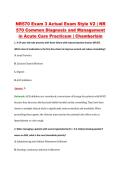
NR570 Exam 3 Actual Exam Style V2 | NR
570 Common Diagnosis and Management
in Acute Care Practicum | Chamberlain
1. A 65-year-old male presents with heart failure with reduced ejection fraction (HFrEF).
Which class of medication is the first-line choice to improve survival and reduce remodeling?
A. Loop Diuretics
B. Calcium Channel Blockers
C. Digoxin
D. ACE Inhibitors
Answer: D
Rationale: ACE inhibitors are considered a cornerstone of therapy for patients with HFrEF
because they decrease afterload and inhibit harmful cardiac remodeling. They have been
shown in multiple clinical trials to significantly reduce mortality and morbidity. When
prescribing these agents, the clinician must monitor for potential side effects such as
hyperkalemia or a dry cough.
2. When managing a patient with severe hyperkalemia (K+ > 6.5 mEq/L) showing peaked T
waves on EKG, what is the most immediate priority?
A. Administering oral Sodium Polystyrene Sulfonate
B. Starting a continuous infusion of Albuterol
,C. Administering intravenous calcium gluconate
D. Ordering a stat hemodialysis consultation
Answer: C
Rationale: Intravenous calcium gluconate is used to stabilize the cardiac myocyte
membrane and prevent life-threatening arrhythmias in the setting of hyperkalemia. It does
not actually lower the serum potassium level, so it must be followed by medications that
shift potassium intracellularly. This intervention is critical when EKG changes like peaked T
waves or widened QRS complexes are present.
3. In the initial management of a patient suspected of having Sepsis, what is the
recommended volume for intravenous fluid resuscitation according to the Surviving Sepsis
Guidelines?
A. 10 mL/kg of crystalloids
B. 20 mL/kg of crystalloids
C. 30 mL/kg of crystalloids
D. 50 mL/kg of crystalloids
Answer: C
Rationale: The standard initial fluid bolus for sepsis-induced hypotension or lactate levels
above 4 mmol/L is 30 mL/kg of isotonic crystalloids. This volume should be administered
within the first three hours of identification to restore tissue perfusion. Ongoing
,reassessment of fluid responsiveness is necessary to avoid volume overload once the initial
bolus is complete.
4. What is the target oxygen saturation range for a patient experiencing an acute
exacerbation of Chronic Obstructive Pulmonary Disease (COPD)?
A. 88% to 92%
B. 94% to 98%
C. 90% to 100%
D. 85% to 88%
Answer: A
Rationale: Targeting a saturation of 88-92% helps prevent the risk of hypercapnic
respiratory failure in COPD patients who may have a blunted respiratory drive. Over-
oxygenation can lead to ventilation-perfusion mismatch and increased CO2 retention. This
range ensures adequate tissue oxygenation while minimizing the risk of acidosis and
respiratory depression.
5. A patient presents to the ED with sudden onset pleuritic chest pain and shortness of
breath. Which diagnostic test is the gold standard for confirming a Pulmonary Embolism (PE)?
A. Computed Tomographic Pulmonary Angiography (CTPA)
B. Chest X-ray
C. Ventilation-Perfusion (V/Q) scan
, D. D-dimer assay
Answer: A
Rationale: CTPA is the preferred imaging modality because it allows for direct
visualization of thrombi within the pulmonary arteries. It provides high sensitivity and
specificity for diagnosing pulmonary embolism in most clinical settings. If a patient has a
contraindication to contrast, such as severe renal failure, a V/Q scan may be considered
instead.
6. Which of the following findings is most suggestive of a pre-renal etiology in a patient with
Acute Kidney Injury (AKI)?
A. Presence of muddy brown casts in the urine sediment
B. Fractional Excretion of Sodium (FeNa) less than 1%
C. BUN to Creatinine ratio of 10:1
D. Urine Sodium concentration greater than 40 mEq/L
Answer: B
Rationale: A FeNa of less than 1% indicates that the kidneys are actively conserving
sodium in response to decreased renal perfusion. In pre-renal AKI, the renal parenchyma is
intact, allowing the tubules to function normally and reabsorb sodium. This distinguishes it
from intrinsic renal injury where tubular damage leads to wasted sodium in the urine.
570 Common Diagnosis and Management
in Acute Care Practicum | Chamberlain
1. A 65-year-old male presents with heart failure with reduced ejection fraction (HFrEF).
Which class of medication is the first-line choice to improve survival and reduce remodeling?
A. Loop Diuretics
B. Calcium Channel Blockers
C. Digoxin
D. ACE Inhibitors
Answer: D
Rationale: ACE inhibitors are considered a cornerstone of therapy for patients with HFrEF
because they decrease afterload and inhibit harmful cardiac remodeling. They have been
shown in multiple clinical trials to significantly reduce mortality and morbidity. When
prescribing these agents, the clinician must monitor for potential side effects such as
hyperkalemia or a dry cough.
2. When managing a patient with severe hyperkalemia (K+ > 6.5 mEq/L) showing peaked T
waves on EKG, what is the most immediate priority?
A. Administering oral Sodium Polystyrene Sulfonate
B. Starting a continuous infusion of Albuterol
,C. Administering intravenous calcium gluconate
D. Ordering a stat hemodialysis consultation
Answer: C
Rationale: Intravenous calcium gluconate is used to stabilize the cardiac myocyte
membrane and prevent life-threatening arrhythmias in the setting of hyperkalemia. It does
not actually lower the serum potassium level, so it must be followed by medications that
shift potassium intracellularly. This intervention is critical when EKG changes like peaked T
waves or widened QRS complexes are present.
3. In the initial management of a patient suspected of having Sepsis, what is the
recommended volume for intravenous fluid resuscitation according to the Surviving Sepsis
Guidelines?
A. 10 mL/kg of crystalloids
B. 20 mL/kg of crystalloids
C. 30 mL/kg of crystalloids
D. 50 mL/kg of crystalloids
Answer: C
Rationale: The standard initial fluid bolus for sepsis-induced hypotension or lactate levels
above 4 mmol/L is 30 mL/kg of isotonic crystalloids. This volume should be administered
within the first three hours of identification to restore tissue perfusion. Ongoing
,reassessment of fluid responsiveness is necessary to avoid volume overload once the initial
bolus is complete.
4. What is the target oxygen saturation range for a patient experiencing an acute
exacerbation of Chronic Obstructive Pulmonary Disease (COPD)?
A. 88% to 92%
B. 94% to 98%
C. 90% to 100%
D. 85% to 88%
Answer: A
Rationale: Targeting a saturation of 88-92% helps prevent the risk of hypercapnic
respiratory failure in COPD patients who may have a blunted respiratory drive. Over-
oxygenation can lead to ventilation-perfusion mismatch and increased CO2 retention. This
range ensures adequate tissue oxygenation while minimizing the risk of acidosis and
respiratory depression.
5. A patient presents to the ED with sudden onset pleuritic chest pain and shortness of
breath. Which diagnostic test is the gold standard for confirming a Pulmonary Embolism (PE)?
A. Computed Tomographic Pulmonary Angiography (CTPA)
B. Chest X-ray
C. Ventilation-Perfusion (V/Q) scan
, D. D-dimer assay
Answer: A
Rationale: CTPA is the preferred imaging modality because it allows for direct
visualization of thrombi within the pulmonary arteries. It provides high sensitivity and
specificity for diagnosing pulmonary embolism in most clinical settings. If a patient has a
contraindication to contrast, such as severe renal failure, a V/Q scan may be considered
instead.
6. Which of the following findings is most suggestive of a pre-renal etiology in a patient with
Acute Kidney Injury (AKI)?
A. Presence of muddy brown casts in the urine sediment
B. Fractional Excretion of Sodium (FeNa) less than 1%
C. BUN to Creatinine ratio of 10:1
D. Urine Sodium concentration greater than 40 mEq/L
Answer: B
Rationale: A FeNa of less than 1% indicates that the kidneys are actively conserving
sodium in response to decreased renal perfusion. In pre-renal AKI, the renal parenchyma is
intact, allowing the tubules to function normally and reabsorb sodium. This distinguishes it
from intrinsic renal injury where tubular damage leads to wasted sodium in the urine.