

Comprehensive Pain Management & Pharmacology for Medical-Surgical Nursing [Success]
Comprehensive Pain Management & Pharmacology for Medical-Surgical
Nursing
Study online at https://quizlet.com/_j5nzu4
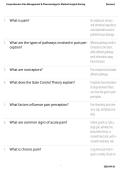
1. What is pain? An unpleasant sensory
and emotional experience
associated with actual or
potential tissue damage.
2. What are the types of pathways involved in pain per- Afferent pathways send in-
ception? formation to the brain,
while efferent pathways
send information away
from the brain.
3. What are nociceptors? Pain receptors that activate
afferent pathways.
4. What does the Gate Control Theory explain? It explains how stimulation
of large-diameter fibers
can close the gate to pain
perception.
5. What factors influence pain perception? Pain threshold, pain toler-
ance, age, and physical ac-
tivity.
6. What are common signs of acute pain? Patient guards or rubs a
body part, wrinkles the
brow, bites the lip, in-
creased heart rate, and in-
creased respiratory rate.
7. What is chronic pain? Long-term pain that re-
quires a variety of pain re-
2026-04-16
, Comprehensive Pain Management & Pharmacology for Medical-Surgical Nursing [Success]
Comprehensive Pain Management & Pharmacology for Medical-Surgical
Nursing
Study online at https://quizlet.com/_j5nzu4
lief methods for manage-
ment.
8. What is the importance of pain assessment? It requires excellent ther-
apeutic communication
skills and should be per-
formed on admission.
9. What scale is used to assess pain in children? The face scale.
10. When should pain medication be administered before 30-60 minutes before
a procedure? dressing change or phys-
ical therapy.
11. What are common symptoms accompanying pain? Immobility, anxiety, con-
stipation (especially with
opioids), sleep distur-
bance, fatigue, and dis-
comfort.
12. What is the recommended duration for applying cold Cold for 15 minutes and
or heat for pain relief? heat for 30 minutes.
13. What are examples of non-opioid analgesics? Aspirin, acetaminophen,
and NSAIDs like ibuprofen.
14. What are the side effects of NSAIDs? Stomach irritation, flu-
id retention, increased
bleeding time, and in-
creased risk of cardiovas-
cular events.
15. What are opioid agonists?
2026-04-16
Comprehensive Pain Management & Pharmacology for Medical-Surgical
Nursing
Study online at https://quizlet.com/_j5nzu4
1. What is pain? An unpleasant sensory
and emotional experience
associated with actual or
potential tissue damage.
2. What are the types of pathways involved in pain per- Afferent pathways send in-
ception? formation to the brain,
while efferent pathways
send information away
from the brain.
3. What are nociceptors? Pain receptors that activate
afferent pathways.
4. What does the Gate Control Theory explain? It explains how stimulation
of large-diameter fibers
can close the gate to pain
perception.
5. What factors influence pain perception? Pain threshold, pain toler-
ance, age, and physical ac-
tivity.
6. What are common signs of acute pain? Patient guards or rubs a
body part, wrinkles the
brow, bites the lip, in-
creased heart rate, and in-
creased respiratory rate.
7. What is chronic pain? Long-term pain that re-
quires a variety of pain re-
2026-04-16
, Comprehensive Pain Management & Pharmacology for Medical-Surgical Nursing [Success]
Comprehensive Pain Management & Pharmacology for Medical-Surgical
Nursing
Study online at https://quizlet.com/_j5nzu4
lief methods for manage-
ment.
8. What is the importance of pain assessment? It requires excellent ther-
apeutic communication
skills and should be per-
formed on admission.
9. What scale is used to assess pain in children? The face scale.
10. When should pain medication be administered before 30-60 minutes before
a procedure? dressing change or phys-
ical therapy.
11. What are common symptoms accompanying pain? Immobility, anxiety, con-
stipation (especially with
opioids), sleep distur-
bance, fatigue, and dis-
comfort.
12. What is the recommended duration for applying cold Cold for 15 minutes and
or heat for pain relief? heat for 30 minutes.
13. What are examples of non-opioid analgesics? Aspirin, acetaminophen,
and NSAIDs like ibuprofen.
14. What are the side effects of NSAIDs? Stomach irritation, flu-
id retention, increased
bleeding time, and in-
creased risk of cardiovas-
cular events.
15. What are opioid agonists?
2026-04-16

