

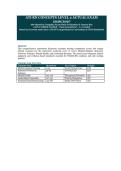
ATI RN CONCEPTS LEVEL 2 ACTUAL EXAM
2026/2027
180-Question Complete Exam-Style Evaluation & Answer Key
100% Certified Verified – Pass Guaranteed – A+ Graded
Based on Current 2026/2027 ATI RN Comprehensive Curriculum & NGN Standards
Abstract
This comprehensive assessment document evaluates nursing competency across 180 unique
clinical scenarios for the 2026/2027 academic cycle. It covers Medical-Surgical, Maternal-
Newborn, Pediatric, Mental Health, and Leadership domains. The actual exam integrates clinical
judgment and evidence-based standards essential for NCLEX-RN readiness and safe nursing
practice.
Content Area Overview
Content Area Questions Key Topics Weight
Medical-Surgical Nursing 1-54 Acute/Chronic Care 30%
Maternal-Newborn & 55-99 Growth/L&D 25%
Pediatric
Mental Health 100-126 Therapeutic/Disorders 15%
Leadership/Community 127-153 Priority/Delegation 15%
Fundamentals/Pharmacology 154-180 Safety/NGN Items 15%
,Domain: Medical-Surgical Nursing
1. A nurse is evaluating a client scenario regarding Hyperkalemia in AKI. Which
finding or action represents the evidence-based standard?
A. Retention of potassium during low urine output.
B. Traditional or ritualistic action
C. Delayed assessment of findings
D. Incorrect clinical pathway
Correct Answer: A. Retention of potassium during low urine output.
Rationale: Retention of potassium during low urine output.
Why Wrong: Options B, C, and D are incorrect because they fail to follow the ATI MS Renal
standard.
Reference: ATI MS Renal, 2026 Curriculum.
2. A nurse is evaluating a client scenario regarding Moon face in Cushing's. Which
finding or action represents the evidence-based standard?
A. Fat redistribution from high cortisol.
B. Traditional or ritualistic action
C. Delayed assessment of findings
D. Incorrect clinical pathway
Correct Answer: A. Fat redistribution from high cortisol.
Rationale: Fat redistribution from high cortisol.
Why Wrong: Options B, C, and D are incorrect because they fail to follow the ATI MS Endocrine
standard.
Reference: ATI MS Endocrine, 2026 Curriculum.
3. A nurse is evaluating a client scenario regarding Pre-oxygenation in Suctioning.
Which finding or action represents the evidence-based standard?
A. Preventing hypoxia during airway clearance.
B. Traditional or ritualistic action
C. Delayed assessment of findings
D. Incorrect clinical pathway
Correct Answer: A. Preventing hypoxia during airway clearance.
Rationale: Preventing hypoxia during airway clearance.
,Why Wrong: Options B, C, and D are incorrect because they fail to follow the ATI MS Resp
standard.
Reference: ATI MS Resp, 2026 Curriculum.
4. A nurse is evaluating a client scenario regarding Site Rotation in DM1. Which
finding or action represents the evidence-based standard?
A. Abdomen rotation prevents lipodystrophy.
B. Traditional or ritualistic action
C. Delayed assessment of findings
D. Incorrect clinical pathway
Correct Answer: A. Abdomen rotation prevents lipodystrophy.
Rationale: Abdomen rotation prevents lipodystrophy.
Why Wrong: Options B, C, and D are incorrect because they fail to follow the ATI MS Endocrine
standard.
Reference: ATI MS Endocrine, 2026 Curriculum.
5. A nurse is evaluating a client scenario regarding Dependent Edema in Right HF.
Which finding or action represents the evidence-based standard?
A. Systemic congestion from heart pump failure.
B. Traditional or ritualistic action
C. Delayed assessment of findings
D. Incorrect clinical pathway
Correct Answer: A. Systemic congestion from heart pump failure.
Rationale: Systemic congestion from heart pump failure.
Why Wrong: Options B, C, and D are incorrect because they fail to follow the ATI MS Cardiac
standard.
Reference: ATI MS Cardiac, 2026 Curriculum.
6. A nurse is evaluating a client scenario regarding Calcium Gluconate for Tetany.
Which finding or action represents the evidence-based standard?
A. Treating hypocalcemia after thyroid surgery.
B. Traditional or ritualistic action
C. Delayed assessment of findings
, D. Incorrect clinical pathway
Correct Answer: A. Treating hypocalcemia after thyroid surgery.
Rationale: Treating hypocalcemia after thyroid surgery.
Why Wrong: Options B, C, and D are incorrect because they fail to follow the ATI MS Endocrine
standard.
Reference: ATI MS Endocrine, 2026 Curriculum.
7. A nurse is evaluating a client scenario regarding Hip Abduction Post-Op. Which
finding or action represents the evidence-based standard?
A. Positioning to prevent prosthetic dislocation.
B. Traditional or ritualistic action
C. Delayed assessment of findings
D. Incorrect clinical pathway
Correct Answer: A. Positioning to prevent prosthetic dislocation.
Rationale: Positioning to prevent prosthetic dislocation.
Why Wrong: Options B, C, and D are incorrect because they fail to follow the ATI MS Ortho
standard.
Reference: ATI MS Ortho, 2026 Curriculum.
8. A nurse is evaluating a client scenario regarding Tidaling in Chest Tube. Which
finding or action represents the evidence-based standard?
A. Normal indicator of patent drainage system.
B. Traditional or ritualistic action
C. Delayed assessment of findings
D. Incorrect clinical pathway
Correct Answer: A. Normal indicator of patent drainage system.
Rationale: Normal indicator of patent drainage system.
Why Wrong: Options B, C, and D are incorrect because they fail to follow the ATI MS Resp
standard.
Reference: ATI MS Resp, 2026 Curriculum.
9. A nurse is evaluating a client scenario regarding Rigid Abdomen in Peritonitis.
Which finding or action represents the evidence-based standard?
2026/2027
180-Question Complete Exam-Style Evaluation & Answer Key
100% Certified Verified – Pass Guaranteed – A+ Graded
Based on Current 2026/2027 ATI RN Comprehensive Curriculum & NGN Standards
Abstract
This comprehensive assessment document evaluates nursing competency across 180 unique
clinical scenarios for the 2026/2027 academic cycle. It covers Medical-Surgical, Maternal-
Newborn, Pediatric, Mental Health, and Leadership domains. The actual exam integrates clinical
judgment and evidence-based standards essential for NCLEX-RN readiness and safe nursing
practice.
Content Area Overview
Content Area Questions Key Topics Weight
Medical-Surgical Nursing 1-54 Acute/Chronic Care 30%
Maternal-Newborn & 55-99 Growth/L&D 25%
Pediatric
Mental Health 100-126 Therapeutic/Disorders 15%
Leadership/Community 127-153 Priority/Delegation 15%
Fundamentals/Pharmacology 154-180 Safety/NGN Items 15%
,Domain: Medical-Surgical Nursing
1. A nurse is evaluating a client scenario regarding Hyperkalemia in AKI. Which
finding or action represents the evidence-based standard?
A. Retention of potassium during low urine output.
B. Traditional or ritualistic action
C. Delayed assessment of findings
D. Incorrect clinical pathway
Correct Answer: A. Retention of potassium during low urine output.
Rationale: Retention of potassium during low urine output.
Why Wrong: Options B, C, and D are incorrect because they fail to follow the ATI MS Renal
standard.
Reference: ATI MS Renal, 2026 Curriculum.
2. A nurse is evaluating a client scenario regarding Moon face in Cushing's. Which
finding or action represents the evidence-based standard?
A. Fat redistribution from high cortisol.
B. Traditional or ritualistic action
C. Delayed assessment of findings
D. Incorrect clinical pathway
Correct Answer: A. Fat redistribution from high cortisol.
Rationale: Fat redistribution from high cortisol.
Why Wrong: Options B, C, and D are incorrect because they fail to follow the ATI MS Endocrine
standard.
Reference: ATI MS Endocrine, 2026 Curriculum.
3. A nurse is evaluating a client scenario regarding Pre-oxygenation in Suctioning.
Which finding or action represents the evidence-based standard?
A. Preventing hypoxia during airway clearance.
B. Traditional or ritualistic action
C. Delayed assessment of findings
D. Incorrect clinical pathway
Correct Answer: A. Preventing hypoxia during airway clearance.
Rationale: Preventing hypoxia during airway clearance.
,Why Wrong: Options B, C, and D are incorrect because they fail to follow the ATI MS Resp
standard.
Reference: ATI MS Resp, 2026 Curriculum.
4. A nurse is evaluating a client scenario regarding Site Rotation in DM1. Which
finding or action represents the evidence-based standard?
A. Abdomen rotation prevents lipodystrophy.
B. Traditional or ritualistic action
C. Delayed assessment of findings
D. Incorrect clinical pathway
Correct Answer: A. Abdomen rotation prevents lipodystrophy.
Rationale: Abdomen rotation prevents lipodystrophy.
Why Wrong: Options B, C, and D are incorrect because they fail to follow the ATI MS Endocrine
standard.
Reference: ATI MS Endocrine, 2026 Curriculum.
5. A nurse is evaluating a client scenario regarding Dependent Edema in Right HF.
Which finding or action represents the evidence-based standard?
A. Systemic congestion from heart pump failure.
B. Traditional or ritualistic action
C. Delayed assessment of findings
D. Incorrect clinical pathway
Correct Answer: A. Systemic congestion from heart pump failure.
Rationale: Systemic congestion from heart pump failure.
Why Wrong: Options B, C, and D are incorrect because they fail to follow the ATI MS Cardiac
standard.
Reference: ATI MS Cardiac, 2026 Curriculum.
6. A nurse is evaluating a client scenario regarding Calcium Gluconate for Tetany.
Which finding or action represents the evidence-based standard?
A. Treating hypocalcemia after thyroid surgery.
B. Traditional or ritualistic action
C. Delayed assessment of findings
, D. Incorrect clinical pathway
Correct Answer: A. Treating hypocalcemia after thyroid surgery.
Rationale: Treating hypocalcemia after thyroid surgery.
Why Wrong: Options B, C, and D are incorrect because they fail to follow the ATI MS Endocrine
standard.
Reference: ATI MS Endocrine, 2026 Curriculum.
7. A nurse is evaluating a client scenario regarding Hip Abduction Post-Op. Which
finding or action represents the evidence-based standard?
A. Positioning to prevent prosthetic dislocation.
B. Traditional or ritualistic action
C. Delayed assessment of findings
D. Incorrect clinical pathway
Correct Answer: A. Positioning to prevent prosthetic dislocation.
Rationale: Positioning to prevent prosthetic dislocation.
Why Wrong: Options B, C, and D are incorrect because they fail to follow the ATI MS Ortho
standard.
Reference: ATI MS Ortho, 2026 Curriculum.
8. A nurse is evaluating a client scenario regarding Tidaling in Chest Tube. Which
finding or action represents the evidence-based standard?
A. Normal indicator of patent drainage system.
B. Traditional or ritualistic action
C. Delayed assessment of findings
D. Incorrect clinical pathway
Correct Answer: A. Normal indicator of patent drainage system.
Rationale: Normal indicator of patent drainage system.
Why Wrong: Options B, C, and D are incorrect because they fail to follow the ATI MS Resp
standard.
Reference: ATI MS Resp, 2026 Curriculum.
9. A nurse is evaluating a client scenario regarding Rigid Abdomen in Peritonitis.
Which finding or action represents the evidence-based standard?

