

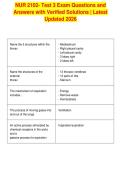
NUR 2102- Test 3 Exam Questions and
Answers with Verified Solutions | Latest
Updated 2026
Name the 5 structures within the - Mediastinum
thorax - Right pleural cavity
- Left pleural cavity
- 3 lobes right
- 2 lobes left
Name the structures of the - 12 thoracic vertebrae
external - 12 pairs of ribs
thorax - Sternum
The mechanism of respiration - Energy
includes... - Remove waste
- Homeostasis
The process of moving gases into Ventilation
and out of the lungs
An active process stimulated by Inspiration/expiration
chemical receptors in the aorta
and a
passive process for expiration
,Moves blood to and from the Pulmonary circulation
alveolar capillary membranes for
gas
exchange
Exchange of respiratory gases in Diffusion
the
alveoli and capillaries
Lungs and cardiovascular system O2 transport
Diffuses into red blood cells and is CO2 transport
hydrated into carbonic acid
True or false: smoking is the True
leading
cause of preventable death
How do you assess the readiness - Ask about tobacco use
to - Advise to quit through clear personalized
quit smoking? messages
- Assess willingness to quit
- Assist to quit
- Arrange follow-up and support
When inspecting pt for general - Nasal flaring
appearance, posture, & breathing, - Use of accessory muscles
what is an abnormal finding? - Tripod position
, When observing respirations for - Chest retraction
rate - Frequent sighing
& quality, what are abnormal - Abnormal breathing patterns (bradypnea,
findings? tachypnea, hyperventilation, kussmaul,
cheyne-
stokes, biot, air trapping)
This type of breathing pattern is Bradypnea
described as: regular, slow
inspirations/expirations with a rate
<12
This type of breathing pattern is Tachypnea
described as: regular, not full with
rate >20
This type of breathing pattern is Hyperventilation
described as: regular, more
inspiration with full expiration but
increase in rate and depth
This type of breathing pattern is Kussmaul
described as: seen in diabetic
patients & diabetic ketoacidosis;
very
deep & rapid breathing pattern
This type of breathing pattern is Cheyne-Stokes
described as: periods of deep
breathing alternated with periods
of
apnea (seen in pt's experiencing
drug overdose)
Answers with Verified Solutions | Latest
Updated 2026
Name the 5 structures within the - Mediastinum
thorax - Right pleural cavity
- Left pleural cavity
- 3 lobes right
- 2 lobes left
Name the structures of the - 12 thoracic vertebrae
external - 12 pairs of ribs
thorax - Sternum
The mechanism of respiration - Energy
includes... - Remove waste
- Homeostasis
The process of moving gases into Ventilation
and out of the lungs
An active process stimulated by Inspiration/expiration
chemical receptors in the aorta
and a
passive process for expiration
,Moves blood to and from the Pulmonary circulation
alveolar capillary membranes for
gas
exchange
Exchange of respiratory gases in Diffusion
the
alveoli and capillaries
Lungs and cardiovascular system O2 transport
Diffuses into red blood cells and is CO2 transport
hydrated into carbonic acid
True or false: smoking is the True
leading
cause of preventable death
How do you assess the readiness - Ask about tobacco use
to - Advise to quit through clear personalized
quit smoking? messages
- Assess willingness to quit
- Assist to quit
- Arrange follow-up and support
When inspecting pt for general - Nasal flaring
appearance, posture, & breathing, - Use of accessory muscles
what is an abnormal finding? - Tripod position
, When observing respirations for - Chest retraction
rate - Frequent sighing
& quality, what are abnormal - Abnormal breathing patterns (bradypnea,
findings? tachypnea, hyperventilation, kussmaul,
cheyne-
stokes, biot, air trapping)
This type of breathing pattern is Bradypnea
described as: regular, slow
inspirations/expirations with a rate
<12
This type of breathing pattern is Tachypnea
described as: regular, not full with
rate >20
This type of breathing pattern is Hyperventilation
described as: regular, more
inspiration with full expiration but
increase in rate and depth
This type of breathing pattern is Kussmaul
described as: seen in diabetic
patients & diabetic ketoacidosis;
very
deep & rapid breathing pattern
This type of breathing pattern is Cheyne-Stokes
described as: periods of deep
breathing alternated with periods
of
apnea (seen in pt's experiencing
drug overdose)

