

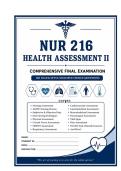
,NUR 216 Exam 3 EXAM (updated 2026)
100 Questions & Answers Latest
Already Graded A+ UPDATE 2026-2027
NUR 216 – Health Assessment II Comprehensive Final Examination
Question 1
A nurse is assessing a client's cranial nerves. Which finding indicates that Cranial Nerve I
(Olfactory) is intact?
A. The client sticks out the tongue.
B. The client smiles symmetrically.
C. The client hears whispered words.
D. The client correctly identifies a minty scent.
Correct Answer: D. The client correctly identifies a minty scent.
Rationale: Cranial Nerve I is responsible for the sense of smell. The nurse tests this nerve using
familiar, non-irritating odors such as mint, vanilla, or coffee.
Question 2
A nurse is assessing Cranial Nerve VII. Which finding demonstrates normal function?
A. The client identifies peppermint.
B. The client sticks out the tongue.
C. The client smiles equally on both sides.
D. The client hears whispered words.
Correct Answer: C. The client smiles equally on both sides.
Rationale: Cranial Nerve VII (Facial nerve) controls facial expressions. Symmetrical smiling
demonstrates intact motor function.
,Question 3
Which assessment finding indicates that Cranial Nerve VIII (Vestibulocochlear) is functioning
properly?
A. The client hears whispered words.
B. The client identifies a lemon scent.
C. The client protrudes the tongue.
D. The client shrugs both shoulders.
Correct Answer: A. The client hears whispered words.
Rationale: Cranial Nerve VIII controls hearing and balance. Whispered voice testing evaluates
auditory function.
Question 4
Which assessment finding indicates normal function of Cranial Nerve XII (Hypoglossal)?
A. The client identifies coffee.
B. The client sticks out the tongue midline.
C. The client smiles.
D. The client hears a whispered voice.
Correct Answer: B. The client sticks out the tongue midline.
Rationale: CN XII controls tongue movement and strength. The tongue should protrude midline
without deviation.
Question 5
A nurse hears wet, popping sounds during inspiration while auscultating the lungs. Which
adventitious breath sound should the nurse document?
A. Wheezes
B. Stridor
, C. Crackles
D. Pleural friction rub
Correct Answer: C. Crackles
Rationale: Crackles (rales) are discontinuous popping sounds heard when air passes through
fluid-filled alveoli or collapsed alveoli reopen during inspiration.
Question 6
Which breath sound is described as a high-pitched sound caused by upper airway obstruction?
A. Crackles
B. Wheezes
C. Stridor
D. Rhonchi
Correct Answer: C. Stridor
Rationale: Stridor is produced by obstruction of the upper airway and is considered a medical
emergency.
Question 7
Continuous musical sounds heard mainly during expiration are called:
A. Crackles
B. Friction rub
C. Wheezes
D. Bronchial sounds
Correct Answer: C. Wheezes
Rationale: Wheezes occur due to narrowed airways and are common in asthma and COPD.
Question 8
100 Questions & Answers Latest
Already Graded A+ UPDATE 2026-2027
NUR 216 – Health Assessment II Comprehensive Final Examination
Question 1
A nurse is assessing a client's cranial nerves. Which finding indicates that Cranial Nerve I
(Olfactory) is intact?
A. The client sticks out the tongue.
B. The client smiles symmetrically.
C. The client hears whispered words.
D. The client correctly identifies a minty scent.
Correct Answer: D. The client correctly identifies a minty scent.
Rationale: Cranial Nerve I is responsible for the sense of smell. The nurse tests this nerve using
familiar, non-irritating odors such as mint, vanilla, or coffee.
Question 2
A nurse is assessing Cranial Nerve VII. Which finding demonstrates normal function?
A. The client identifies peppermint.
B. The client sticks out the tongue.
C. The client smiles equally on both sides.
D. The client hears whispered words.
Correct Answer: C. The client smiles equally on both sides.
Rationale: Cranial Nerve VII (Facial nerve) controls facial expressions. Symmetrical smiling
demonstrates intact motor function.
,Question 3
Which assessment finding indicates that Cranial Nerve VIII (Vestibulocochlear) is functioning
properly?
A. The client hears whispered words.
B. The client identifies a lemon scent.
C. The client protrudes the tongue.
D. The client shrugs both shoulders.
Correct Answer: A. The client hears whispered words.
Rationale: Cranial Nerve VIII controls hearing and balance. Whispered voice testing evaluates
auditory function.
Question 4
Which assessment finding indicates normal function of Cranial Nerve XII (Hypoglossal)?
A. The client identifies coffee.
B. The client sticks out the tongue midline.
C. The client smiles.
D. The client hears a whispered voice.
Correct Answer: B. The client sticks out the tongue midline.
Rationale: CN XII controls tongue movement and strength. The tongue should protrude midline
without deviation.
Question 5
A nurse hears wet, popping sounds during inspiration while auscultating the lungs. Which
adventitious breath sound should the nurse document?
A. Wheezes
B. Stridor
, C. Crackles
D. Pleural friction rub
Correct Answer: C. Crackles
Rationale: Crackles (rales) are discontinuous popping sounds heard when air passes through
fluid-filled alveoli or collapsed alveoli reopen during inspiration.
Question 6
Which breath sound is described as a high-pitched sound caused by upper airway obstruction?
A. Crackles
B. Wheezes
C. Stridor
D. Rhonchi
Correct Answer: C. Stridor
Rationale: Stridor is produced by obstruction of the upper airway and is considered a medical
emergency.
Question 7
Continuous musical sounds heard mainly during expiration are called:
A. Crackles
B. Friction rub
C. Wheezes
D. Bronchial sounds
Correct Answer: C. Wheezes
Rationale: Wheezes occur due to narrowed airways and are common in asthma and COPD.
Question 8

