Chapter 9: Molecular structure of
DNA and RNA
To fulfil it’s role, genetic material must meet four criteria:
1. Information: the genetic material must contain the information necessary to construct an entire
organism. It must prove the blueprint for determining the inherited traits of an organism.
2. Transmission: during reproduction, the genetic material must be passed from parents to offspring.
3. Replication: because the genetic material is passed from parents to offspring, and from mother cell
to daughter cells during cell division, it must be copied.
4. Variation: within any species, a significant amount of phenotypic variability occurs. The genetic
materiel must also vary in ways that can account for the known phenotypic differences within each
species. -> capable of change -> adaption + evolution (because of mutations)
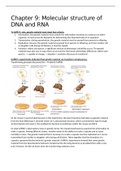
Griffith’s experiments indicated that genetic material can transform streptococcus
Transforming principle discovered by -> Frederick Griffith.
So the mouse in past (d) died because in this experiment, the type R bacteria had taken up genetic material
from the heat-killed type S (smooth strains of S. pneumoniae) bacteria, which converted the type R (rough
strains) bacteria into type S. this enabled the bacteria to proliferate within the mouse and kill it.
So what Griffith’s observations mean in genetic terms: the transformed bacteria acquired the information to
make a capsule. Among different strains, variation exists in the ability to create a capsule and to cause
mortality in mice. The genetic material that is necessary to create a capsule must be replicated so it can be
transmitted from mother to daughter cells during cell division. Taken together that the formation of a
capsule is governed by the bacteria’s genetic material. Griffith’s experiments showed that some genetic
material from the dead bacteria had been transferred tot the living bacteria an provided them with a new
trait. However, he did not know what the transforming substance was.
, Avery, Macleod, and McCarty showed that DNA is the substance that transforms bacteria
You might point out that the DNA abstract was not 100% pure, therefore they also did experiment with
adding DNase (digest DNA), RNase, protease. When the DNA extract were treated with RNase or protease,
they still converted type R bacteria in type S, however when they added DNase did didn’t happen.
DNA is the transforming principle. DNA the genetic material.
The purpose of adding RNase or protease to a DNA extract, was to rule out the possibility that small amounts
of contaminating RNA or protein were responsible for converting the type R bacteria into type S.
Hersey and Chase
Bacteriophage or phage is a virus that infects bacterial cells. T2 (virus) phage consist of genetic material. It
consists only DNA and proteins. During infection the phage is attached on the outside of the bacterium and
does not enter the cell. Only the genetic material enters the bacterial cell. They asked: what is in genetic
material. They used radioisotopes to distinguish proteins from DNA. Sulfur atoms are only found in proteins.
Phosphorus atoms are only found in DNA. Radioactive S and P were used. Most of the radioactive P had
entered the bacterial cells whereas most of the radioactive S remained outside the cells. Conclusion: the
genetic material is DNA.
DNA and RNA
To fulfil it’s role, genetic material must meet four criteria:
1. Information: the genetic material must contain the information necessary to construct an entire
organism. It must prove the blueprint for determining the inherited traits of an organism.
2. Transmission: during reproduction, the genetic material must be passed from parents to offspring.
3. Replication: because the genetic material is passed from parents to offspring, and from mother cell
to daughter cells during cell division, it must be copied.
4. Variation: within any species, a significant amount of phenotypic variability occurs. The genetic
materiel must also vary in ways that can account for the known phenotypic differences within each
species. -> capable of change -> adaption + evolution (because of mutations)
Griffith’s experiments indicated that genetic material can transform streptococcus
Transforming principle discovered by -> Frederick Griffith.
So the mouse in past (d) died because in this experiment, the type R bacteria had taken up genetic material
from the heat-killed type S (smooth strains of S. pneumoniae) bacteria, which converted the type R (rough
strains) bacteria into type S. this enabled the bacteria to proliferate within the mouse and kill it.
So what Griffith’s observations mean in genetic terms: the transformed bacteria acquired the information to
make a capsule. Among different strains, variation exists in the ability to create a capsule and to cause
mortality in mice. The genetic material that is necessary to create a capsule must be replicated so it can be
transmitted from mother to daughter cells during cell division. Taken together that the formation of a
capsule is governed by the bacteria’s genetic material. Griffith’s experiments showed that some genetic
material from the dead bacteria had been transferred tot the living bacteria an provided them with a new
trait. However, he did not know what the transforming substance was.
, Avery, Macleod, and McCarty showed that DNA is the substance that transforms bacteria
You might point out that the DNA abstract was not 100% pure, therefore they also did experiment with
adding DNase (digest DNA), RNase, protease. When the DNA extract were treated with RNase or protease,
they still converted type R bacteria in type S, however when they added DNase did didn’t happen.
DNA is the transforming principle. DNA the genetic material.
The purpose of adding RNase or protease to a DNA extract, was to rule out the possibility that small amounts
of contaminating RNA or protein were responsible for converting the type R bacteria into type S.
Hersey and Chase
Bacteriophage or phage is a virus that infects bacterial cells. T2 (virus) phage consist of genetic material. It
consists only DNA and proteins. During infection the phage is attached on the outside of the bacterium and
does not enter the cell. Only the genetic material enters the bacterial cell. They asked: what is in genetic
material. They used radioisotopes to distinguish proteins from DNA. Sulfur atoms are only found in proteins.
Phosphorus atoms are only found in DNA. Radioactive S and P were used. Most of the radioactive P had
entered the bacterial cells whereas most of the radioactive S remained outside the cells. Conclusion: the
genetic material is DNA.