Chapter 3: chromosome
transmission during cell division
and sexual reproduction
During cell division, eukaryotic cells can sort their chromosomes in two different ways.
1. Mitosis: sorts chromosomes so that each daughter cell receives the same number and types of
chromosomes at the original mother cell.
2. Meiosis: results in daughter cells with half the number of chromosomes that the mother cell had. It
is needed for sexual reproduction in eukaryotic species. During sexual reproduction, gametes with
half the number of chromosomes unite at fertilization.
Chromosomes are structures within living cells that contain the genetic material. Genes are physically
located within chromosomes. Each chromosomes contains a very long segment of DNA, which is the genetic
material, and protein, which are bound to the DNA and provide it with an organized structure.
Chromatin = the complex in eukaryotic cells between DNA and proteins.
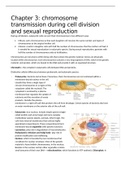
Distinctive cellular differences between prokaryotic and eukaryotic species:
- Prokaryotes: bacteria and archaea. Prenucleus, their chromosomes are not contained within a
membrane-bound nucleus in the cell.
Usually they have a single type of
circular chromosomes in a region of the
cytoplasm called the nucleoid. The
cytoplasm is enclosed by a plasma
membrane that regulates the uptake of
nutrients and the excretion of waste
products. Outside the plasma
membrane is a rigid cell wall that protects the cell from breakage. Certain species of bacteria also have
an outer membrane on the exterior side of the cell wall.
- Eukaryotes: true nucleus. Include simple species (single-
celled protists and some fungi) and more complex
multicellular species (plants, animals, other fungi). The
cells have internal membranes that enclose highly
specialized compartments. These compartments form
membrane-bound organelles with specific functions.
Lysosomes: play role in degradation of macromolecules.
Endoplasmic reticulum and Golgi body: play role in
protein modification and trafficking.
Nucleus: which is bounded by two membranes that
constitute the nuclear envelope. Most of the genetic
material is found within chromosomes, in the nucleus.
Besides in the nucleus certain other organelles contain
small amounts of their own DNA -> mitochondrion: which functions in ATP synthesis. Chloroplast: in
, plant and algal cells, which functions in photosynthesis. The DNA
found in these organelles is referred to as extranuclear, or
extrachromosomal DNA.
Compartmentalization means that the cells have membrane-bound
compartments (eukaryotic cells exhibit this).
Eukaryotic chromosomes are examined cytologically to yield a karyotype
Cytogenetics: the field of genetics that involves the microscopic
examination of chromosomes. When a cell is preparing to divide, the
chromosomes become more tightly coiled, which shortens them and
increases their dimeter. So the distinctive shapes and numbers of the
chromosomes become visible with a light microscope. Each species has a
particular chromosome composition.
Cytogeneticist can make the examination of the chromosomal composition
of a particular cell or they may examine chromosomes as a way to
distinguish between two closely related species.
Somatic cell = refers to any cell of the body that is not a gamete or a
precursor to a gamete. For example leukocytes (white blood cells).
Germ cells: gametes: sperm and egg cells or their precursors.
A way of preparing cells for a karyotype ->
Fixative that chemically freezes them so that the chromosomes will no
longer move around.
Karyotype: an organized representation of the chromosomes within a cell. It reveals how many
chromosomes are found within an actively dividing somatic cell.
Eukaryotic chromosomes are inherited in sets
Most eukaryotic species are diploid or have a diploid phase in their life cycle, which means that each type of
chromosomes is a member of a pair. Diploid cell has two sets of chromosomes. When a species is diploid,
the members of a pair of chromosomes are called homologs: each type
of chromosomes is found in a homologous pair. In each pair, one
chromosome was inherited from the mother and its homolog was
inherited from the father.
The two chromosomes in a homologous pair are nearly identical in size,
have the same a binding pattern, and contain a similar composition of
genetic material. If a particular gene is found on one copy of a
chromosomes, it is also found on the other homolog. However, the two
homologs may carry different versions of a given gene, which is called
alleles. Some alleles are dominant, meaning they mask the expression of
recessive alleles. The sequences of bases of one homolog usually differs
from the sequences of the other homolog by less than 1%. But it should
be emphasized that the sequences are not completely identical. The
slight differences in DNA sequences provide the allelic differences in
genes.
transmission during cell division
and sexual reproduction
During cell division, eukaryotic cells can sort their chromosomes in two different ways.
1. Mitosis: sorts chromosomes so that each daughter cell receives the same number and types of
chromosomes at the original mother cell.
2. Meiosis: results in daughter cells with half the number of chromosomes that the mother cell had. It
is needed for sexual reproduction in eukaryotic species. During sexual reproduction, gametes with
half the number of chromosomes unite at fertilization.
Chromosomes are structures within living cells that contain the genetic material. Genes are physically
located within chromosomes. Each chromosomes contains a very long segment of DNA, which is the genetic
material, and protein, which are bound to the DNA and provide it with an organized structure.
Chromatin = the complex in eukaryotic cells between DNA and proteins.
Distinctive cellular differences between prokaryotic and eukaryotic species:
- Prokaryotes: bacteria and archaea. Prenucleus, their chromosomes are not contained within a
membrane-bound nucleus in the cell.
Usually they have a single type of
circular chromosomes in a region of the
cytoplasm called the nucleoid. The
cytoplasm is enclosed by a plasma
membrane that regulates the uptake of
nutrients and the excretion of waste
products. Outside the plasma
membrane is a rigid cell wall that protects the cell from breakage. Certain species of bacteria also have
an outer membrane on the exterior side of the cell wall.
- Eukaryotes: true nucleus. Include simple species (single-
celled protists and some fungi) and more complex
multicellular species (plants, animals, other fungi). The
cells have internal membranes that enclose highly
specialized compartments. These compartments form
membrane-bound organelles with specific functions.
Lysosomes: play role in degradation of macromolecules.
Endoplasmic reticulum and Golgi body: play role in
protein modification and trafficking.
Nucleus: which is bounded by two membranes that
constitute the nuclear envelope. Most of the genetic
material is found within chromosomes, in the nucleus.
Besides in the nucleus certain other organelles contain
small amounts of their own DNA -> mitochondrion: which functions in ATP synthesis. Chloroplast: in
, plant and algal cells, which functions in photosynthesis. The DNA
found in these organelles is referred to as extranuclear, or
extrachromosomal DNA.
Compartmentalization means that the cells have membrane-bound
compartments (eukaryotic cells exhibit this).
Eukaryotic chromosomes are examined cytologically to yield a karyotype
Cytogenetics: the field of genetics that involves the microscopic
examination of chromosomes. When a cell is preparing to divide, the
chromosomes become more tightly coiled, which shortens them and
increases their dimeter. So the distinctive shapes and numbers of the
chromosomes become visible with a light microscope. Each species has a
particular chromosome composition.
Cytogeneticist can make the examination of the chromosomal composition
of a particular cell or they may examine chromosomes as a way to
distinguish between two closely related species.
Somatic cell = refers to any cell of the body that is not a gamete or a
precursor to a gamete. For example leukocytes (white blood cells).
Germ cells: gametes: sperm and egg cells or their precursors.
A way of preparing cells for a karyotype ->
Fixative that chemically freezes them so that the chromosomes will no
longer move around.
Karyotype: an organized representation of the chromosomes within a cell. It reveals how many
chromosomes are found within an actively dividing somatic cell.
Eukaryotic chromosomes are inherited in sets
Most eukaryotic species are diploid or have a diploid phase in their life cycle, which means that each type of
chromosomes is a member of a pair. Diploid cell has two sets of chromosomes. When a species is diploid,
the members of a pair of chromosomes are called homologs: each type
of chromosomes is found in a homologous pair. In each pair, one
chromosome was inherited from the mother and its homolog was
inherited from the father.
The two chromosomes in a homologous pair are nearly identical in size,
have the same a binding pattern, and contain a similar composition of
genetic material. If a particular gene is found on one copy of a
chromosomes, it is also found on the other homolog. However, the two
homologs may carry different versions of a given gene, which is called
alleles. Some alleles are dominant, meaning they mask the expression of
recessive alleles. The sequences of bases of one homolog usually differs
from the sequences of the other homolog by less than 1%. But it should
be emphasized that the sequences are not completely identical. The
slight differences in DNA sequences provide the allelic differences in
genes.