

Escrito por estudiantes que aprobaron Inmediatamente disponible después del pago Leer en línea o como PDF ¿Documento equivocado? Cámbialo gratis 4,6 TrustPilot
logo-home
Examen

PSYC 140 Module Final Exam Questions and Answers (250+ Questions) | Lifespan Development, Freud, Erikson, Piaget, Learning Theories & Developmental Psychology

Puntuación
-
Vendido
-
Páginas
30
Grado
A+
Subido en
25-06-2026
Escrito en
2025/2026

Prepare for PSYC 140 Module Final Exam with this comprehensive collection of 250+ expertly organized exam questions and verified answers covering the foundational principles of developmental psychology and lifespan development. This high-yield study guide provides an in-depth review of human growth across the lifespan, major psychological theories, cognitive and psychosocial development, behaviorism, learning theories, and developmental research concepts. Organized in an easy-to-follow question-and-answer format, this resource promotes active recall, strengthens conceptual understanding, reinforces critical developmental psychology principles, and prepares students for PSYC 140 module exams, cumulative final examinations, quizzes, and introductory psychology coursework. This comprehensive review covers the lifespan perspective of human development, multidirectional and multidimensional development, nature versus nurture, continuous versus discontinuous development, maturation, Freud's psychosexual stages, Erikson's psychosocial stages, Piaget's cognitive development theory, schemas, assimilation, accommodation, equilibration, object permanence, conservation, egocentrism, formal operational thinking, classical conditioning, operant conditioning, Pavlov's conditioning experiments, Skinner's reinforcement theory, Bandura's social learning theory, Vygotsky's sociocultural theory, the Zone of Proximal Development (ZPD), scaffolding, Bronfenbrenner's ecological systems theory, Lorenz's ethological theory and imprinting, information processing theory, ecological and sociocultural influences on development, developmental dimensions, cognitive maturation, personality development, learning principles, and psychological applications across infancy, childhood, adolescence, adulthood, and aging. The guide also includes theory comparisons, applied developmental scenarios, multiple-choice review questions, and high-yield exam concepts that closely align with undergraduate developmental psychology curricula, making it an excellent resource for exam preparation and long-term retention. APA References Santrock, J. W. (2024). Life-Span Development (19th ed.). McGraw-Hill Education. Sigelman, C. K., & Rider, E. A. (2024). Life-Span Human Development (10th ed.). Cengage Learning. Papalia, D. E., Martorell, G., & Duskin Feldman, R. (2023). Experience Human Development (15th ed.). McGraw-Hill Education. Berk, L. E. (2023). Development Through the Lifespan (8th ed.). Pearson. American Psychological Association. (2020). Publication Manual of the American Psychological Association (7th ed.). American Psychological Association. Relevant for Students PSYC 140 Students Developmental Psychology Students Lifespan Development Students Introduction to Psychology Students Human Growth and Development Students Child Development Students Behavioral Science Students Education Students Social Work Students Nursing Students Health Science Students Psychology Majors College Psychology Students University Psychology Students Students Preparing for Final Examinations Keywords PSYC 140, PSYC 140 Module Final Exam, Developmental Psychology, Lifespan Development, Human Development, Psychology Final Exam, Psychology Exam Questions, Lifespan Perspective, Nature vs Nurture, Continuous Development, Discontinuous Development, Maturation, Freud Psychosexual Stages, Erikson Psychosocial Stages, Piaget Cognitive Development, Jean Piaget, Erik Erikson, Sigmund Freud, Pavlov Classical Conditioning, Skinner Operant Conditioning, Albert Bandura, Social Learning Theory, Vygotsky, Zone of Proximal Development, Scaffolding, Bronfenbrenner Ecological Theory, Konrad Lorenz, Ethological Theory, Imprinting, Information Processing Theory, Schemas, Assimilation, Accommodation, Equilibration, Object Permanence, Conservation, Egocentrism, Formal Operational Stage, Cognitive Development, Personality Development, Behavioral Psychology, Learning Theories, Child Development, Adolescent Development, Adult Development, Aging, Human Growth and Development, Psychology Study Guide, Psychology Notes, Final Exam Review, Developmental Psychology Questions and Answers

Mostrar más Leer menos
Institución
Grado

Vista previa del contenido

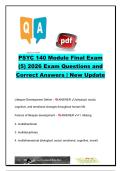
PSYC 140 Module Final Exam
(5) 2026 Exam Questions and
Correct Answers | New Update


Lifespan Development Define - ANSWER ✔✔physical, social,

cognitive, and emotional changes throughout human life


Factors of lifespan development - ANSWER ✔✔1. lifelong


2. multidirectional

3. multidisciplinary

4. multidimensional (biological, social, emotional, cognitive, moral)

,Maturation: adults ____, while children ____ - ANSWER ✔✔age,

grow


Nature - ANSWER ✔✔biological, genetic


people are BORN a specific way


Nurture - ANSWER ✔✔environmental, learned/influenced by others


people change based on surroundings - raising, human environment, etc


Continuous development - ANSWER ✔✔Various stages of

development gradually flow into one another


Can be difficult to determine when one stage starts and another starts


Behaviorists


Discontinuous development - ANSWER ✔✔Developmental stages

are distinct


One stage definitely ends before another begins

, Stage theorists


Sigmund Freud - ANSWER ✔✔Psychosexual stages of development


Proposed the id, ego, superego are what develop one's personality


Proposed 5 stages of development involving a conflict and fixation with

an area of the body associated with gratification/pleasure


Freud's 5 stages of development - ANSWER ✔✔1. Oral stage: birth-

18 months: relief from anxiety through oral gratification of needs


2. Anal stage: 18 months-3yoa: learning independence and control, with

focus on the excretory function


3. Phallic stage: 3-5yoa: identification with parent of same sex;

development of sexual identity; focus on genital organs


4. Latency stage: 5 years-puberty: sexuality is repressed; focus is on

relationships with same-sex peers


COPYRIGHT©JOSHCLAY 2025/2026. YEAR PUBLISHED 2026. COMPANY REGISTRATION NUMBER: 619652435. TERMS OF USE. PRIVACY
STATEMENT. ALL RIGHTS RESERVED
3

Escuela, estudio y materia

Institución
Grado

Información del documento

Subido en
25 de junio de 2026
Número de páginas
30
Escrito en
2025/2026
Tipo
Examen
Contiene
Preguntas y respuestas

Temas

$18.99
Accede al documento completo:

¿Documento equivocado? Cámbialo gratis Dentro de los 14 días posteriores a la compra y antes de descargarlo, puedes elegir otro documento. Puedes gastar el importe de nuevo.
Escrito por estudiantes que aprobaron
Inmediatamente disponible después del pago
Leer en línea o como PDF


Documento también disponible en un lote

Conoce al vendedor

Seller avatar
Los indicadores de reputación están sujetos a la cantidad de artículos vendidos por una tarifa y las reseñas que ha recibido por esos documentos. Hay tres niveles: Bronce, Plata y Oro. Cuanto mayor reputación, más podrás confiar en la calidad del trabajo del vendedor.
NinjaNerd Liberty University
Seguir Necesitas iniciar sesión para seguir a otros usuarios o asignaturas
Vendido
382
Miembro desde
2 año
Número de seguidores
6
Documentos
14835
Última venta
23 horas hace
NinjaNerd

Here You will All Documents and Package Deals Offered by Seller NinjaNerd.

3.5

74 reseñas

5
26
4
14
3
16
2
4
1
14

Por qué los estudiantes eligen Stuvia

Creado por compañeros estudiantes, verificado por reseñas

Calidad en la que puedes confiar: escrito por estudiantes que aprobaron y evaluado por otros que han usado estos resúmenes.

¿No estás satisfecho? Elige otro documento

¡No te preocupes! Puedes elegir directamente otro documento que se ajuste mejor a lo que buscas.

Paga como quieras, empieza a estudiar al instante

Sin suscripción, sin compromisos. Paga como estés acostumbrado con tarjeta de crédito y descarga tu documento PDF inmediatamente.

Student with book image

“Comprado, descargado y aprobado. Así de fácil puede ser.”

Alisha Student

Preguntas frecuentes
