

Escrito por estudiantes que aprobaron Inmediatamente disponible después del pago Leer en línea o como PDF ¿Documento equivocado? Cámbialo gratis 4,6 TrustPilot
logo-home
Document preview thumbnail
Vista previa 3 fuera de 27 páginas
Examen

NSG 533 Exam 2 Questions and Answers (250+ Genetics, Genomics, Hepatitis, NAFLD & Cancer Biology Q&A) | Mendelian Inheritance, Genetic Disorders, Hepatitis A–D, Nonalcoholic Fatty Liver Disease & Oncology Concepts | NSG 533 Advanced Pathophysiology 2026

Document preview thumbnail
Vista previa 3 fuera de 27 páginas

This comprehensive NSG 533 Exam 2 Questions and Answers study guide contains more than 250 exam-style questions, answers, and detailed rationales covering medical genetics, genomics, inheritance patterns, genetic disorders, chromosomal abnormalities, hepatitis pathophysiology, liver disease, nonalcoholic fatty liver disease (NAFLD), cancer biology, tumor genetics, and advanced pathophysiology concepts. The material is specifically designed to help nursing students master high-yield concepts frequently tested in NSG 533 examinations, advanced pathophysiology courses, graduate nursing programs, nurse practitioner curricula, and board-style assessments. The guide provides an extensive review of genetics and genomics, including genes, genomes, genetic variation, Mendelian inheritance patterns, autosomal dominant disorders, autosomal recessive disorders, X-linked inheritance, mitochondrial inheritance, genomic imprinting, uniparental disomy, chromosomal mutations, penetrance, anticipation, mosaicism, genotype-phenotype relationships, and epigenetics. Students learn to distinguish between major inheritance patterns while examining clinically significant genetic conditions such as cystic fibrosis, sickle cell disease, Tay-Sachs disease, Duchenne muscular dystrophy, Marfan syndrome, Huntington disease, Fragile X syndrome, Rett syndrome, hereditary hemochromatosis, and BRCA-associated cancers. Advanced concepts such as CRISPR gene editing, heterozygote advantage, pharmacogenetics, predictive testing, prenatal testing, and newborn genetic screening are also explored in detail. A major portion of the study material focuses on viral hepatitis and liver disease pathophysiology. Students review Hepatitis A (HAV), Hepatitis B (HBV), Hepatitis C (HCV), and Hepatitis D (HDV), including transmission routes, incubation periods, clinical manifestations, diagnostic laboratory markers, serologic interpretation, treatment strategies, vaccination recommendations, disease prevention, and long-term complications. Content includes interpretation of HBsAg, HBsAb, HBcAb, HCV antibody testing, PCR viral load analysis, fibrosis assessment, chronic hepatitis management, cirrhosis development, hepatocellular carcinoma risk, and current antiviral therapies. The material emphasizes clinical reasoning skills necessary for identifying, diagnosing, and managing infectious liver diseases in advanced nursing practice. The guide also delivers comprehensive coverage of nonalcoholic fatty liver disease (NAFLD) and nonalcoholic steatohepatitis (NASH), including epidemiology, disease progression, obesity-related pathogenesis, insulin resistance, metabolic syndrome, fibrosis development, diagnostic imaging, liver biopsy interpretation, elastography, fibrosis scoring systems, pediatric NAFLD, and evidence-based treatment strategies. Students examine the relationship between obesity, type 2 diabetes mellitus, dyslipidemia, metabolic syndrome, and progressive liver injury while reviewing pharmacologic and lifestyle interventions used to reduce fibrosis and prevent progression to cirrhosis and hepatocellular carcinoma. Additional content focuses on cancer biology and molecular oncology, including tumor suppressor genes, proto-oncogenes, oncogenes, genomic instability, metastasis, invasion, anaplasia, retinoblastoma, TP53 mutations, immune evasion mechanisms, carcinoma in situ, cancer metabolism, hereditary cancer syndromes, and the molecular basis of tumor development. Students gain a deeper understanding of cellular transformation, cancer progression, genetic susceptibility, and pathophysiologic mechanisms that drive malignant disease. The question-and-answer format promotes active recall, critical thinking, and exam readiness while reinforcing concepts essential for advanced nursing education and clinical practice. Academic References: McCance, K. L., & Huether, S. E. (2024). Pathophysiology: The Biologic Basis for Disease in Adults and Children (10th Edition). Elsevier. Copstead, L. C., & Banasik, J. L. (2024). Pathophysiology (7th Edition). Elsevier. Lewis, S. M., Bucher, L., Heitkemper, M. M., Harding, M. M., Kwong, J., & Roberts, D. (2024). Medical-Surgical Nursing: Assessment and Management of Clinical Problems (12th Edition). Elsevier. Kumar, V., Abbas, A. K., & Aster, J. C. (2025). Robbins & Cotran Pathologic Basis of Disease (11th Edition). Elsevier. Kliegman, R. M., St. Geme, J. W., Blum, N. J., Shah, S. S., Tasker, R. C., & Wilson, K. M. (2024). Nelson Textbook of Pediatrics (22nd Edition). Elsevier. National Human Genome Research Institute (NHGRI). Genetics and Genomics Educational Resources. American Association for the Study of Liver Diseases (AASLD). Hepatitis and NAFLD Clinical Practice Guidelines. Relevant Students: This resource is ideal for NSG 533 students, Advanced Pathophysiology students, Family Nurse Practitioner (FNP) students, Adult-Gerontology Nurse Practitioner (AGNP) students, Doctor of Nursing Practice (DNP) students, Master of Science in Nursing (MSN) students, Advanced Practice Registered Nurse (APRN) students, Graduate Nursing students, Medical-Surgical Nursing students, Genetics students, Genomics students, Hepatology students, Oncology Nursing students, Nurse Practitioner certification candidates, Pathophysiology examination candidates, Public Health students, Healthcare professionals, and nursing students preparing for advanced nursing examinations, board certification assessments, and clinical practice. Keywords NSG 533, NSG 533 Exam 2, advanced pathophysiology, genetics, genomics, gene expression, genome, Mendelian inheritance, autosomal dominant, autosomal recessive, X linked dominant, X linked recessive, mitochondrial inheritance, genomic imprinting, uniparental disomy, chromosomal mutations, deletion mutation, duplication mutation, inversion mutation, translocation mutation, substitution mutation, penetrance, anticipation, mosaicism, genotype, phenotype, epigenetics, CRISPR, gene editing, pharmacogenetics, heterozygote advantage, prenatal testing, newborn screening, cystic fibrosis, CFTR gene, sickle cell disease, HBB gene, Tay Sachs disease, HEXA gene, Duchenne muscular dystrophy, DMD gene, Marfan syndrome, Huntington disease, Fragile X syndrome, Rett syndrome, hereditary hemochromatosis, BRCA1, BRCA2, hepatitis A, HAV, hepatitis B, HBV, hepatitis C, HCV, hepatitis D, HDV, liver disease, cirrhosis, hepatocellular carcinoma, HCC, viral hepatitis, liver fibrosis, HBsAg, HBsAb, HBcAb, HCV antibody, HCV PCR, elastography, NAFLD, nonalcoholic fatty liver disease, NASH, nonalcoholic steatohepatitis, metabolic syndrome, obesity, insulin resistance, type 2 diabetes, liver biopsy, fibrosis score, hepatology, oncology, cancer biology, tumor suppressor genes, oncogenes, proto oncogenes, retinoblastoma, RB1, TP53, genomic instability, metastasis, invasion, anaplasia, carcinoma in situ, cancer pathophysiology, nursing exam review, graduate nursing exam preparation

Vista previa del contenido

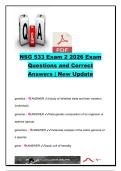
NSG 533 Exam 2 2026 Exam
Questions and Correct
Answers | New Update


genetics - ANSWER ✔✔study of inherited traits and their variation

(individual)


genome - ANSWER ✔✔total genetic composition of an organism or

species (group)


genomics - ANSWER ✔✔molecular analysis of the entire genome of

a species


gene - ANSWER ✔✔basic unit of heredity

,list the four types of mendelian inheritance - ANSWER ✔✔1.

autosomal dominant

2. autosomal recessive

3. X-linked dominant

4. X-linked recessive


autosomal dominant - ANSWER ✔✔- phenotype is expressed in

those who have 1 copy of a gene mutation


- mothers and fathers are equally likely to transmit or inherit the disorder


- seen in multiple generations


autosomal recessive - ANSWER ✔✔- requires presence of 2 copies

of a gene mutation in order to express phenotype


- usually seen in a single generation


- mothers/fathers equally likely to transmit or inherit disorder

, X-linked dominant - ANSWER ✔✔- dominant disorder caused by a

mutation in a gene on the X chromosome


- heterozygous female (XAXa) and hemizygous male (XAY)


- affected males have more severe phenotype


X-Linked Recessive - ANSWER ✔✔mutation on gene in X

chromosome causes phenotype to be expressed in hemizygous males

(XaY) and homozygous females (XaXa)


types of X-linked recessive disorders - ANSWER ✔✔1. duchene

muscular dystrophy

2. hemophilia

3. color blindness


examples of X-Linked dominant disorders - ANSWER ✔✔1. Fragile X

syndrome

2. Rett syndrome


examples of Autosomal Dominant disorders - ANSWER ✔✔-Marfan

syndrome


COPYRIGHT©NINJANERD 2025/2026. YEAR PUBLISHED 2026. COMPANY REGISTRATION NUMBER: 619652435. TERMS OF USE. PRIVACY
STATEMENT. ALL RIGHTS RESERVED
3


Información del documento

Subido en
24 de junio de 2026
Número de páginas
27
Escrito en
2025/2026
Tipo
Examen
Contiene
Preguntas y respuestas
$18.99

¿Documento equivocado? Cámbialo gratis Dentro de los 14 días posteriores a la compra y antes de descargarlo, puedes elegir otro documento. Puedes gastar el importe de nuevo.
Escrito por estudiantes que aprobaron
Inmediatamente disponible después del pago
Leer en línea o como PDF

Seller avatar
Los indicadores de reputación están sujetos a la cantidad de artículos vendidos por una tarifa y las reseñas que ha recibido por esos documentos. Hay tres niveles: Bronce, Plata y Oro. Cuanto mayor reputación, más podrás confiar en la calidad del trabajo del vendedor.
NinjaNerd
3.5
(75)
Vendido
391
Seguidores
6
Artículos
15109
Última venta
2 días hace


Por qué los estudiantes eligen Stuvia

Creado por compañeros estudiantes, verificado por reseñas

Calidad en la que puedes confiar: escrito por estudiantes que aprobaron y evaluado por otros que han usado estos resúmenes.

¿No estás satisfecho? Elige otro documento

¡No te preocupes! Puedes elegir directamente otro documento que se ajuste mejor a lo que buscas.

Paga como quieras, empieza a estudiar al instante

Sin suscripción, sin compromisos. Paga como estés acostumbrado con tarjeta de crédito y descarga tu documento PDF inmediatamente.

Student with book image

“Comprado, descargado y aprobado. Así de fácil puede ser.”

Alisha Student

Preguntas frecuentes