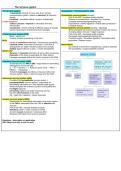
The nervous system
The nervous system: Sympathetic + Parasympathetic state
- A specialised network of nerve cells & our primary
communication system / based on electrical (& chemical) Sympathetic nervous system (arousal)
signals - Part of the ANS / increases bodily activities
- Localised + immediate effects / works in milliseconds - Release of noradrenaline / activates f-or-f response
2 main functions: - Increases heart/sweating/breathing rate
- Collect / process / respond to information from the - Pupil dilation / Inhibits digestion / Inhibits saliva production /
environment Contracts rectum
- Coordinates / directs working of different organs & muscles Parasympathetic nervous system (resting + digesting)
via the transmission of electrochemical messages - Works alongside the endocrine system to return the body to
its resting state in the rest + digest response
Central nervous system (CNS) - Part of the ANS / decreases bodily activities
- Brain + spinal cord - Decreases heart/sweating/breathing rate
- Involves complex processing in the brain - Constricts pupils / Stimulates digestion / Stimulates saliva
Brain production / Relaxes rectum
- Centre of conscious awareness + unconscious processing
- Cerebral cortex: outer layer of the brain, 3 mm thick & Homeostasis
distinguishes our higher mental functions from animals - Our internal environment is regulated by a balance between
(folded) against Skinner’s claim. / 2 main hemispheres the sympathetic + parasympathetic systems
Spinal cord
- Receives + transmits information & some reflex processing.
Extension of the brain & responsible for reflex actions
- Passages messages to/from the brain/ connects to the PNS
Peripheral nervous system (PNS)
- Subdivided into the ANS + SNS / responsible for transmitting
messages to & from the CNS
- S → R → Sensory n → Relay (in spinal cord) → Motor →
Effector → Response
- Transmits messages via millions of neurons to/from the
nervous system / motor n take info away from the CNS
Autonomic nervous system (ANS)
- Consists of the sympathetic nervous system +
parasympathetic nervous system / responsible for
transmitting information to + from internal bodily organs
- Works alongside the endocrine system to bring about the
f-or-flight response
- Involuntary system (not under conscious control)
- Governs vital functions in the body
- EG - heart rate / digestion / stress responses
Somatic nervous system (SNS)
- Responsible for transmitting information from sense organs
to the CNS & information from the CNS to effectors like
muscles
- Part of the PNS / controls skeletal musicals
- Voluntary system / under conscious control
- Governs muscle movement / conscious effort
- Receives information from sensory receptors
Questions - descriptive or application
(99% likely to be ao1 or ao2, no ao3)
, The endocrine system
The endocrine system: Endocrine + ANS → Fight or flight response
- Secretes hormones required to regulate many bodily functions - Often work in parallel in response to stressors
- Provides a chemical system of communication via the blood - 2 types of stressor: acute (short-term) / chronic
stream (long-term)
- Slower (seconds) than the nervous system
- Widespread / more powerful effects Fight or flight response SH SNS AA NE
- Generated by the sympathetic branch of the ANS
1. Stressor → Hypothalamus stimulates the SNS
Glands 2. SNS stimulates the adrenal medulla to release
- Organs that produce hormones adrenaline into the bloodstream & noradrenaline
Pituitary gland (The ‘master’ gland) released
- Controls the release of hormones from all other glands in the 3. Generalised effects (increased heart/breathing rate,
body etc)
- Produces ACTH / involved in the stress response by (POST-THREAT)
stimulating the production + release of cortisol from the 4. Parasympathic nervous system acts as a ‘brake’,
adrenal glands returning the body to resting state once the stressor
Hypothalamus has passed / increases action of the sympathetic
- Produces CRH / Links the nervous system to the endocrine branch (rest & digest function)
system
Pineal Gland Fight or flight symptoms
- Produces Melatonin / Modulates sleep pattern, keeping the - Increased heart rate / pupil dilation / decreased saliva
body to a day/night rhythm production
Thyroid gland - Immediate & automatic - instant when a threat is
- Produces Thyroxine / aids heart & digestive functioning / perceive
regulating metabolism (rate of energy use in the body) / brain Previous q’s are all ao2
development
Thymus gland
- Produces Thymosin / Stimulates the development of T cells
in the immune system
Pancreas
- Produces Insulin / Regulates blood-sugar levels
Adrenal Glands
- Produces Adrenaline / triggers the fight-or-flight response /
increases heart/breathing rate, etc
Testicles + Ovaries
- Produces Oestrogen / controls the development of female
physical features / female genitalia / breast development /
menstruation
- Produces Testosterone / controls development of male
physical features / facial + body hair growth / deepening of the
voice / sex drive + sperm production
Hormones
- A chemical messenger that circulates in the blood
- Controls how cells/organs work, influencing behaviour or
mood
- Secreted in the bloodstream / affect any cell in the body that
has a receptor for that specific hormone
Eg - thyroxine
- Produced by the thyroid gland / affects cells in the heart &
throughout the body
- Increases metabolic rates & affects growth rates
Neurons / Synaptic transmission (ao1)
The nervous system: Sympathetic + Parasympathetic state
- A specialised network of nerve cells & our primary
communication system / based on electrical (& chemical) Sympathetic nervous system (arousal)
signals - Part of the ANS / increases bodily activities
- Localised + immediate effects / works in milliseconds - Release of noradrenaline / activates f-or-f response
2 main functions: - Increases heart/sweating/breathing rate
- Collect / process / respond to information from the - Pupil dilation / Inhibits digestion / Inhibits saliva production /
environment Contracts rectum
- Coordinates / directs working of different organs & muscles Parasympathetic nervous system (resting + digesting)
via the transmission of electrochemical messages - Works alongside the endocrine system to return the body to
its resting state in the rest + digest response
Central nervous system (CNS) - Part of the ANS / decreases bodily activities
- Brain + spinal cord - Decreases heart/sweating/breathing rate
- Involves complex processing in the brain - Constricts pupils / Stimulates digestion / Stimulates saliva
Brain production / Relaxes rectum
- Centre of conscious awareness + unconscious processing
- Cerebral cortex: outer layer of the brain, 3 mm thick & Homeostasis
distinguishes our higher mental functions from animals - Our internal environment is regulated by a balance between
(folded) against Skinner’s claim. / 2 main hemispheres the sympathetic + parasympathetic systems
Spinal cord
- Receives + transmits information & some reflex processing.
Extension of the brain & responsible for reflex actions
- Passages messages to/from the brain/ connects to the PNS
Peripheral nervous system (PNS)
- Subdivided into the ANS + SNS / responsible for transmitting
messages to & from the CNS
- S → R → Sensory n → Relay (in spinal cord) → Motor →
Effector → Response
- Transmits messages via millions of neurons to/from the
nervous system / motor n take info away from the CNS
Autonomic nervous system (ANS)
- Consists of the sympathetic nervous system +
parasympathetic nervous system / responsible for
transmitting information to + from internal bodily organs
- Works alongside the endocrine system to bring about the
f-or-flight response
- Involuntary system (not under conscious control)
- Governs vital functions in the body
- EG - heart rate / digestion / stress responses
Somatic nervous system (SNS)
- Responsible for transmitting information from sense organs
to the CNS & information from the CNS to effectors like
muscles
- Part of the PNS / controls skeletal musicals
- Voluntary system / under conscious control
- Governs muscle movement / conscious effort
- Receives information from sensory receptors
Questions - descriptive or application
(99% likely to be ao1 or ao2, no ao3)
, The endocrine system
The endocrine system: Endocrine + ANS → Fight or flight response
- Secretes hormones required to regulate many bodily functions - Often work in parallel in response to stressors
- Provides a chemical system of communication via the blood - 2 types of stressor: acute (short-term) / chronic
stream (long-term)
- Slower (seconds) than the nervous system
- Widespread / more powerful effects Fight or flight response SH SNS AA NE
- Generated by the sympathetic branch of the ANS
1. Stressor → Hypothalamus stimulates the SNS
Glands 2. SNS stimulates the adrenal medulla to release
- Organs that produce hormones adrenaline into the bloodstream & noradrenaline
Pituitary gland (The ‘master’ gland) released
- Controls the release of hormones from all other glands in the 3. Generalised effects (increased heart/breathing rate,
body etc)
- Produces ACTH / involved in the stress response by (POST-THREAT)
stimulating the production + release of cortisol from the 4. Parasympathic nervous system acts as a ‘brake’,
adrenal glands returning the body to resting state once the stressor
Hypothalamus has passed / increases action of the sympathetic
- Produces CRH / Links the nervous system to the endocrine branch (rest & digest function)
system
Pineal Gland Fight or flight symptoms
- Produces Melatonin / Modulates sleep pattern, keeping the - Increased heart rate / pupil dilation / decreased saliva
body to a day/night rhythm production
Thyroid gland - Immediate & automatic - instant when a threat is
- Produces Thyroxine / aids heart & digestive functioning / perceive
regulating metabolism (rate of energy use in the body) / brain Previous q’s are all ao2
development
Thymus gland
- Produces Thymosin / Stimulates the development of T cells
in the immune system
Pancreas
- Produces Insulin / Regulates blood-sugar levels
Adrenal Glands
- Produces Adrenaline / triggers the fight-or-flight response /
increases heart/breathing rate, etc
Testicles + Ovaries
- Produces Oestrogen / controls the development of female
physical features / female genitalia / breast development /
menstruation
- Produces Testosterone / controls development of male
physical features / facial + body hair growth / deepening of the
voice / sex drive + sperm production
Hormones
- A chemical messenger that circulates in the blood
- Controls how cells/organs work, influencing behaviour or
mood
- Secreted in the bloodstream / affect any cell in the body that
has a receptor for that specific hormone
Eg - thyroxine
- Produced by the thyroid gland / affects cells in the heart &
throughout the body
- Increases metabolic rates & affects growth rates
Neurons / Synaptic transmission (ao1)