1
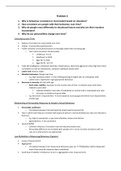
Problem 6
1. Why is behaviour consistent or inconsistent based on situations?
2. How consistent are people with their behaviour over time?
3. Why do people react differently to situational factors and why are their reactions
inconsistent?
4. Why do our personalities change over time?
Consistency over Time
Degree of consistency in personality over time
Studies → personality ques onnaires
Profile similarity: personality becomes increasingly stable with increasing age
o Test-retest correlation of personality
Childhood → 0.31
Adulthood → 0.54
Age 30 → 0.64
Age 50-70 → 0.74
Traits like intelligence, emotional reactivity, impulsiveness, shyness & aggression show high test-retest
correlations as well as extraversion, sensation seeking & activity level
Latent trait remains stable
Manifest behaviour change over time
o E.g. high sensation seeker → rock climbing (young) & higher bets at card games (old)
o Latent trait is expressed in age appropriate behaviour
Decrease in intensity of traits with age
o Rank-order stability: decrease in trait at same rate of time → maintain same rank order
related to each other
indicates whether rank order of individuals on certain trait is maintained over time
Increases as adolescents grow older
o E.g. decrease in impulsiveness → most impulsive at young age will s ll be most impulsiveness
at older age
Relationship of Personality Measures to People’s Actual Behaviour
Personality coefficient
o Correlation between trait self-report & actual reports (around 0.3)
Test is valid if trait measure correlate with aspect of person’s real-world behaviour that are relevant to
that trait
o E.g. high in neuroticism → pay more a en on, show more distress
o Agreeableness → less alcoholism
Caspi & Moffitt
o Common influence of situation may override personality traits
o Personality difference are revealed when people are in novel, stressful transitions with no
cues as to what actions are appropriate
Low Reliability in Measuring Behaviour (Epstein)
Issues of measurement
Aggregation
o Correlation between trait measures & behaviour goes up → if behaviour were measured
more than once & measure were combined
Good deal of stability in behaviour once it is aggregated across measurements
, 2
Change in Personality with Age
Everyone experiences increasement in maturity
Decline → neuro cism & openness to experience
Increase → conscien ousness & agreeableness
Personality can change due to major life change (e.g. new career, chronical illness, role
demands mother)
People make life choices that enhances already existent traits
o E.g. highly extraverted person → career with social ac vity
Consistency across Situations
Personality traits are average tendencies to behave in certain ways
o E.g. sociable person is expected to be sociable during different situations
Particular situations influence to what extent someone express that trait
o E.g. more conscientious when having time to plan ≠ less conscientious under time pressure
Study by Hartshorne & May (1928)
o Watch student’s honesty at summer camp → whether they cheated at several situa ons
o Correlations between honesty measure in two situations was low
Situationism (Mischel)
o Situational differences determine behaviour
o E.g. young woman is friendly to her friends, but reserved with strangers
o Explanations of exceptional people (Bill Gates, etc.)
Exceptional things happen when chance situations meet the prepared person
Right situations happen to people with right personal characteristics to produce
exceptional outcome
Person-Situation Interaction / Interactionism
Two possible explanations for behaviour
o Behaviour is function of personality traits → B = f (P) (personality psychology)
o Behaviour is function of situational forces → B = f (S) (social psychology)
Person-situation interaction
o Interaction between personality & situational forces
o Take particular situations & personality traits into account
Problem 6
1. Why is behaviour consistent or inconsistent based on situations?
2. How consistent are people with their behaviour over time?
3. Why do people react differently to situational factors and why are their reactions
inconsistent?
4. Why do our personalities change over time?
Consistency over Time
Degree of consistency in personality over time
Studies → personality ques onnaires
Profile similarity: personality becomes increasingly stable with increasing age
o Test-retest correlation of personality
Childhood → 0.31
Adulthood → 0.54
Age 30 → 0.64
Age 50-70 → 0.74
Traits like intelligence, emotional reactivity, impulsiveness, shyness & aggression show high test-retest
correlations as well as extraversion, sensation seeking & activity level
Latent trait remains stable
Manifest behaviour change over time
o E.g. high sensation seeker → rock climbing (young) & higher bets at card games (old)
o Latent trait is expressed in age appropriate behaviour
Decrease in intensity of traits with age
o Rank-order stability: decrease in trait at same rate of time → maintain same rank order
related to each other
indicates whether rank order of individuals on certain trait is maintained over time
Increases as adolescents grow older
o E.g. decrease in impulsiveness → most impulsive at young age will s ll be most impulsiveness
at older age
Relationship of Personality Measures to People’s Actual Behaviour
Personality coefficient
o Correlation between trait self-report & actual reports (around 0.3)
Test is valid if trait measure correlate with aspect of person’s real-world behaviour that are relevant to
that trait
o E.g. high in neuroticism → pay more a en on, show more distress
o Agreeableness → less alcoholism
Caspi & Moffitt
o Common influence of situation may override personality traits
o Personality difference are revealed when people are in novel, stressful transitions with no
cues as to what actions are appropriate
Low Reliability in Measuring Behaviour (Epstein)
Issues of measurement
Aggregation
o Correlation between trait measures & behaviour goes up → if behaviour were measured
more than once & measure were combined
Good deal of stability in behaviour once it is aggregated across measurements
, 2
Change in Personality with Age
Everyone experiences increasement in maturity
Decline → neuro cism & openness to experience
Increase → conscien ousness & agreeableness
Personality can change due to major life change (e.g. new career, chronical illness, role
demands mother)
People make life choices that enhances already existent traits
o E.g. highly extraverted person → career with social ac vity
Consistency across Situations
Personality traits are average tendencies to behave in certain ways
o E.g. sociable person is expected to be sociable during different situations
Particular situations influence to what extent someone express that trait
o E.g. more conscientious when having time to plan ≠ less conscientious under time pressure
Study by Hartshorne & May (1928)
o Watch student’s honesty at summer camp → whether they cheated at several situa ons
o Correlations between honesty measure in two situations was low
Situationism (Mischel)
o Situational differences determine behaviour
o E.g. young woman is friendly to her friends, but reserved with strangers
o Explanations of exceptional people (Bill Gates, etc.)
Exceptional things happen when chance situations meet the prepared person
Right situations happen to people with right personal characteristics to produce
exceptional outcome
Person-Situation Interaction / Interactionism
Two possible explanations for behaviour
o Behaviour is function of personality traits → B = f (P) (personality psychology)
o Behaviour is function of situational forces → B = f (S) (social psychology)
Person-situation interaction
o Interaction between personality & situational forces
o Take particular situations & personality traits into account