1
Problem 1
1. How does our unconsciousness affect our behaviour?
2. How do internal factors influence decision making?
3. What does the Freudian model say about the mind?
Fundaments of Freud
• Psychic energy motivates all human behaviour
• Operates according to law of conservation of energy
o Amount of psychic energy an individual possess is constant throughout his lifetime
Topographical Model of Mind
• The mind has three regions
o Conscious
§ Thoughts, feelings & behaviour that one is aware of
o Preconscious
§ Memories
§ Can be brought back into conscious
o Unconscious
§ Source of desire, urges, feelings, ideas connected to conflict, pain
§ Not accessible to conscious to protect one from one’s troubling thoughts
§ Largest part of the human mind
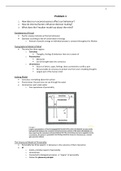
Iceberg Model
• Conscious: everything above the surface
• Preconscious: the part one can see through the water
• Unconscious: part under water
o Core operations of personality
The Structural Model of Personality
• Personality has three aspects → behaviour is the outcome of their interaction
• Id
o Innate, primitive aspect of personality
o Unconscious
o Connected to biological processes → “engine” of personality
o Follow the pleasure principle
, 2
§ all needs should be satisfied
§ Unsatisfied needs create state of tension
o Satisfies needs with primary process
§ Forming an unconscious mental image of an object that provides satisfaction for the
need
→experience is called wish fulfilment
• Ego
oDevelops within age of 2-3
oEvolves from the id & utilizes id’s energy for its own use
oMediates between desire of id & restrictions of external world
oFollow the reality principle
§ Takes external reality & internal needs into account
§ Makes sure id’s impulses are expressed effectively without causing any danger
§ Delays discharge of id’s tension until appropriate context or object is found
o Uses the secondary process:
§ Development of strategies for solving problems & obtaining satisfaction
§ Matching the unconscious image to tension-reducing object to a real object
§ Until such an object is present → keeps tension in check
o Source of intellectual processes & problem solving
o Reality testing
§ Forms plans to satisfy needs & tests them beforehand mentally for efficiency
o Pragmatic & no moral sense
o Ego strength: ability to deal with desire of id & morals of superego (should be balanced)
• Superego
o Develops while resolving a conflict during development
o Develop around age of 5
o Embodiment of parental & societal values
§ To obtain parents love, child avoids things that parents dismiss & keep things that
parents appreciate
o Is not bound by reality
o Introjection: incorporation of parental values
o Divided into two subsystems
1. Ego ideal: compromises rules for behaviour that parents approve
2. Conscience: compromises riles for behaviour that is disapproved
Ø Disapproved behaviour causes feelings of guilt
o Three goals
§ Tries to prevent disapproved behaviour
§ Tries to force ego to act morally
§ Tries to guide one towards perfection in thought, word & act
Drives of personality
• People are energy systems which energy is used in psychological work & released through biological
processes
• Source of psychic energy are instincts
• Drive has two parts: biological need & psychological representation
• Eros: life or sexual instincts
o Life-sustaining, pleasure-oriented urges
o Libido: energy of life instinct
• Thanatos: death instincts
o Urge to destroy, harm, or aggress against others or oneself
o Humans have a fundamental instinct towards destruction
o Expression of death instincts is held back by life instincts
o Creates tension → results on aggression
• Energy used to direct one type of behaviour is not available to drive other types of behaviour
o Person directing death instinct into sports, has less energy to direct instinct towards another
object, person
Problem 1
1. How does our unconsciousness affect our behaviour?
2. How do internal factors influence decision making?
3. What does the Freudian model say about the mind?
Fundaments of Freud
• Psychic energy motivates all human behaviour
• Operates according to law of conservation of energy
o Amount of psychic energy an individual possess is constant throughout his lifetime
Topographical Model of Mind
• The mind has three regions
o Conscious
§ Thoughts, feelings & behaviour that one is aware of
o Preconscious
§ Memories
§ Can be brought back into conscious
o Unconscious
§ Source of desire, urges, feelings, ideas connected to conflict, pain
§ Not accessible to conscious to protect one from one’s troubling thoughts
§ Largest part of the human mind
Iceberg Model
• Conscious: everything above the surface
• Preconscious: the part one can see through the water
• Unconscious: part under water
o Core operations of personality
The Structural Model of Personality
• Personality has three aspects → behaviour is the outcome of their interaction
• Id
o Innate, primitive aspect of personality
o Unconscious
o Connected to biological processes → “engine” of personality
o Follow the pleasure principle
, 2
§ all needs should be satisfied
§ Unsatisfied needs create state of tension
o Satisfies needs with primary process
§ Forming an unconscious mental image of an object that provides satisfaction for the
need
→experience is called wish fulfilment
• Ego
oDevelops within age of 2-3
oEvolves from the id & utilizes id’s energy for its own use
oMediates between desire of id & restrictions of external world
oFollow the reality principle
§ Takes external reality & internal needs into account
§ Makes sure id’s impulses are expressed effectively without causing any danger
§ Delays discharge of id’s tension until appropriate context or object is found
o Uses the secondary process:
§ Development of strategies for solving problems & obtaining satisfaction
§ Matching the unconscious image to tension-reducing object to a real object
§ Until such an object is present → keeps tension in check
o Source of intellectual processes & problem solving
o Reality testing
§ Forms plans to satisfy needs & tests them beforehand mentally for efficiency
o Pragmatic & no moral sense
o Ego strength: ability to deal with desire of id & morals of superego (should be balanced)
• Superego
o Develops while resolving a conflict during development
o Develop around age of 5
o Embodiment of parental & societal values
§ To obtain parents love, child avoids things that parents dismiss & keep things that
parents appreciate
o Is not bound by reality
o Introjection: incorporation of parental values
o Divided into two subsystems
1. Ego ideal: compromises rules for behaviour that parents approve
2. Conscience: compromises riles for behaviour that is disapproved
Ø Disapproved behaviour causes feelings of guilt
o Three goals
§ Tries to prevent disapproved behaviour
§ Tries to force ego to act morally
§ Tries to guide one towards perfection in thought, word & act
Drives of personality
• People are energy systems which energy is used in psychological work & released through biological
processes
• Source of psychic energy are instincts
• Drive has two parts: biological need & psychological representation
• Eros: life or sexual instincts
o Life-sustaining, pleasure-oriented urges
o Libido: energy of life instinct
• Thanatos: death instincts
o Urge to destroy, harm, or aggress against others or oneself
o Humans have a fundamental instinct towards destruction
o Expression of death instincts is held back by life instincts
o Creates tension → results on aggression
• Energy used to direct one type of behaviour is not available to drive other types of behaviour
o Person directing death instinct into sports, has less energy to direct instinct towards another
object, person