Escrito por estudiantes que aprobaron Inmediatamente disponible después del pago Leer en línea o como PDF ¿Documento equivocado? Cámbialo gratis 4,6 TrustPilot
logo-home
Examen

Exam 4: NR 222/ NR222 (New 2026/ 2027 Update) Health and Wellness Guide |Questions & Answers| Grade A| (Accurate Solutions) 100% Correct - Chamberlain.

Puntuación
-
Vendido
-
Páginas
22
Grado
A+
Subido en
22-06-2026
Escrito en
2025/2026

Exam 4: NR 222/ NR222 (New 2026/ 2027 Update) Health and Wellness Guide |Questions & Answers| Grade A| (Accurate Solutions) 100% Correct - Chamberlain. Q. When teaching a patient how to control their blood sugar levels, what type of learning is this? ANSWER cognitive learning Q. What is the term for when a patient is not following instructions as given? ANSWER Non-Compliance Q. What is the first step in trying to achieve cultural competence? ANSWER Clarifying your own values Q. What is the highest accomplishment of health for people? ANSWER Health Equity Q. After teaching a patient something, what process has the nurse completed? ANSWER Developing learning objectives Q. If you want to teach a patient something, what must your first do? ANSWER Assess what the patient already knows (what is their learning level/learning capability) Q. Healthy eating habits; look for objective outcome in effective domain ANSWER patient verbalizes the value of healthy eating Q. What are 3 reasons in which you would cancel a teaching session with your patient? ANSWER 1. Patient's pain level is 10/10 2. Patient is crying and visibly upset 3. Patient has a high fever Before providing instruction to a patient, you need to assess for health literacy (what does the patient know about health?) Q. Term for group of interacting individuals by blood, marriage, cohabitation, adoption who independently perform relevant functions in individual roles ANSWER Family Q. When a patient says "let me understand this correctly", this is called ANSWER Clarifying Q. Example of a statement that blocks effective communication ANSWER Why do you always put so much salt on your food? Q. Determination phase of therapeutic relationship ANSWER requires to determine if client's needs are met and evaluating goal achievements with client Q. What type of family is this - Spouse, Children, Aunt, and Uncle ANSWER Extended Family Q. Rationale for using IS bar ANSWER it is a quick note you give to another nurse when handing off a patient to them. these notes are used to standardize communication. Q. Cultural Awareness ANSWER examining your own background Q. what is the last sense to go when communicating with an unresponsive patient? ANSWER hearing Q. When a patient is going into cardiac surgery and compares it to traffic trends and bypasses, this is called a what? ANSWER analogy Q. What kind of family is this - Spouse, my 15 year old, her 5 year old ANSWER Blended family Q. Accurate understanding of values. Values _____ over time. ANSWER Values evolve over time. Values are NOT static. Q. Purpose of patient records ownership of the patient record ANSWER - medical record is the property of the health care facility but the patient has the rights to access its contents Q. Purpose of Medical Record ANSWER Communication Legal documentation Auditing/monitoring Education Reimbursement Research Q. The 5 C's of exceptions to confidentiality ANSWER Consent court order continued treatment compliance communication Q. HIPPA Health Insurance Portability and Accountability Act ANSWER - protect patient information Q. Penalties ANSWER 4 tiers Q. guidelines for quality documentation ANSWER Factual Accurate Appropriate use of abbreviations Complete Current Organized Q. Medical record contains ANSWER Personal information, financial information, medical information and social information Q. Narritve ANSWER involves writing information about the patient and patient care in chronologic order Q. PIE charting ANSWER (Assessment) Problem statement Intervention Evaluation Ex. P- pt reports pain 7/10 on 0/10 scale I- given morphine 1mg IV at 23:35 E- pt reports pain as 1/10 at 23:55 Q. Focus Charting ANSWER data action response Q. Charting by exception ANSWER use of predetermined standards and norms to record ONLY significant assessment data Q. Case management process ANSWER method to organizing care through an illness using critical pathway Q. SBAR ANSWER Situation Background Assessment Recommendation Q. Why use SBAR? ANSWER To reduce the barrier to effective communication across different disciplines and levels of staff. SBAR creates a shared mental model around all patient handoffs and situations requiring escalation, or critical exchange of information (handovers) SBAR is memory prompt; easy to remember and encourages prior preparation for communication SBAR reduces the incidence of missed communications Q. telephone orders ANSWER not valid until signature WRITE it down READ it back get CONFIRMation Q. incident report ANSWER means of identifying risk situations and improving client care should not be copied or placed in pt chart make no reference in the pt chart communication a process of sharing information using a set of common rules emotional intelligence the ability to identify our own emotions and those of others, to self-motivate ourselves and know how to monitor our emotions and those of the people around us. critical thinking helps nurses.. overcome perceptual biases or stereotypes that interfere with accurately perceiving and interpreting messages from others the 5 levels of communication 1. intrapersonal 2. interpersonal 3. small group 4. public 5. mass intrapersonal communication communication with yourself interpersonal communication communication between two people words voice tone body language small group communication small number of people face to face interaction public communication a group of people mass communication communication that required technology circular transactional model each person in the communication interaction is both a speaker anda listener and can be simultaneously sending and receiving messages verbal communication Vocabulary Denotative & Connotative Meaning Pacing Intonation Clarity & Brevity Timing & Relevance nonverbal communication Personal Appearance Posture & Gait Facial Expression Eye Contact Gestures Sounds Territoriality & Personal Space zones of personal space intimate, personal, social, public intimate distance 0-18 inches bathing, holding a baby personal distance 18 inches to 4 feet sitting at patient's bedside social distance 4-12 feet giving directions to visitors in the hallway public distance 12 feet and more speaking at a community forum Special Zones of Touch social, consent, vulnerable, intimate social zone (Permission Not Needed) Hands Arms Shoulders Back consent zone (permission needed) mouth wrists feet vulnerable zone (special care needed) face neck front of body intimate zone (permission and great sensitivity needed) genitalia rectum List interpersonal skills *Verbal Communication - What we say and how we say it. *Non-Verbal Communication - What we communicate without words, body language is an example. *Listening Skills - How we interpret both the verbal and non-verbal messages sent by others. *Negotiation - Working with others to find a mutually agreeable outcome. *Problem Solving - Working with others to identify, define and solve problems. *Decision Making - Exploring and analysing options to make sound decisions. *Assertiveness - Communicating our values, ideas, beliefs, opinions, needs and wants freely. Stickley's Model for Non-Verbal Communication Sit at an angle to the client uncross arms and legs relax eye contact touch your intuition STUDY THERAPEUTIC AND NON-THERAPEUTIC COMMUNICATION motivational interviewing Resist telling them what to do Understand their motivation Listen with empathy Empower them elements of professional communication courtesy, use of names, trustworthiness, autonomy and responsibility, assertiveness the 7C's of effective communication Clarity consideration correct complete consideration concrete courteous factors influencing communication -psychophysiological context -relational context -situational context -environmental context -cultural context Erikson's Psychosocial Theory age: trust versus mistrust Infancy, birth to one year Erikson's Psychosocial Theory age: autonomy versus shame and doubt Early childhood, one to three years Erikson's Psychosocial Theory age: initiative versus guilt Preschoolers, three to six years Erikson's Psychosocial Theory age: industry versus inferiority School-age, six to twelve years Erikson's Psychosocial Theory age: identity versus role confusion Adolescents, ages 12 to 20. Erikson's Psychosocial Theory age: Intimacy vs. Isolation Young adult, 20 to 35 years Erikson's Psychosocial Theory age: Generativity vs. Stagnation Middle adult, 35 to 65 years Erikson's Psychosocial Theory age: Integrity vs. Despair Older adult, 65 years and up Piaget's Cognitive Developmental Theory: Sensorimotor Object permanence, birth to 2 years Piaget's Cognitive Developmental Theory: pre-operational Magical thinking, egocentrism, animism, 2 to 7 years Piaget's Cognitive Developmental Theory: Concrete operational Reversibility, classification, conservation, 7 to 11 years Piaget's Cognitive Developmental Theory: Formal operational Early: egocentric thought, invulnerability Later: abstract thinking, 12 years and up Kohlberg's Theory of Moral Development: Level One Preconventional (younger than 6) Stage 1: Punishment & obedience Stage 2: Instrumental relativist & orientation Kohlberg's Theory of Moral Development: Level Two Conventional Level (7-11 years) Stage 3: Good boy-Nice girl orientation Stage 4: Society-maintaining orientation Kohlberg's Theory of Moral Development: Level Three Postconventional (11 years on) Stage 5: Social contract orientation Stage 6: Universal ethical principle orientation Effective communication skills reduce errors improve outcome increase client satisfaction Develop relationships Collect relevant data Provide education Interact during intervention Improve patient safety interpersonal relationships Both nurse and client must be equal participants in the communication partnership. Client responses are not always what we expect. Each client has specific communication needs. Some clients have specific learning and teaching needs, while others may have sensory perception impairments that need to be considered. More is communicated than meets the eye (and the ear). We must pay attention to the client's verbal and nonverbal communication When talking to clients at the bedside, provide for privacy by closing the door to the room and inquiring about any visitors who may be present Attitudes and Ethical Standards Attitudes that aid communication are curiosity, perseverance, self-confidence, and creativity. Each attitude motivates the nurse to learn more about the client and communicate effectively. For example, the nurse recognizes that the client does not understand the instructions and provides education in a different format. Perception of Communication Every time we receive communication, we process it using all five senses - sight, hearing, taste, touch, and smell. Our culture and education also influence our perception. For example, the client receives information by hearing, seeing, and feeling the nurse's caring and compassionate behavior. Therapeutic Relationship A therapeutic relationship is defined as one that helps and promotes trust and respect while nurturing faith and hope For example, by developing a trusting relationship, the nurse is able to help the client recover from illness. What, When, Where, Why, and How The nurse must continually decide what, when, where, why, and how to deliver information. The nurse must decide which techniques best apply to each situation and may experience fatigue and frustration. For example, teaching about breastfeeding to a client who has just found out her baby has a congenital heart defect may not be appropriate. Whereas, teaching a mother who has recently given birth how to breastfeed is timely. Non-Therapeutic Communication How are things going in school? Not so great. I've got a test and two papers due in the next ten days and my boss is calling every day to see if I could work more hours. I'm sure things will work out. They always do. I guess I'm worrying about nothing. I should just stop talking about it. Therapeutic Communication How are things going in school? Not so great. I've got a test and two papers due in the next ten days, and my boss is calling every day to see if I could work more hours. Tell me more about how you're feeling. Thank you so much for asking. It's so helpful to talk to someone. Standard 10. Communication Assesses one's own communication skills and effectiveness Demonstrates cultural humility, professionalism and respect when communicating Assesses communication ability, health literacy, resources, and preferences of the client Uses language translation resources appropriately Incorporates alternative strategies to communicate effectively with clients who have visual, speech, language, or communication difficulties Uses communication styles and methods that demonstrate caring, respect, active listening, authenticity and trust Conveys accurate information Maintains communication with the interprofessional team to facilitate safe transitions and continuity in care delivery Confirms the recipient of the communication heard and understands the message Promotes safety in the practice environment by disclosing and reporting concerns related to potential or actual hazards or deviations from standards of care Demonstrates continuous improvement of communication skills Self-Talk Self-talk refers to your thoughts and inner communications that strongly influence your perceptions, feelings, behaviors, and self-esteem Small Group Small-group communication occurs when a small group collaborates. This type of communication is usually goal-oriented and requires an understanding of group dynamics. Small-group communication occurs when a small group collaborates. This type of communication is usually goal-oriented and requires an understanding of group dynamics. One-on-one interactions occur between a nurse and another person in a face-to-face manner Public Public communication is the interaction with a large audience. Electronic Electronic communication is the use of technology to create ongoing relationships with clients or the interprofessional team verbal communication vocabulary, meaning, pacing, intonation, clarity and brevity, and timing and relevance. Meaning Some words have different meanings depending on the context of their use Pacing Conversation should move at a comfortable pace and appropriate speed based on the information. Speak slowly and enunciate clearly Timing and Relevance Timing is critical in communication. If your message is poorly timed or irrelevant, communication is ineffective. Clarity and Brevity Effective communication is simple, brief, and direct. Often, fewer words are less confusing Intonation Tone of voice can dramatically alter the meaning and perception of a message. Is your tone conveying enthusiasm, anger, concern, or indifference? Is this your intention? Avoid sending unintended messages with your tone of voice. Vocabulary Communication is ineffective if senders and receivers cannot translate each other's words or phrases. When caring for a client who speaks a different language, use an interpreter Nonverbal communication includes our five senses and does not involve written or spoken words Eye Contact Posture and Gait Personal Space Appearance Facial Expression Gestures Sounds Therapeutic relationships promote purposeful and positive client change and growth achieves optimal personal growth forms positive relationships with others satisfies health needs achieves personal goals how many essential characteristics of a therapeutic relationship. Three Rapport is harmony and mutual fondness between people in a relationship. Empathy Empathy and another’s feelings without losing personal identity and perspective. Purpose means that the nurse focuses on communication toward a specific client-centered goal. Phases of the Therapeutic Relationship preinteraction, orientation, working, and termination preinteraction Begins when the nurse starts preparation for the initial interaction with a client and occurs before initial contact with the client. orientation Begins when the nurse and client meet for the first time. This is also called the introductory phase working Begins as the nurse and client collaborate as partners in promoting the client's health termination Marks the end of the relationship as it exists for the predefined purpose. Motivational interviewing communication technique that encourages clients to share their thoughts, beliefs, fears, and concerns in an effort to change behavior. Active listening Sit at an angle facing the client. Uncross your arms and legs relaxed and comfortable. Establish and maintain intermittent eye contact Use respectful and appropriate touch Trust your intuition Sharing Observations Example: “You seem tired today.” “I’ve noticed that you haven’t eaten much today.” Sharing Empathy Example: ”It must be very frustrating to want to walk independently but be unable to do so at this time.” Sharing Hope Example: “You are very courageous and strong. I believe you will find a way to cope with your current situation.” Sharing Humor Never joke about sexual orientation, race, economic status, disability, or cultural attributes Sharing Feelings Sharing your own emotions with clients can be appropriate in a variety of situations; however, be careful not to burden the client or break confidentiality. Sharing Information Example: ”Today you will have a chest x-ray, which takes a picture of your lungs to see if they are healing.” therapeutic communication strategies clarifying focusing paraphrasing validation asking relevant questions summarizing confrontation Review the presenta Asking personal questions are not relevant just to satisfy your curiosity is inappropriate in a professional setting. If clients wish to share private information, allow them to do so in their own time and in their own way. Non-therapeutic: “Why are you not married?” Therapeutic: “How would you describe your relationship with your partner?” Giving Personal Opinions When nurses offer personal opinions, it impedes the client’s decision-making ability. Now, personal opinions differ from professional advice. Often, clients need professional suggestions to help them make healthy choices. Suggestions are options for the client to accept or reject. Personal opinions can sway a client in one direction or another. Non-therapeutic: ”If I were you, I would put my son in daycare so I could return to work.” Therapeutic: “Let’s talk about which options are available to help you care for your son and continue to work.” Asking for Explanations Nurses are often tempted to ask clients why they believe, feel, or act a certain way. However, this is non-therapeutic. Clients often interpret a “why” question as an accusation or test of competence. Asking “why” questions causes resentment, insecurity, and mistrust. Non-therapeutic: “Why are you afraid to have surgery?” Therapeutic: “You seem scared. Tell me more about how you are feeling.” Negative Responses Automatic responses tend to result from stereotypes, which reflect poor nursing judgment Defensive Responses Nurses who become defensive when criticized imply that no one else’s opinion matters. Passive responses are used to avoid conflict. They reflect depression, sadness, or anxiety. For example, the client may state, “This diagnosis is so bad. There is nothing I can do about it. Arguing Challenging or arguing with a client is nonproductive and damaging to the relationship Changing the subject when someone is talking is considered rude and demonstrates a lack of empathy False reassurance discourages open communication. When reassurance is not supported by facts, it does more harm than good. Sympathy is concern, pity, or sorrow felt for another person. By expressing sympathy, the nurse takes on the client’s problems as if they were their own Offering approval or disapproval is not therapeutic. Nurses should not impose their own attitudes, values, beliefs, or moral standards on clients. Professional Appearance A professional nurse is expected to be clean, neat, well-groomed, and odor-free, which includes strong-smelling soaps and perfumes Professional Demeanor The nurse should appear warm, friendly, confident, and competent in all professional interactions. Nurses must speak in a clear voice, use grammatically correct language, and use good listening skills to help and support clients and colleagues. Finally, the nurse should be on time for all interactions, appear organized, be well-prepared, and equipped to manage professional communication. Elements of Professional Communication courteous, trustworthy, and autonomous. Courteous Practicing courtesy during professional communication means that you say hello and goodbye to clients and knock on doors before entering. We address people by their preferred names, pronouns, and titles and say please and thank you as appropriate. Trustworthy To be trustworthy means helping others without hesitation. For you to be trusted as a nurse, you must display consistency, reliability, honesty, competence, and respect. Autonomous Autonomy means being self-directed and independent in accomplishing goals and advocating for others. First or Last Name Typically, nurses first greet a client by using their preferred pronoun or title and last name. Once a relationship has been established, you may use the client's first name, if approved by the client Endearment Terms Avoid the use of endearment terms, such as "honey," "dear," "sweetheart," or "sweetie." The nurse-client relationship does not progress beyond the use of first names. Endearment terms are too personal for use in a professional environment. Using a Name Not a Diagnosis Never refer to a client by their diagnosis, room number, or other characteristic or physical attribute. To do so is demeaning and impersonal. AIDET ACKNOWLEDGE. Greet the client by name. INTRODUCE. Introduce yourself with your name, skill set, professional certification, and experience. DURATION. Give an accurate time expectation for procedures, medications, and discharge EXPLANATION. Explain step-by-step what to expect THANK YOU. Thank the client for choosing your hospital or for their communication and cooperation. Adapting Communication Techniques Hearing Loss Vision Loss Speaking Difficulty Cognitive Impairment Cultural Diversity Advantages of interprofessional collaboration reduced medical errors reduced inefficiencies and healthcare costs improved relationships and job satisfaction improved client care and outcomes Members of the Interprofessional Team Registered Dietitian Speech Therapist Occupational Therapist Physical Therapist Respiratory Therapist Social Worker Medical Provider Case Manager Standard 5A. Coordination of Care The registered nurse coordinates care delivery. This includes: Collaborating with the client and the interdisciplinary team to help manage healthcare based on mutually agreed-upon goals. Organizing the plan of care with input from the client and other professional team members. Managing the client's care to reach goals. Engaging clients in self-care to achieve goals for quality of life. Assisting the client to identify options for care and navigate the healthcare system. Communicating with clients, the professional team, and community-based resources to ensure safe transition and continuity of care. Advocating for the delivery of dignified and client-centered care. Documenting the coordination of care. Standard 11. Collaboration The registered nurse collaborates with the client and other members of the professional care team. This includes: Partnering with the client and the professional team to advocate for change leading to positive outcomes and quality care. Treating others with dignity and respect in all interactions. Valuing the expertise and contribution of other professionals. Using the unique and complementary abilities of all members of the team to achieve goals. Articulating the nurse's role and responsibilities within the professional team. Using appropriate tools and techniques to facilitate communication in a manner that protects dignity, respect, privacy, and confidentiality. Promoting engagement through consensus building and conflict management. Using effective group dynamics and strategies to enhance performance of the team. Partnering with the client and the professional team to create, implement, and evaluate plans of care. Role modeling the development of shared goals, clear roles, mutual trust, effective communication, efficient processes, and measurable outcomes within the professional team. Hand-Off Communication Client transition, or hand-off, represents a high risk for errors. The majority of the problems involve communication. ISBAR Identify, Situation, Background, Assessment, and Recommendation Lateral Violence A common cause of disrupted team effectiveness is lateral violence, also called workplace bullying. Stopping Lateral Violence Remain calm and address the behavior in an assertive manner. Describe how the behavior is affecting your ability to function professionally. Ask for the behavior to stop. Notify the supervisor for support. Provision 8 Health is a Universal Right Collaboration for Health, Human Rights, and Health Diplomacy Obligation to Advance Health and Human Rights and Reduce Disparities Collaboration for Human Rights in Complex, Extreme or Extraordinary Practice Settings

Mostrar más Leer menos
Institución
NR 222
Grado
NR 222

Vista previa del contenido

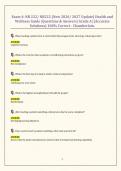
Exam 4: NR 222/ NR222 (New 2026/ 2027 Update) Health and
Wellness Guide |Questions & Answers| Grade A| (Accurate
Solutions) 100% Correct - Chamberlain.

Q. When teaching a patient how to control their blood sugar levels, what type of learning is this?
ANSWER
cognitive learning


Q. What is the term for when a patient is not following instructions as given?
ANSWER
Non-Compliance


Q. What is the first step in trying to achieve cultural competence?
ANSWER
Clarifying your own values


Q. What is the highest accomplishment of health for people?
ANSWER
Health Equity


Q. After teaching a patient something, what process has the nurse completed?
ANSWER
Developing learning objectives


Q. If you want to teach a patient something, what must your first do?
ANSWER
Assess what the patient already knows (what is their learning level/learning capability)


1

,Q. Healthy eating habits; look for objective outcome in effective domain
ANSWER
patient verbalizes the value of healthy eating


Q. What are 3 reasons in which you would cancel a teaching session with your patient?
ANSWER
1. Patient's pain level is 10/10
2. Patient is crying and visibly upset
3. Patient has a high fever


Before providing instruction to a patient, you need to assess for
health literacy (what does the patient know about health?)


Q. Term for group of interacting individuals by blood, marriage, cohabitation, adoption who independently
perform relevant functions in individual roles

ANSWER
Family


Q. When a patient says "let me understand this correctly", this is called
ANSWER
Clarifying


Q. Example of a statement that blocks effective communication
ANSWER
Why do you always put so much salt on your food?


Q. Determination phase of therapeutic relationship
ANSWER
requires to determine if client's needs are met and evaluating goal achievements with client


2

, Q. What type of family is this - Spouse, Children, Aunt, and Uncle
ANSWER
Extended Family


Q. Rationale for using IS bar
ANSWER
it is a quick note you give to another nurse when handing off a patient to them. these notes are used to
standardize communication.


Q. Cultural Awareness
ANSWER
examining your own background


Q. what is the last sense to go when communicating with an unresponsive patient?
ANSWER
hearing


Q. When a patient is going into cardiac surgery and compares it to traffic trends and bypasses, this is called a
what?

ANSWER
analogy


Q. What kind of family is this - Spouse, my 15 year old, her 5 year old
ANSWER
Blended family


Q. Accurate understanding of values. Values _____ over time.
ANSWER
Values evolve over time. Values are NOT static.


3

Escuela, estudio y materia

Institución
NR 222
Grado
NR 222

Información del documento

Subido en
22 de junio de 2026
Número de páginas
22
Escrito en
2025/2026
Tipo
Examen
Contiene
Preguntas y respuestas

Temas

$12.49
Accede al documento completo:

¿Documento equivocado? Cámbialo gratis Dentro de los 14 días posteriores a la compra y antes de descargarlo, puedes elegir otro documento. Puedes gastar el importe de nuevo.
Escrito por estudiantes que aprobaron
Inmediatamente disponible después del pago
Leer en línea o como PDF

Conoce al vendedor
Seller avatar
TheStudyPlug

Documento también disponible en un lote

Conoce al vendedor

Seller avatar
TheStudyPlug Chamberlain College Of Nursing
Seguir Necesitas iniciar sesión para seguir a otros usuarios o asignaturas
Vendido
4
Miembro desde
5 meses
Número de seguidores
0
Documentos
380
Última venta
1 mes hace
Grade Up Tech

1.Well-organized study resources 2.Great for last-minute prep 3.Exam-ready Q&A format 4.Ready to download in pdf form immediately after download

0.0

0 reseñas

5
0
4
0
3
0
2
0
1
0

Por qué los estudiantes eligen Stuvia

Creado por compañeros estudiantes, verificado por reseñas

Calidad en la que puedes confiar: escrito por estudiantes que aprobaron y evaluado por otros que han usado estos resúmenes.

¿No estás satisfecho? Elige otro documento

¡No te preocupes! Puedes elegir directamente otro documento que se ajuste mejor a lo que buscas.

Paga como quieras, empieza a estudiar al instante

Sin suscripción, sin compromisos. Paga como estés acostumbrado con tarjeta de crédito y descarga tu documento PDF inmediatamente.

Student with book image

“Comprado, descargado y aprobado. Así de fácil puede ser.”

Alisha Student

Preguntas frecuentes