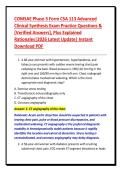
COMSAE Phase 3 Form CSA 111 Advanced Clinical
Synthesis Exam Practice Questions & [Verified
Answers], Plus Explained Rationales|2026 Latest
Update| Instant Download PDF
1. A 67-year-old man presents with crushing substernal chest pain
radiating to his left arm for 2 hours. ECG demonstrates ST-
segment elevations in leads II, III, and aVF. Blood pressure is
88/56 mmHg. Jugular venous distention is present, and lung
auscultation is clear. Which diagnosis best explains these findings?
A. Acute pulmonary edema
B. Right ventricular infarction
C. Ventricular septal rupture
D. Acute pericarditis
Answer: B. Right ventricular infarction
Rationale: Inferior wall myocardial infarctions involving the right
coronary artery may extend to the right ventricle. The triad of
hypotension, jugular venous distention, and clear lung fields strongly
suggests right ventricular infarction. These patients are preload
dependent and may worsen with nitrates.
2. A 32-year-old woman presents with fever, hypotension, diffuse
rash, and multisystem organ dysfunction. She recently used
superabsorbent tampons during menstruation. Which organism is
most likely responsible?
A. Streptococcus pneumoniae
B. Escherichia coli
,C. Staphylococcus aureus
D. Neisseria meningitidis
Answer: C. Staphylococcus aureus
Rationale: Toxic shock syndrome is classically caused by toxin-
producing Staphylococcus aureus. TSST-1 acts as a superantigen,
triggering massive cytokine release, fever, hypotension, rash, and
multiorgan failure.
3. A 75-year-old patient with atrial fibrillation develops sudden
abdominal pain that is severe and disproportionate to physical
examination findings. Serum lactate is elevated. Which diagnosis
is most likely?
A. Diverticulitis
B. Mesenteric ischemia
C. Cholecystitis
D. Pancreatitis
Answer: B. Mesenteric ischemia
Rationale: Acute mesenteric ischemia often presents with severe
abdominal pain out of proportion to examination findings. Embolic
occlusion of the superior mesenteric artery is frequently associated
with atrial fibrillation. Elevated lactate reflects bowel hypoperfusion.
4. A hospitalized patient develops thrombocytopenia five days after
initiation of unfractionated heparin. Which mechanism underlies
this condition?
A. Bone marrow suppression
B. Autoantibodies against factor VIII
C. Antibodies against platelet factor 4-heparin complexes
D. Complement-mediated platelet destruction
,Answer: C. Antibodies against platelet factor 4-heparin complexes
Rationale: Heparin-induced thrombocytopenia (HIT) results from IgG
antibodies directed against platelet factor 4-heparin complexes. This
causes platelet activation, thrombocytopenia, and paradoxical
thrombosis.
5. A 24-year-old woman develops ptosis and diplopia that worsen
throughout the day. Symptoms improve after rest. Which
antibody is most commonly associated with this condition?
A. Anti-centromere antibody
B. Acetylcholine receptor antibody
C. Anti-Jo-1 antibody
D. Anti-dsDNA antibody
Answer: B. Acetylcholine receptor antibody
Rationale: Myasthenia gravis is caused by autoantibodies against
postsynaptic acetylcholine receptors. Hallmark findings include
fluctuating skeletal muscle weakness and fatigability that improves
with rest.
6. A patient with diabetic ketoacidosis begins treatment with insulin.
Which electrolyte abnormality is most likely to worsen during
therapy?
A. Hypernatremia
B. Hypercalcemia
C. Hypokalemia
D. Hypermagnesemia
Answer: C. Hypokalemia
, Rationale: Insulin drives potassium into cells, often causing serum
potassium levels to decline rapidly during DKA treatment. Potassium
must be monitored closely and replaced when necessary.
7. A newborn develops bilious vomiting shortly after birth. Imaging
demonstrates a "double-bubble" sign. Which diagnosis is most
likely?
A. Hirschsprung disease
B. Duodenal atresia
C. Pyloric stenosis
D. Intussusception
Answer: B. Duodenal atresia
Rationale: Duodenal atresia classically presents with bilious vomiting
and a double-bubble appearance on radiography. It is commonly
associated with trisomy 21.
8. A 58-year-old smoker develops hematuria and flank pain. CT
imaging reveals a renal mass. Which paraneoplastic syndrome is
most associated with renal cell carcinoma?
A. Hyperparathyroidism
B. SIADH
C. Polycythemia
D. Hypothyroidism
Answer: C. Polycythemia
Rationale: Renal cell carcinoma may produce ectopic erythropoietin,
resulting in secondary polycythemia. Other paraneoplastic
manifestations include hypercalcemia and hypertension.
Synthesis Exam Practice Questions & [Verified
Answers], Plus Explained Rationales|2026 Latest
Update| Instant Download PDF
1. A 67-year-old man presents with crushing substernal chest pain
radiating to his left arm for 2 hours. ECG demonstrates ST-
segment elevations in leads II, III, and aVF. Blood pressure is
88/56 mmHg. Jugular venous distention is present, and lung
auscultation is clear. Which diagnosis best explains these findings?
A. Acute pulmonary edema
B. Right ventricular infarction
C. Ventricular septal rupture
D. Acute pericarditis
Answer: B. Right ventricular infarction
Rationale: Inferior wall myocardial infarctions involving the right
coronary artery may extend to the right ventricle. The triad of
hypotension, jugular venous distention, and clear lung fields strongly
suggests right ventricular infarction. These patients are preload
dependent and may worsen with nitrates.
2. A 32-year-old woman presents with fever, hypotension, diffuse
rash, and multisystem organ dysfunction. She recently used
superabsorbent tampons during menstruation. Which organism is
most likely responsible?
A. Streptococcus pneumoniae
B. Escherichia coli
,C. Staphylococcus aureus
D. Neisseria meningitidis
Answer: C. Staphylococcus aureus
Rationale: Toxic shock syndrome is classically caused by toxin-
producing Staphylococcus aureus. TSST-1 acts as a superantigen,
triggering massive cytokine release, fever, hypotension, rash, and
multiorgan failure.
3. A 75-year-old patient with atrial fibrillation develops sudden
abdominal pain that is severe and disproportionate to physical
examination findings. Serum lactate is elevated. Which diagnosis
is most likely?
A. Diverticulitis
B. Mesenteric ischemia
C. Cholecystitis
D. Pancreatitis
Answer: B. Mesenteric ischemia
Rationale: Acute mesenteric ischemia often presents with severe
abdominal pain out of proportion to examination findings. Embolic
occlusion of the superior mesenteric artery is frequently associated
with atrial fibrillation. Elevated lactate reflects bowel hypoperfusion.
4. A hospitalized patient develops thrombocytopenia five days after
initiation of unfractionated heparin. Which mechanism underlies
this condition?
A. Bone marrow suppression
B. Autoantibodies against factor VIII
C. Antibodies against platelet factor 4-heparin complexes
D. Complement-mediated platelet destruction
,Answer: C. Antibodies against platelet factor 4-heparin complexes
Rationale: Heparin-induced thrombocytopenia (HIT) results from IgG
antibodies directed against platelet factor 4-heparin complexes. This
causes platelet activation, thrombocytopenia, and paradoxical
thrombosis.
5. A 24-year-old woman develops ptosis and diplopia that worsen
throughout the day. Symptoms improve after rest. Which
antibody is most commonly associated with this condition?
A. Anti-centromere antibody
B. Acetylcholine receptor antibody
C. Anti-Jo-1 antibody
D. Anti-dsDNA antibody
Answer: B. Acetylcholine receptor antibody
Rationale: Myasthenia gravis is caused by autoantibodies against
postsynaptic acetylcholine receptors. Hallmark findings include
fluctuating skeletal muscle weakness and fatigability that improves
with rest.
6. A patient with diabetic ketoacidosis begins treatment with insulin.
Which electrolyte abnormality is most likely to worsen during
therapy?
A. Hypernatremia
B. Hypercalcemia
C. Hypokalemia
D. Hypermagnesemia
Answer: C. Hypokalemia
, Rationale: Insulin drives potassium into cells, often causing serum
potassium levels to decline rapidly during DKA treatment. Potassium
must be monitored closely and replaced when necessary.
7. A newborn develops bilious vomiting shortly after birth. Imaging
demonstrates a "double-bubble" sign. Which diagnosis is most
likely?
A. Hirschsprung disease
B. Duodenal atresia
C. Pyloric stenosis
D. Intussusception
Answer: B. Duodenal atresia
Rationale: Duodenal atresia classically presents with bilious vomiting
and a double-bubble appearance on radiography. It is commonly
associated with trisomy 21.
8. A 58-year-old smoker develops hematuria and flank pain. CT
imaging reveals a renal mass. Which paraneoplastic syndrome is
most associated with renal cell carcinoma?
A. Hyperparathyroidism
B. SIADH
C. Polycythemia
D. Hypothyroidism
Answer: C. Polycythemia
Rationale: Renal cell carcinoma may produce ectopic erythropoietin,
resulting in secondary polycythemia. Other paraneoplastic
manifestations include hypercalcemia and hypertension.