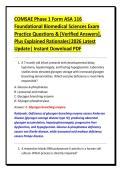
COMSAE Phase 2 Form BSA 103 Clinical
Simulation Exam Practice Questions &
[Verified Answers], Plus Explained
Rationales|2026 Latest Update| Instant
Download PDF
1. A 67-year-old man presents with crushing retrosternal chest pain
for 2 hours associated with diaphoresis and nausea. ECG shows ST
elevations in leads V1-V4. Which coronary artery is most likely
occluded?
A. Right coronary artery
B. Left circumflex artery
C. Left anterior descending artery
D. Posterior descending artery
Answer: C. Left anterior descending artery
Rationale: Anterior wall STEMI involving V1-V4 indicates occlusion of
the LAD artery. The LAD supplies the anterior wall and anterior septum.
RCA causes inferior MI with ST elevations in II, III, and aVF.
2. A 58-year-old diabetic woman presents with fever, flank pain, and
hypotension. Urinalysis reveals numerous WBCs and nitrites.
Blood pressure is 82/50 mmHg despite fluid administration. What
is the next best step?
A. Oral ciprofloxacin
B. Vasopressors and IV antibiotics
,C. Repeat urinalysis
D. Observation
Answer: B. Vasopressors and IV antibiotics
Rationale: This patient has septic shock due to pyelonephritis. Early
broad-spectrum antibiotics and vasopressors after fluid resuscitation
are essential.
3. A 26-year-old woman presents with unilateral eye pain worsened
with movement and decreased visual acuity. MRI shows
periventricular plaques. Diagnosis?
A. Myasthenia gravis
B. Multiple sclerosis
C. Optic glioma
D. Temporal arteritis
Answer: B. Multiple sclerosis
Rationale: Optic neuritis is a common presenting feature of MS. MRI
demonstrates demyelinating plaques in the CNS.
4. A 35-year-old man has recurrent kidney stones and peptic ulcer
disease. Labs reveal hypercalcemia and elevated PTH. Which
syndrome is most likely?
A. MEN 1
B. MEN 2A
C. MEN 2B
D. Von Hippel-Lindau syndrome
Answer: A. MEN 1
,Rationale: MEN 1 consists of parathyroid adenoma, pancreatic
endocrine tumors, and pituitary adenoma.
5. A newborn develops jaundice within 24 hours after birth. Direct
Coombs test is positive. Most likely cause?
A. Physiologic jaundice
B. Breast milk jaundice
C. Hemolytic disease of the newborn
D. Gilbert syndrome
Answer: C. Hemolytic disease of the newborn
Rationale: Early jaundice with positive Coombs indicates immune-
mediated hemolysis due to Rh or ABO incompatibility.
6. A patient develops fever, rigidity, autonomic instability, and
elevated CK after haloperidol administration. Diagnosis?
A. Serotonin syndrome
B. Neuroleptic malignant syndrome
C. Malignant hyperthermia
D. Catatonia
Answer: B. Neuroleptic malignant syndrome
Rationale: NMS is characterized by fever, lead-pipe rigidity, autonomic
dysfunction, and elevated CK after dopamine blockade.
7. A 50-year-old smoker develops hematuria without pain. Next best
step?
, A. Repeat urinalysis
B. Urine culture
C. CT urography and cystoscopy
D. Antibiotics
Answer: C. CT urography and cystoscopy
Rationale: Painless hematuria in a smoker is bladder cancer until
proven otherwise.
8. A pregnant woman at 34 weeks develops hypertension,
proteinuria, headache, and visual disturbances. Management?
A. Bed rest only
B. Immediate delivery
C. Oral antihypertensives only
D. Repeat BP next week
Answer: B. Immediate delivery
Rationale: Severe preeclampsia after 34 weeks requires delivery to
prevent maternal and fetal complications.
9. A 72-year-old man presents with tremor at rest, bradykinesia, and
rigidity. Deficiency of which neurotransmitter causes this
disorder?
A. Acetylcholine
B. Dopamine
C. Serotonin
D. GABA
Answer: B. Dopamine
Simulation Exam Practice Questions &
[Verified Answers], Plus Explained
Rationales|2026 Latest Update| Instant
Download PDF
1. A 67-year-old man presents with crushing retrosternal chest pain
for 2 hours associated with diaphoresis and nausea. ECG shows ST
elevations in leads V1-V4. Which coronary artery is most likely
occluded?
A. Right coronary artery
B. Left circumflex artery
C. Left anterior descending artery
D. Posterior descending artery
Answer: C. Left anterior descending artery
Rationale: Anterior wall STEMI involving V1-V4 indicates occlusion of
the LAD artery. The LAD supplies the anterior wall and anterior septum.
RCA causes inferior MI with ST elevations in II, III, and aVF.
2. A 58-year-old diabetic woman presents with fever, flank pain, and
hypotension. Urinalysis reveals numerous WBCs and nitrites.
Blood pressure is 82/50 mmHg despite fluid administration. What
is the next best step?
A. Oral ciprofloxacin
B. Vasopressors and IV antibiotics
,C. Repeat urinalysis
D. Observation
Answer: B. Vasopressors and IV antibiotics
Rationale: This patient has septic shock due to pyelonephritis. Early
broad-spectrum antibiotics and vasopressors after fluid resuscitation
are essential.
3. A 26-year-old woman presents with unilateral eye pain worsened
with movement and decreased visual acuity. MRI shows
periventricular plaques. Diagnosis?
A. Myasthenia gravis
B. Multiple sclerosis
C. Optic glioma
D. Temporal arteritis
Answer: B. Multiple sclerosis
Rationale: Optic neuritis is a common presenting feature of MS. MRI
demonstrates demyelinating plaques in the CNS.
4. A 35-year-old man has recurrent kidney stones and peptic ulcer
disease. Labs reveal hypercalcemia and elevated PTH. Which
syndrome is most likely?
A. MEN 1
B. MEN 2A
C. MEN 2B
D. Von Hippel-Lindau syndrome
Answer: A. MEN 1
,Rationale: MEN 1 consists of parathyroid adenoma, pancreatic
endocrine tumors, and pituitary adenoma.
5. A newborn develops jaundice within 24 hours after birth. Direct
Coombs test is positive. Most likely cause?
A. Physiologic jaundice
B. Breast milk jaundice
C. Hemolytic disease of the newborn
D. Gilbert syndrome
Answer: C. Hemolytic disease of the newborn
Rationale: Early jaundice with positive Coombs indicates immune-
mediated hemolysis due to Rh or ABO incompatibility.
6. A patient develops fever, rigidity, autonomic instability, and
elevated CK after haloperidol administration. Diagnosis?
A. Serotonin syndrome
B. Neuroleptic malignant syndrome
C. Malignant hyperthermia
D. Catatonia
Answer: B. Neuroleptic malignant syndrome
Rationale: NMS is characterized by fever, lead-pipe rigidity, autonomic
dysfunction, and elevated CK after dopamine blockade.
7. A 50-year-old smoker develops hematuria without pain. Next best
step?
, A. Repeat urinalysis
B. Urine culture
C. CT urography and cystoscopy
D. Antibiotics
Answer: C. CT urography and cystoscopy
Rationale: Painless hematuria in a smoker is bladder cancer until
proven otherwise.
8. A pregnant woman at 34 weeks develops hypertension,
proteinuria, headache, and visual disturbances. Management?
A. Bed rest only
B. Immediate delivery
C. Oral antihypertensives only
D. Repeat BP next week
Answer: B. Immediate delivery
Rationale: Severe preeclampsia after 34 weeks requires delivery to
prevent maternal and fetal complications.
9. A 72-year-old man presents with tremor at rest, bradykinesia, and
rigidity. Deficiency of which neurotransmitter causes this
disorder?
A. Acetylcholine
B. Dopamine
C. Serotonin
D. GABA
Answer: B. Dopamine