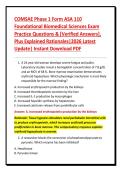
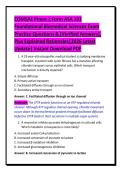
COMSAE Phase 1 Form ASA 112
Foundational Biomedical Sciences Exam
Practice Questions & [Verified Answers],
Plus Explained Rationales|2026 Latest
Update| Instant Download PDF
1. A 6-year-old boy is brought to the clinic because of recurrent
respiratory infections, steatorrhea, and failure to thrive. Genetic
testing reveals a mutation affecting chloride ion transport across
epithelial membranes. Which of the following best explains the
pathophysiology of this disorder?
A. Defective sodium-potassium ATPase activity
B. Impaired chloride secretion resulting in dehydrated mucus
C. Increased bicarbonate secretion into mucus
D. Excessive sodium excretion into sweat
Answer: B. Impaired chloride secretion resulting in dehydrated mucus
Rationale: Cystic fibrosis results from mutations in the CFTR chloride
channel. Defective chloride secretion and increased sodium absorption
create dehydrated, viscous secretions that obstruct ducts and airways.
2. A researcher administers a drug that irreversibly inhibits
cyclooxygenase enzymes. Which of the following substances will
have decreased synthesis?
A. Leukotriene B4
B. Prostaglandin E2
C. Histamine
D. Bradykinin
,Answer: B. Prostaglandin E2
Rationale: Cyclooxygenase converts arachidonic acid into
prostaglandins and thromboxanes. Inhibition decreases prostaglandin
synthesis while leukotriene production proceeds through the
lipoxygenase pathway.
3. A patient develops weakness after prolonged corticosteroid
therapy. Which muscle fiber change is most likely present?
A. Type I fiber hypertrophy
B. Type II fiber atrophy
C. Increased mitochondrial proliferation
D. Type I fiber necrosis
Answer: B. Type II fiber atrophy
Rationale: Glucocorticoid-induced myopathy preferentially causes
atrophy of fast-twitch type II fibers, leading to proximal muscle
weakness.
4. A 58-year-old man experiences crushing substernal chest pain.
Laboratory studies show elevated troponin I. Which cellular event
most directly causes irreversible myocardial injury?
A. ATP depletion alone
B. Ribosomal detachment
C. Membrane damage with calcium influx
D. Glycogen depletion
Answer: C. Membrane damage with calcium influx
Rationale: Irreversible injury occurs when membrane integrity is lost,
leading to massive calcium influx, mitochondrial dysfunction, and
activation of degradative enzymes.
, 5. During DNA replication, an enzyme removes RNA primers and fills
the resulting gaps with DNA nucleotides. Which enzyme performs
this function?
A. DNA polymerase I
B. DNA polymerase III
C. Primase
D. Helicase
Answer: A. DNA polymerase I
Rationale: DNA polymerase I possesses both 5'→3' exonuclease and
polymerase activity, allowing removal of RNA primers and replacement
with DNA.
6. A woman with autoimmune hemolytic anemia develops jaundice.
Which pigment is primarily responsible?
A. Biliverdin
B. Unconjugated bilirubin
C. Urobilinogen
D. Hemosiderin
Answer: B. Unconjugated bilirubin
Rationale: Excessive red blood cell destruction increases heme
breakdown, generating elevated unconjugated bilirubin that may cause
jaundice.
7. A patient has hyperkalemia due to renal failure. Which ECG
finding is expected initially?
A. U waves
B. Flattened T waves
C. Peaked T waves
D. ST elevation
, Answer: C. Peaked T waves
Rationale: Hyperkalemia first produces tall, peaked T waves due to
accelerated repolarization. Progressive elevations cause QRS widening
and eventual sine-wave morphology.
8. Which cranial nerve provides parasympathetic innervation to the
parotid gland?
A. Facial nerve
B. Trigeminal nerve
C. Glossopharyngeal nerve
D. Vagus nerve
Answer: C. Glossopharyngeal nerve
Rationale: Parasympathetic fibers originate from CN IX, travel through
the lesser petrosal nerve and otic ganglion, and reach the parotid gland
via the auriculotemporal nerve.
9. A patient presents with nephrotic syndrome. Which laboratory
abnormality is most likely?
A. Hyperalbuminemia
B. Hyperlipidemia
C. Low LDL levels
D. Elevated serum immunoglobulins
Answer: B. Hyperlipidemia
Rationale: Nephrotic syndrome causes urinary protein loss, stimulating
hepatic lipoprotein synthesis and resulting in hyperlipidemia.
10. Which cytokine is primarily responsible for fever generation
during acute inflammation?
Foundational Biomedical Sciences Exam
Practice Questions & [Verified Answers],
Plus Explained Rationales|2026 Latest
Update| Instant Download PDF
1. A 6-year-old boy is brought to the clinic because of recurrent
respiratory infections, steatorrhea, and failure to thrive. Genetic
testing reveals a mutation affecting chloride ion transport across
epithelial membranes. Which of the following best explains the
pathophysiology of this disorder?
A. Defective sodium-potassium ATPase activity
B. Impaired chloride secretion resulting in dehydrated mucus
C. Increased bicarbonate secretion into mucus
D. Excessive sodium excretion into sweat
Answer: B. Impaired chloride secretion resulting in dehydrated mucus
Rationale: Cystic fibrosis results from mutations in the CFTR chloride
channel. Defective chloride secretion and increased sodium absorption
create dehydrated, viscous secretions that obstruct ducts and airways.
2. A researcher administers a drug that irreversibly inhibits
cyclooxygenase enzymes. Which of the following substances will
have decreased synthesis?
A. Leukotriene B4
B. Prostaglandin E2
C. Histamine
D. Bradykinin
,Answer: B. Prostaglandin E2
Rationale: Cyclooxygenase converts arachidonic acid into
prostaglandins and thromboxanes. Inhibition decreases prostaglandin
synthesis while leukotriene production proceeds through the
lipoxygenase pathway.
3. A patient develops weakness after prolonged corticosteroid
therapy. Which muscle fiber change is most likely present?
A. Type I fiber hypertrophy
B. Type II fiber atrophy
C. Increased mitochondrial proliferation
D. Type I fiber necrosis
Answer: B. Type II fiber atrophy
Rationale: Glucocorticoid-induced myopathy preferentially causes
atrophy of fast-twitch type II fibers, leading to proximal muscle
weakness.
4. A 58-year-old man experiences crushing substernal chest pain.
Laboratory studies show elevated troponin I. Which cellular event
most directly causes irreversible myocardial injury?
A. ATP depletion alone
B. Ribosomal detachment
C. Membrane damage with calcium influx
D. Glycogen depletion
Answer: C. Membrane damage with calcium influx
Rationale: Irreversible injury occurs when membrane integrity is lost,
leading to massive calcium influx, mitochondrial dysfunction, and
activation of degradative enzymes.
, 5. During DNA replication, an enzyme removes RNA primers and fills
the resulting gaps with DNA nucleotides. Which enzyme performs
this function?
A. DNA polymerase I
B. DNA polymerase III
C. Primase
D. Helicase
Answer: A. DNA polymerase I
Rationale: DNA polymerase I possesses both 5'→3' exonuclease and
polymerase activity, allowing removal of RNA primers and replacement
with DNA.
6. A woman with autoimmune hemolytic anemia develops jaundice.
Which pigment is primarily responsible?
A. Biliverdin
B. Unconjugated bilirubin
C. Urobilinogen
D. Hemosiderin
Answer: B. Unconjugated bilirubin
Rationale: Excessive red blood cell destruction increases heme
breakdown, generating elevated unconjugated bilirubin that may cause
jaundice.
7. A patient has hyperkalemia due to renal failure. Which ECG
finding is expected initially?
A. U waves
B. Flattened T waves
C. Peaked T waves
D. ST elevation
, Answer: C. Peaked T waves
Rationale: Hyperkalemia first produces tall, peaked T waves due to
accelerated repolarization. Progressive elevations cause QRS widening
and eventual sine-wave morphology.
8. Which cranial nerve provides parasympathetic innervation to the
parotid gland?
A. Facial nerve
B. Trigeminal nerve
C. Glossopharyngeal nerve
D. Vagus nerve
Answer: C. Glossopharyngeal nerve
Rationale: Parasympathetic fibers originate from CN IX, travel through
the lesser petrosal nerve and otic ganglion, and reach the parotid gland
via the auriculotemporal nerve.
9. A patient presents with nephrotic syndrome. Which laboratory
abnormality is most likely?
A. Hyperalbuminemia
B. Hyperlipidemia
C. Low LDL levels
D. Elevated serum immunoglobulins
Answer: B. Hyperlipidemia
Rationale: Nephrotic syndrome causes urinary protein loss, stimulating
hepatic lipoprotein synthesis and resulting in hyperlipidemia.
10. Which cytokine is primarily responsible for fever generation
during acute inflammation?