

NUR 3450 : mental health - All Units Concept Review Guide -
Galen College of Nursing
Unit 1
Chapter 1
● Safety is the #1 priority. Danger to self, Danger to others → keep them safe
● Mental health: state of well being in which individuals reach their own potential, cope
with the normal stresses of life, work productively, and contribute to community
● Traits of mental health. Capacity for….
- Rational thinking
- Communication skills
- Learning
- Emotional growth
- Resilience
- Self esteem
A- ROS (head to toe), MSE (mental status exam)
D-
P-
I-
E- Safe discharge → MDT
● Mental illness: refers to all psychiatric disorders that have definable diagnosis.
Significant dysfunction in mental functioning related to developmental, biological, and
physiological disturbances
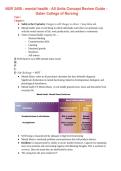
● Mental health VS Mental illness. A real middle ground exists: stress and discomfort from
everyday life
● Well being is characterized by adequate to high level functioning
● Mental illness= emotional problems and experiences that will produce distress
● Resilience is characterized by: ability to secure needed resources. Capacity for regulating
one's own emotions and overcoming negative self defeating thoughts. This is essential to
recovery. Does not mean they are unaffected by stress
● The young have the most resilience!!!
, ● Risk and protective factors: biological factors. Social and economic circumstances,
Environmental factors.
● Most damaging is the belief that:
- These disorders are under personal control
- They have a choice to engage in bad behavior
- (these beliefs support the stigma to which people with mental illness are often
subjected to)
● Nature VS Nurture —> Diathesis-Stress Model: In which diathesis represents
biological predisposition and stress represents environmental stress or trauma is the most
accepted explanation for mental illness
● NAMI: Formed 1979 National alliance on mental illness
● In 1980’s NAMI began pushing for change of mental healthcare providers dictating
treatment without the input of the pt
● Mental Health Parity Act was passed in 1996
● Mental health parity did not cover mental healthcare at all
- Identified yearly of lifetime limits health coverage
- Limited hospital days or outpatient treatment sessions
- Assigned higher copayments or deductibles
● Epidemiology of mental disorders: is the quantitative study of the distribution of mental
disorders in human populations. Understanding this helps identify high risk groups
● Incidence: conveys information about the risk of contracting a disease. It refers to the
number of new cases of mental disorders in a healthy population within a given period of
time usually annually
● Prevalence: describes the total number of cases new and existing in a given population
during a specific period of time regardless of when they became ill.
● QSEN- Competencies (quality and safety education for nurses)
● All healthcare workers must:
- Provide pt centered care
- Minimize the risk of harm to pt’s
- Work in interdisciplinary teams
- Employ evidence based practice
- Apply quality improvement
- Utilize informatics
● DSM5: official medical guidelines of the american psychiatric association for diagnosing
psych disorders. Is usually associated with a timeframe. Ex; this many events within this
period of time
Chapter 2
, Freud's levels of awareness
● Conscious
- Contains all the material a person is aware of at any one time
● Preconscious
- Contain material that can be retrieved rather easily thought conscious effort
● Unconscious
- Includes all repressed memories, passions, and unacceptable urges lying deep
below the surface
● Id: Pleasure principle. Ego:Problem solver. Superego:Moral component.
● 17 Defense Mechanisms. Typically unconsciously being utilized except suppression
Harry Stack Sullivan
● Interpersonal therapy is an effective short term therapy. The assumption is that
psychiatric disorders are influenced by interpersonal interactions and the social context.
The goal is to reduce or eliminate psychiatric symptoms by improving interpersonal
functioning and satisfaction with social relationships
1. Grief and loss: complicated bereavement after death, divorce or other loss
2. Interpersonal disputed: conflicts with a significant other
3. Role transition: problematic change in life status or social or vocational role
● Behavioral therapy: assumes that changes in maladaptive behavior can occur without
insight into the underlying cause
● Assumption: change in maladaptive behavior can occur without understanding the
underlying case
● Modeling: patient learns through imitation, patient can also unlearn through imitation as
well
● Operant conditioning: positive reinforcement to increase desired behaviors
● Systemic desensitization: form of behavior modification. 4-steps breaking down fear,
exposure (little by little) hierarchy of fears, practice
● Aversion therapy: pairing a negative stimuli with target behavior (antabuse)
Cognitive behavioral therapy
Aaron Beck- identified that patients with depression thought differently than those without
- Negative thinking
- Self critical thinking
- CBT : challenges those negative thoughts (identify and reframe)
Galen College of Nursing
Unit 1
Chapter 1
● Safety is the #1 priority. Danger to self, Danger to others → keep them safe
● Mental health: state of well being in which individuals reach their own potential, cope
with the normal stresses of life, work productively, and contribute to community
● Traits of mental health. Capacity for….
- Rational thinking
- Communication skills
- Learning
- Emotional growth
- Resilience
- Self esteem
A- ROS (head to toe), MSE (mental status exam)
D-
P-
I-
E- Safe discharge → MDT
● Mental illness: refers to all psychiatric disorders that have definable diagnosis.
Significant dysfunction in mental functioning related to developmental, biological, and
physiological disturbances
● Mental health VS Mental illness. A real middle ground exists: stress and discomfort from
everyday life
● Well being is characterized by adequate to high level functioning
● Mental illness= emotional problems and experiences that will produce distress
● Resilience is characterized by: ability to secure needed resources. Capacity for regulating
one's own emotions and overcoming negative self defeating thoughts. This is essential to
recovery. Does not mean they are unaffected by stress
● The young have the most resilience!!!
, ● Risk and protective factors: biological factors. Social and economic circumstances,
Environmental factors.
● Most damaging is the belief that:
- These disorders are under personal control
- They have a choice to engage in bad behavior
- (these beliefs support the stigma to which people with mental illness are often
subjected to)
● Nature VS Nurture —> Diathesis-Stress Model: In which diathesis represents
biological predisposition and stress represents environmental stress or trauma is the most
accepted explanation for mental illness
● NAMI: Formed 1979 National alliance on mental illness
● In 1980’s NAMI began pushing for change of mental healthcare providers dictating
treatment without the input of the pt
● Mental Health Parity Act was passed in 1996
● Mental health parity did not cover mental healthcare at all
- Identified yearly of lifetime limits health coverage
- Limited hospital days or outpatient treatment sessions
- Assigned higher copayments or deductibles
● Epidemiology of mental disorders: is the quantitative study of the distribution of mental
disorders in human populations. Understanding this helps identify high risk groups
● Incidence: conveys information about the risk of contracting a disease. It refers to the
number of new cases of mental disorders in a healthy population within a given period of
time usually annually
● Prevalence: describes the total number of cases new and existing in a given population
during a specific period of time regardless of when they became ill.
● QSEN- Competencies (quality and safety education for nurses)
● All healthcare workers must:
- Provide pt centered care
- Minimize the risk of harm to pt’s
- Work in interdisciplinary teams
- Employ evidence based practice
- Apply quality improvement
- Utilize informatics
● DSM5: official medical guidelines of the american psychiatric association for diagnosing
psych disorders. Is usually associated with a timeframe. Ex; this many events within this
period of time
Chapter 2
, Freud's levels of awareness
● Conscious
- Contains all the material a person is aware of at any one time
● Preconscious
- Contain material that can be retrieved rather easily thought conscious effort
● Unconscious
- Includes all repressed memories, passions, and unacceptable urges lying deep
below the surface
● Id: Pleasure principle. Ego:Problem solver. Superego:Moral component.
● 17 Defense Mechanisms. Typically unconsciously being utilized except suppression
Harry Stack Sullivan
● Interpersonal therapy is an effective short term therapy. The assumption is that
psychiatric disorders are influenced by interpersonal interactions and the social context.
The goal is to reduce or eliminate psychiatric symptoms by improving interpersonal
functioning and satisfaction with social relationships
1. Grief and loss: complicated bereavement after death, divorce or other loss
2. Interpersonal disputed: conflicts with a significant other
3. Role transition: problematic change in life status or social or vocational role
● Behavioral therapy: assumes that changes in maladaptive behavior can occur without
insight into the underlying cause
● Assumption: change in maladaptive behavior can occur without understanding the
underlying case
● Modeling: patient learns through imitation, patient can also unlearn through imitation as
well
● Operant conditioning: positive reinforcement to increase desired behaviors
● Systemic desensitization: form of behavior modification. 4-steps breaking down fear,
exposure (little by little) hierarchy of fears, practice
● Aversion therapy: pairing a negative stimuli with target behavior (antabuse)
Cognitive behavioral therapy
Aaron Beck- identified that patients with depression thought differently than those without
- Negative thinking
- Self critical thinking
- CBT : challenges those negative thoughts (identify and reframe)

