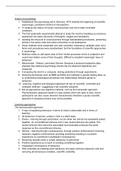
Origins of psychology
1. Established first psychology lab in Germany 1879 (marked the beginning of scientific
psychology), pioneered method of introspection.
2. To analyse the nature of human consciousness and mind under controlled
conditions.
3. The first systematic experimental attempt to study the mind by breaking up conscious
awareness into basic structures of thoughts, images and sensations.
4. Isolating the structure of consciousness through standardised procedures, presenting
stimuli in the same order and same instructions to all participants.
5. Some methods were systematic and well controlled, extraneous variables were not a
factor and procedures were standardised. Set the foundation of scientific approaches
in psychology.
6. Methods relied on self-report data of their mental processes which is subjective and
could have hidden some of their thoughts. Difficult to establish meaningful ‘laws of
behaviour’
7. Behaviorists - Watson, (and later) Skinner. Because it produced subjective data,
whereas they believed psychology should only be observed objectively and
measured.
8. Comparing the mind to a computer, testing predictions through experiments.
9. Scanning techniques such as fMRI and EEG and methods in genetic testing allow us
to understand physiological processes and relationships between genes to
behaviour.
10. Learning, cognitive and biological approach all rely on scientific, controlled and
unbiased methods - suggesting it has scientific discipline.
11. Not all approaches use objective methods, such as the humanistic approach.
Psychodynamic approach based on case studies which are open to bias. Active
participants can also cause demand characteristics therefore a purely scientific
approach to studying humans may not be possible.
Learning approaches
The behaviouralist approach:
1. A way of explaining behaviour in terms of what is observable and in terms of
learning.
2. All behaviour is learned, a baby’s mind is a blank slate.
3. Pavlov - learning through association, occurs when two stimuli are repeatedly paired
together. An unconditioned stimulus and a new neutral stimulus are paired. The
neutral stimulus then becomes associated and eventually produces the same
response as the unconditioned stimulus.
4. Skinner - learning through consequences, through positive reinforcement (receiving
rewards), negative reinforcement (avoiding something resulting in a positive
experience) or punishment (unpleasant consequence)
5. Receiving rewards when a certain behaviour is performed
6. Positive experience as a result of avoiding something negative
7. Unpleasant consequence of behaviour
8. Well controlled by breaking down behaviour into basic stimulus-response units and
removing all extraneous variables, scientific credibility.
, 9. Oversimplified by reducing learning to too simple components. Ignores the mental
processes involved in learning. Learning is more complex.
10. Yes, operant conditioning is the basis of token economy systems in many institutions
(prisons, psych wards, phobia treatment). Widespread application.
11. Ignores the influence of free will on behaviour as deterministic in the sense of all
behaviour by past conditioning. Ignores the influence of conscious decision making.
12. Animals were often housed in cruel conditions and fed less so they stayed hungry.
This is an ethical issue.
Social learning theory:
1. A way of explaining behaviour that includes both direct and indirect reinforcement,
combining learning theory with the role of cognitive factors.
2. Bandura - children watched an adult aggressively hit a bobo doll with a hammer and
shout abuse at it. When the children were later observed playing they behave more
aggressively towards the doll than other dolls.
3. Children who saw the adult being praised for their aggressive behaviour were more
likely to show aggression followed by the control group who did not see any
consequence of the adults behaviours and lastly the group who saw the adults
punished for their behaviour were least likely to show aggression.
4. Reinforcement occuring indirectly through watching someone else being reinforced
for a behaviour and viewing the consequence if they were to imitate.
5. Cognitive factors (thinking) that influence learning and come between stimulus and
response.
6. Attention (noticing the behaviours), retention (behaviour remembered), motor
reproduction (ability to perform the behaviour), motivation (to perform the behaviour,
whether it was awarded or punished)
7. The observer associates themself with a role model and imitates the role model
(modelling) because they want to be them.
8. Recognises the importance of cognitive factors in learning, classical and operant
conditioning cannot account for learning on their own.
9. Reduced validity, recent studies suggest observational learning may be a result of
mirror neurons which allow us to empathise and imitate others. Suggests biological
influences on social learning were under emphasised.
10. Reduced validity, participants may respond to demand characteristics, children in the
doll experiment were acting as they thought it was expected. Therefore tells us little
about real life situations.
11. Yes, can explain cultural differences in behaviour and can account how children learn
from others and media and explains how cultural norms are transmitted (eg gender
roles).
12. Social learning theory accounts that we are not just influenced by our external
environment but also our own free will to choose to perform the behaviours, which is
not accounted for in the behaviouralist approach which denies free will.
The cognitive approach
1. How our mental processes affect behaviour.
2. Thoughts, perception, attention.
3. The process whereby psychologists draw conclusions about the way mental
processes operate on the basis of observed behaviour.
1. Established first psychology lab in Germany 1879 (marked the beginning of scientific
psychology), pioneered method of introspection.
2. To analyse the nature of human consciousness and mind under controlled
conditions.
3. The first systematic experimental attempt to study the mind by breaking up conscious
awareness into basic structures of thoughts, images and sensations.
4. Isolating the structure of consciousness through standardised procedures, presenting
stimuli in the same order and same instructions to all participants.
5. Some methods were systematic and well controlled, extraneous variables were not a
factor and procedures were standardised. Set the foundation of scientific approaches
in psychology.
6. Methods relied on self-report data of their mental processes which is subjective and
could have hidden some of their thoughts. Difficult to establish meaningful ‘laws of
behaviour’
7. Behaviorists - Watson, (and later) Skinner. Because it produced subjective data,
whereas they believed psychology should only be observed objectively and
measured.
8. Comparing the mind to a computer, testing predictions through experiments.
9. Scanning techniques such as fMRI and EEG and methods in genetic testing allow us
to understand physiological processes and relationships between genes to
behaviour.
10. Learning, cognitive and biological approach all rely on scientific, controlled and
unbiased methods - suggesting it has scientific discipline.
11. Not all approaches use objective methods, such as the humanistic approach.
Psychodynamic approach based on case studies which are open to bias. Active
participants can also cause demand characteristics therefore a purely scientific
approach to studying humans may not be possible.
Learning approaches
The behaviouralist approach:
1. A way of explaining behaviour in terms of what is observable and in terms of
learning.
2. All behaviour is learned, a baby’s mind is a blank slate.
3. Pavlov - learning through association, occurs when two stimuli are repeatedly paired
together. An unconditioned stimulus and a new neutral stimulus are paired. The
neutral stimulus then becomes associated and eventually produces the same
response as the unconditioned stimulus.
4. Skinner - learning through consequences, through positive reinforcement (receiving
rewards), negative reinforcement (avoiding something resulting in a positive
experience) or punishment (unpleasant consequence)
5. Receiving rewards when a certain behaviour is performed
6. Positive experience as a result of avoiding something negative
7. Unpleasant consequence of behaviour
8. Well controlled by breaking down behaviour into basic stimulus-response units and
removing all extraneous variables, scientific credibility.
, 9. Oversimplified by reducing learning to too simple components. Ignores the mental
processes involved in learning. Learning is more complex.
10. Yes, operant conditioning is the basis of token economy systems in many institutions
(prisons, psych wards, phobia treatment). Widespread application.
11. Ignores the influence of free will on behaviour as deterministic in the sense of all
behaviour by past conditioning. Ignores the influence of conscious decision making.
12. Animals were often housed in cruel conditions and fed less so they stayed hungry.
This is an ethical issue.
Social learning theory:
1. A way of explaining behaviour that includes both direct and indirect reinforcement,
combining learning theory with the role of cognitive factors.
2. Bandura - children watched an adult aggressively hit a bobo doll with a hammer and
shout abuse at it. When the children were later observed playing they behave more
aggressively towards the doll than other dolls.
3. Children who saw the adult being praised for their aggressive behaviour were more
likely to show aggression followed by the control group who did not see any
consequence of the adults behaviours and lastly the group who saw the adults
punished for their behaviour were least likely to show aggression.
4. Reinforcement occuring indirectly through watching someone else being reinforced
for a behaviour and viewing the consequence if they were to imitate.
5. Cognitive factors (thinking) that influence learning and come between stimulus and
response.
6. Attention (noticing the behaviours), retention (behaviour remembered), motor
reproduction (ability to perform the behaviour), motivation (to perform the behaviour,
whether it was awarded or punished)
7. The observer associates themself with a role model and imitates the role model
(modelling) because they want to be them.
8. Recognises the importance of cognitive factors in learning, classical and operant
conditioning cannot account for learning on their own.
9. Reduced validity, recent studies suggest observational learning may be a result of
mirror neurons which allow us to empathise and imitate others. Suggests biological
influences on social learning were under emphasised.
10. Reduced validity, participants may respond to demand characteristics, children in the
doll experiment were acting as they thought it was expected. Therefore tells us little
about real life situations.
11. Yes, can explain cultural differences in behaviour and can account how children learn
from others and media and explains how cultural norms are transmitted (eg gender
roles).
12. Social learning theory accounts that we are not just influenced by our external
environment but also our own free will to choose to perform the behaviours, which is
not accounted for in the behaviouralist approach which denies free will.
The cognitive approach
1. How our mental processes affect behaviour.
2. Thoughts, perception, attention.
3. The process whereby psychologists draw conclusions about the way mental
processes operate on the basis of observed behaviour.