

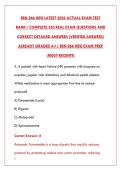
BSN 266 HESI LATEST 2026 ACTUAL EXAM TEST
BANK| COMPLETE 350 REAL EXAM QUESTIONS AND
CORRECT DETAILED ANSWERS (VERIFIED ANSWERS)
ALREADY GRADED A+| BSN 266 HESI EXAM PREP
(MOST RECENT!!)
1. A patient with heart failure (HF) presents with dyspnea on
exertion, jugular vein distention, and bilateral pedal edema.
Which medication is most appropriate first-line to reduce
preload?
A) Furosemide (Lasix)
B) Digoxin
C) Metoprolol
D) Spironolactone
Correct Answer: A
Rationale: Furosemide is a loop diuretic that rapidly reduces
preload by promoting sodium and water excretion, relieving
1
,symptoms of fluid overload (dyspnea, JVD, edema). Digoxin (B)
increases contractility but does not reduce preload. Metoprolol
(C) is a beta-blocker for chronic HF management but not first-line
for acute decompensation. Spironolactone (D) is a
potassium-sparing diuretic used in chronic HF.
2. A patient with hypertension has a blood pressure of 180/110
mmHg. Which finding requires immediate intervention?
A) Headache and blurred vision (hypertensive emergency)
B) Mild ankle edema
C) Occasional palpitations
D) Fatigue
Correct Answer: A
Rationale: BP ≥180/120 with target organ damage (headache,
blurred vision, dyspnea, chest pain, neurologic deficits) defines
hypertensive emergency requiring immediate IV antihypertensive
2
,therapy. Ankle edema (B), palpitations (C), and fatigue (D) are
not emergent.
3. A patient with acute myocardial infarction (MI) receives
thrombolytic therapy. Which complication is the nurse most
concerned about?
A) Bleeding (intracranial hemorrhage)
B) Bradycardia
C) Hyperglycemia
D) Constipation
Correct Answer: A
Rationale: Thrombolytics (e.g., tPA, tenecteplase) lyse clots but
also increase risk of bleeding, especially intracranial
hemorrhage. The nurse monitors for change in neurologic status,
severe headache, vomiting, and signs of internal bleeding.
Bradycardia (B) may occur during MI but is not the primary
complication of thrombolytics.
3
, 4. A patient with atrial fibrillation (AF) is prescribed warfarin.
The INR is 1.2. The nurse should:
A) Expect to administer additional warfarin as ordered
B) Hold the warfarin because INR is too high
C) Administer vitamin K
D) Document as normal
Correct Answer: A
Rationale: For AF, target INR is 2.0–3.0. INR 1.2 is
subtherapeutic; the patient is at risk for stroke. The provider will
likely increase the warfarin dose. Vitamin K (C) is given for
elevated INR with bleeding. Documenting (D) without action is
unsafe.
5. A patient with heart failure is started on carvedilol (Coreg).
The nurse should monitor for:
A) Bradycardia and hypotension
B) Hyperglycemia
4
BANK| COMPLETE 350 REAL EXAM QUESTIONS AND
CORRECT DETAILED ANSWERS (VERIFIED ANSWERS)
ALREADY GRADED A+| BSN 266 HESI EXAM PREP
(MOST RECENT!!)
1. A patient with heart failure (HF) presents with dyspnea on
exertion, jugular vein distention, and bilateral pedal edema.
Which medication is most appropriate first-line to reduce
preload?
A) Furosemide (Lasix)
B) Digoxin
C) Metoprolol
D) Spironolactone
Correct Answer: A
Rationale: Furosemide is a loop diuretic that rapidly reduces
preload by promoting sodium and water excretion, relieving
1
,symptoms of fluid overload (dyspnea, JVD, edema). Digoxin (B)
increases contractility but does not reduce preload. Metoprolol
(C) is a beta-blocker for chronic HF management but not first-line
for acute decompensation. Spironolactone (D) is a
potassium-sparing diuretic used in chronic HF.
2. A patient with hypertension has a blood pressure of 180/110
mmHg. Which finding requires immediate intervention?
A) Headache and blurred vision (hypertensive emergency)
B) Mild ankle edema
C) Occasional palpitations
D) Fatigue
Correct Answer: A
Rationale: BP ≥180/120 with target organ damage (headache,
blurred vision, dyspnea, chest pain, neurologic deficits) defines
hypertensive emergency requiring immediate IV antihypertensive
2
,therapy. Ankle edema (B), palpitations (C), and fatigue (D) are
not emergent.
3. A patient with acute myocardial infarction (MI) receives
thrombolytic therapy. Which complication is the nurse most
concerned about?
A) Bleeding (intracranial hemorrhage)
B) Bradycardia
C) Hyperglycemia
D) Constipation
Correct Answer: A
Rationale: Thrombolytics (e.g., tPA, tenecteplase) lyse clots but
also increase risk of bleeding, especially intracranial
hemorrhage. The nurse monitors for change in neurologic status,
severe headache, vomiting, and signs of internal bleeding.
Bradycardia (B) may occur during MI but is not the primary
complication of thrombolytics.
3
, 4. A patient with atrial fibrillation (AF) is prescribed warfarin.
The INR is 1.2. The nurse should:
A) Expect to administer additional warfarin as ordered
B) Hold the warfarin because INR is too high
C) Administer vitamin K
D) Document as normal
Correct Answer: A
Rationale: For AF, target INR is 2.0–3.0. INR 1.2 is
subtherapeutic; the patient is at risk for stroke. The provider will
likely increase the warfarin dose. Vitamin K (C) is given for
elevated INR with bleeding. Documenting (D) without action is
unsafe.
5. A patient with heart failure is started on carvedilol (Coreg).
The nurse should monitor for:
A) Bradycardia and hypotension
B) Hyperglycemia
4

