

MGMT 304 EXAM 1 QUESTIONS AND VERIFIED
ANSWERS
Correct
Incorrect
Your answers
1 of 80
Term
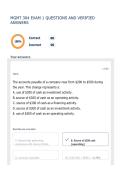
The accounts payable of a company rose from $200 to $500 during
the year. This change represents a:
A. use of $300 of cash as investment activity.
B. source of $300 of cash as an operating activity.
C. source of $300 of cash as a financing activity.
D. source of $300 of cash as an investment activity.
E. use of $500 of cash as an operating activity.
Give this one a try later!
E. Reward high performing B. Source of $300 cash
employees with shares of stock (operating)
D. Accounts receivable 98 / (538+294) = 98/832 = 11.78%.
, Don't know?
2 of 80
Definition
Definition: How quickly and cheaply an asset can be converted to
cash without significant loss of value.
Importance: Ensures a firm can meet short-term obligations, avoid
distress, and gives flexibility for surprises/opportunities. More liquidity
⇒ lower risk (but often lower return).
Give this one a try later!
What are the five groups of ratios?
What is liquidity? Why is it
Give two or threeexamples of each
important?
kind.
What is the cash flow identity? What is a source of cash? Give three
Explain what it says. examples.
Don't know?
3 of 80
Definition
Compounding means earning interest on both the principal and any
previously earned interest.
,Each period, the interest gets added to the balance, forming a
snowball effect.
The more frequently you compound, the faster your money grows.
✅ Key Idea: “Interest on interest.”
Give this one a try later!
➢ What does it mean to ➢ What do we mean by the present
compound interest? value of an investment?
What are the five groups of ratios?
What is the capital budgeting
Give two or threeexamples of each
decision?
kind.
Don't know?
4 of 80
Definition
Definition: A conflict of interest between management (agents) and
owners/shareholders (principals).
Root cause: Separation of ownership and control in corporations.
Shareholders want value maximization.
Managers may pursue personal goals (e.g., empire building, perks, job
security).
Examples:
Managers investing in low-return projects to increase firm size (empire
building)
Avoiding risky but value-increasing projects to protect their job
, behalf.
organization?
decision?
ANSWERS
Correct
Incorrect
Your answers
1 of 80
Term
The accounts payable of a company rose from $200 to $500 during
the year. This change represents a:
A. use of $300 of cash as investment activity.
B. source of $300 of cash as an operating activity.
C. source of $300 of cash as a financing activity.
D. source of $300 of cash as an investment activity.
E. use of $500 of cash as an operating activity.
Give this one a try later!
E. Reward high performing B. Source of $300 cash
employees with shares of stock (operating)
D. Accounts receivable 98 / (538+294) = 98/832 = 11.78%.
, Don't know?
2 of 80
Definition
Definition: How quickly and cheaply an asset can be converted to
cash without significant loss of value.
Importance: Ensures a firm can meet short-term obligations, avoid
distress, and gives flexibility for surprises/opportunities. More liquidity
⇒ lower risk (but often lower return).
Give this one a try later!
What are the five groups of ratios?
What is liquidity? Why is it
Give two or threeexamples of each
important?
kind.
What is the cash flow identity? What is a source of cash? Give three
Explain what it says. examples.
Don't know?
3 of 80
Definition
Compounding means earning interest on both the principal and any
previously earned interest.
,Each period, the interest gets added to the balance, forming a
snowball effect.
The more frequently you compound, the faster your money grows.
✅ Key Idea: “Interest on interest.”
Give this one a try later!
➢ What does it mean to ➢ What do we mean by the present
compound interest? value of an investment?
What are the five groups of ratios?
What is the capital budgeting
Give two or threeexamples of each
decision?
kind.
Don't know?
4 of 80
Definition
Definition: A conflict of interest between management (agents) and
owners/shareholders (principals).
Root cause: Separation of ownership and control in corporations.
Shareholders want value maximization.
Managers may pursue personal goals (e.g., empire building, perks, job
security).
Examples:
Managers investing in low-return projects to increase firm size (empire
building)
Avoiding risky but value-increasing projects to protect their job
, behalf.
organization?
decision?

