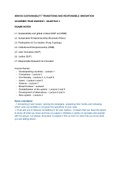
0EM150 SUSTAINABILITY TRANSITIONS AND RESPONSIBLE INNOVATION
ACADEMIC YEAR 2020/2021 - QUARTILE 3
EXAME NOTES
L1. Sustainability and global context (MLP and SNM)
L2. Sustainable Entrepreneurship (Business Ethics)
L3. Participation & Co-creation (Fung Typology)
L4. Institutional Entrepreneurship (SNM)
L5. User Innovation (MLP)
L6. Justice (EJF)
L7. Responsible Research & Innovation
Course themes
- Developed/ing countries – Lecture 1
- Companies – Lecture 2
- Civil Society – Lecture 3, 4, 5 and 6
- Users – Lecture 4 and 5
- Science – Lecture 7
- Broad Context – Lecture1
- Destabilisation of the system – Lecture 3 and 4
- Development of alternatives – Lecture 5 and 6
- New system – Lecture 2
Exam orientation
-> Answering it well means: naming the strategies, explaining their merits and indicating
which ones are suitable or not given the specificity of your case.
-> If we ask you to 'discuss' something or for your opinion - it means that you have the space
to show off what you know and how you apply it. Mobilise a variety of concepts and operate
with the jargon, but please remember to explain it first so that it is clear that you know what
you are talking about.
,L1. Sustainability and global context (MLP and SNM)
-> try to understand how transitions unfold in different contexts by looking at particular places
but also looking at connectives (spatial linkages), including the proximity
-> analyse global forces in the case
-> MPL – incorporate space dynamics and proximity issues
– MLP, an adjusted view of scale: focus on space. There is also a spatial scale in addition to
time and space.
– Analysis of the dynamics of socio-technical systems through interactions between actors
and institutions at various spatial scales (incorporating a spatial scale to the multi-level
perspective – MLP in addition to temporal and structural scale).
– The second generation of multi-level perspective (MLP) adds a spatial scale to the
perspective, complementing time and structure scales.
– Institutional and political aspects constitute the major barriers to transition and upscaling.
Proximity - as a factor in innovative activity
• Geographical (distance)
• Cognitive (shared knowledge)
• Organisational (control)
• Social (trust based on social relations)
• Institutional (based on common institutions, soft & hard)
MLP (Space)
Landscape – (international features) high proximity and power across incumbents
Regime – (national features) typical regime networks, high proximity and power within
incumbents
Niche – (national or local features) typical niche networks, low proximity and power within
niches
● Analysis of particular settings: places
– Analysis of particular settings (places) in which transitions are embedded & evolve
(absolute spatial scale)
MLP
- Look to Regime: high institutionalized social structures; set of regulative, normative,
cognitive rules; account for path-dependence, stability and lock-in; malfunction and
disrepair are temporary; need to be destabilised to stimulate change
* Hybrid, disaggregated; incomplete, fragmented; often in a state of disrepair; coexisting
variety - a strategy; precarious; Role of informal institutions, clash with formal; Distrust,
contestation, struggles, non-egalitarianism
- There is a Momentum (inertia) of social-technical regimes
- Look at the Path Dependence and Lock-in (Practices; Historical colonialism;
Discrimination; Enduring poverty; Social inequalities; Politics, power; Corruption)
- Check the Normative orientation - often assumed & not unpacked (what people really
think about sustainability) – differing qualitatively between places
, – Analysis of particular settings (places) reveals the importance of path dependence, culture,
politics, physical infrastructure, capabilities, and resource scarcity. So, it makes sense to
look at specific places.
– The space concept added is not only about territorial matters. It is in the sense that space
is also constructed and created through physical, social and economic networks.
– It is important to pay enough attention to local diversity, interpretations and institutional
contexts, to acknowledge the specificity of the various socio, political, economic and
historical contexts.
– Examining local practices to reflect to what extent local circumstances may determine
certain developments.
– The historical and current reality of the developed and developing world differs
significantly.
– Regimes in the developing world show a much higher degree of non-uniformity and
internal tensions than in developed contexts.
Analysis of particular settings reveals:
• Local, regional, global, rural, urban scales
• Spatial differentiation, place specificity
• Importance of path dependence, culture, politics, physical infrastructure, capabilities,
resource scarcity
• ‘Stickiness of institutions’ (Amin and Thrift, 1994)
• Potential for transitions differing qualitatively b’n places
-> Transitions as constituted spatially, happening in actual geographical places that have
materiality to them
● Analysis of connections: linkages
– Attention to geo connections & interactions (spatial linkages) within & between places
Transnational connectivity
- Means to complement missing resources & capacities
- Importance of local specificity (understand the real needs)
SMN
Experimentation
– An inclusive, practice-based and challenge-led initiative designed to promote system
innovation through social learning under conditions of deep uncertainty and ambiguity
– What exactly is sustainable and how to achieve it since the definition of sustainability may
vary depending on the social and material factors interacting.
Transnational linkages
– Transnational linkages refer to diverse cross-border interactions, relationships and
infrastructures that enable the flows and circulations of resources, people, knowledge,
technologies, institutions and finance. Transnational linkages complement local, regional and
national capabilities assisting experiments in sustainable transitions in a global context.
– Transitions of socio-technical systems are developed and shaped by interactions,
relationships and infrastructures between actors across different spatial scale levels.
– Exploring the connections and interactions between and across various spatial scales and
levels.
ACADEMIC YEAR 2020/2021 - QUARTILE 3
EXAME NOTES
L1. Sustainability and global context (MLP and SNM)
L2. Sustainable Entrepreneurship (Business Ethics)
L3. Participation & Co-creation (Fung Typology)
L4. Institutional Entrepreneurship (SNM)
L5. User Innovation (MLP)
L6. Justice (EJF)
L7. Responsible Research & Innovation
Course themes
- Developed/ing countries – Lecture 1
- Companies – Lecture 2
- Civil Society – Lecture 3, 4, 5 and 6
- Users – Lecture 4 and 5
- Science – Lecture 7
- Broad Context – Lecture1
- Destabilisation of the system – Lecture 3 and 4
- Development of alternatives – Lecture 5 and 6
- New system – Lecture 2
Exam orientation
-> Answering it well means: naming the strategies, explaining their merits and indicating
which ones are suitable or not given the specificity of your case.
-> If we ask you to 'discuss' something or for your opinion - it means that you have the space
to show off what you know and how you apply it. Mobilise a variety of concepts and operate
with the jargon, but please remember to explain it first so that it is clear that you know what
you are talking about.
,L1. Sustainability and global context (MLP and SNM)
-> try to understand how transitions unfold in different contexts by looking at particular places
but also looking at connectives (spatial linkages), including the proximity
-> analyse global forces in the case
-> MPL – incorporate space dynamics and proximity issues
– MLP, an adjusted view of scale: focus on space. There is also a spatial scale in addition to
time and space.
– Analysis of the dynamics of socio-technical systems through interactions between actors
and institutions at various spatial scales (incorporating a spatial scale to the multi-level
perspective – MLP in addition to temporal and structural scale).
– The second generation of multi-level perspective (MLP) adds a spatial scale to the
perspective, complementing time and structure scales.
– Institutional and political aspects constitute the major barriers to transition and upscaling.
Proximity - as a factor in innovative activity
• Geographical (distance)
• Cognitive (shared knowledge)
• Organisational (control)
• Social (trust based on social relations)
• Institutional (based on common institutions, soft & hard)
MLP (Space)
Landscape – (international features) high proximity and power across incumbents
Regime – (national features) typical regime networks, high proximity and power within
incumbents
Niche – (national or local features) typical niche networks, low proximity and power within
niches
● Analysis of particular settings: places
– Analysis of particular settings (places) in which transitions are embedded & evolve
(absolute spatial scale)
MLP
- Look to Regime: high institutionalized social structures; set of regulative, normative,
cognitive rules; account for path-dependence, stability and lock-in; malfunction and
disrepair are temporary; need to be destabilised to stimulate change
* Hybrid, disaggregated; incomplete, fragmented; often in a state of disrepair; coexisting
variety - a strategy; precarious; Role of informal institutions, clash with formal; Distrust,
contestation, struggles, non-egalitarianism
- There is a Momentum (inertia) of social-technical regimes
- Look at the Path Dependence and Lock-in (Practices; Historical colonialism;
Discrimination; Enduring poverty; Social inequalities; Politics, power; Corruption)
- Check the Normative orientation - often assumed & not unpacked (what people really
think about sustainability) – differing qualitatively between places
, – Analysis of particular settings (places) reveals the importance of path dependence, culture,
politics, physical infrastructure, capabilities, and resource scarcity. So, it makes sense to
look at specific places.
– The space concept added is not only about territorial matters. It is in the sense that space
is also constructed and created through physical, social and economic networks.
– It is important to pay enough attention to local diversity, interpretations and institutional
contexts, to acknowledge the specificity of the various socio, political, economic and
historical contexts.
– Examining local practices to reflect to what extent local circumstances may determine
certain developments.
– The historical and current reality of the developed and developing world differs
significantly.
– Regimes in the developing world show a much higher degree of non-uniformity and
internal tensions than in developed contexts.
Analysis of particular settings reveals:
• Local, regional, global, rural, urban scales
• Spatial differentiation, place specificity
• Importance of path dependence, culture, politics, physical infrastructure, capabilities,
resource scarcity
• ‘Stickiness of institutions’ (Amin and Thrift, 1994)
• Potential for transitions differing qualitatively b’n places
-> Transitions as constituted spatially, happening in actual geographical places that have
materiality to them
● Analysis of connections: linkages
– Attention to geo connections & interactions (spatial linkages) within & between places
Transnational connectivity
- Means to complement missing resources & capacities
- Importance of local specificity (understand the real needs)
SMN
Experimentation
– An inclusive, practice-based and challenge-led initiative designed to promote system
innovation through social learning under conditions of deep uncertainty and ambiguity
– What exactly is sustainable and how to achieve it since the definition of sustainability may
vary depending on the social and material factors interacting.
Transnational linkages
– Transnational linkages refer to diverse cross-border interactions, relationships and
infrastructures that enable the flows and circulations of resources, people, knowledge,
technologies, institutions and finance. Transnational linkages complement local, regional and
national capabilities assisting experiments in sustainable transitions in a global context.
– Transitions of socio-technical systems are developed and shaped by interactions,
relationships and infrastructures between actors across different spatial scale levels.
– Exploring the connections and interactions between and across various spatial scales and
levels.