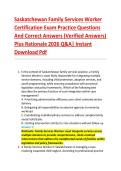
Alberta Child Protection Worker
Competency Assessment Exam Practice
Questions And Correct Answers
(Verified Answers) Plus Rationale 2026
Q&A| Instant Download Pdf
1. A newly assigned child protection worker in Alberta receives a report
that a 7-year-old child is frequently absent from school, appears
unkempt, and often arrives hungry. The caregiver denies neglect and
attributes the situation to financial stress. What is the most
appropriate initial response?
A. Immediately remove the child from the home without assessment
B. Open a file, conduct a safety assessment, and gather collateral
information
C. Close the file because poverty alone is not neglect
D. Refer the case to police for criminal neglect investigation
Correct answer: B
Rationale: A child protection worker must first conduct a structured safety
assessment and gather information before making decisions about
removal or closure, as initial reports require verification and balanced
evaluation.
2. During an investigation, a parent admits to using physical discipline
that leaves bruises but insists it is culturally acceptable. What principle
should guide the worker’s response in Alberta?
,A. Cultural practices override provincial child protection standards
B. Physical discipline is always criminal regardless of severity
C. The child’s safety and harm threshold under provincial legislation is the
primary consideration
D. The case must automatically be transferred to immigration services
Correct answer: C
Rationale: Child protection decisions are governed by the child’s safety and
statutory thresholds, not cultural justification alone, especially when
physical harm is present.
3. A 14-year-old discloses suicidal thoughts but refuses consent to
contact caregivers. What is the worker’s best action?
A. Respect confidentiality and take no further action
B. Immediately involve emergency mental health intervention due to
imminent risk
C. Wait until parental consent is obtained
D. Close the file if the youth is not in immediate danger
Correct answer: B
Rationale: When there is risk of serious harm such as suicidality,
confidentiality limits are overridden to ensure immediate safety
intervention.
4. A child is found living in a home with chronic domestic violence
between caregivers. The child is not directly physically harmed. What
risk factor is most significant?
A. Economic instability
B. Exposure to domestic violence as emotional and developmental harm
C. Lack of extended family support
D. School absenteeism alone
Correct answer: B
Rationale: Exposure to domestic violence is recognized as significant
,emotional and developmental harm, even in absence of direct physical
injury.
5. A worker is unsure whether a report meets the threshold for
intervention. What is the best practice?
A. Immediately dismiss unclear reports
B. Consult supervision and complete a structured intake assessment
C. Wait for additional reports before taking action
D. Refer all unclear reports to law enforcement
Correct answer: B
Rationale: Professional standards require consultation and structured
assessment when thresholds are unclear, ensuring informed decision-
making.
6. A parent refuses all services offered but there is moderate risk to the
child. What is the most appropriate response?
A. Close the case immediately
B. Respect refusal and take no further steps
C. Continue monitoring and consider court intervention if risk escalates
D. Remove the child without documentation
Correct answer: C
Rationale: Service refusal does not eliminate child protection
responsibility; ongoing monitoring and escalation pathways are required.
7. A child discloses physical abuse by a caregiver but later recants the
statement. What should the worker do?
A. Disregard the initial disclosure entirely
B. Proceed with a full investigation using corroborating evidence
C. Immediately close the file
D. Assume the child was lying and penalize the family
, Correct answer: B
Rationale: Recantation is common in abuse cases; investigations must
continue using multiple evidence sources.
8. A teenager is frequently absent from school due to caring for younger
siblings. What is the primary concern?
A. Academic performance only
B. Potential role reversal and neglect indicators
C. Lack of transportation
D. Poor school policy compliance
Correct answer: B
Rationale: Chronic caregiving responsibilities for siblings may indicate
parentification and neglect concerns.
9. A caregiver has untreated substance use disorder affecting parenting
capacity. What is the worker’s priority?
A. Punitive action
B. Child safety and risk mitigation planning
C. Immediate criminal prosecution
D. Ignoring substance use unless child is injured
Correct answer: B
Rationale: Child protection focuses on safety planning and risk mitigation
rather than punishment.
10. A child is suspected to be experiencing emotional abuse. Which
indicator is most relevant?
A. Good physical health
B. Persistent anxiety, withdrawal, and fearfulness
C. High academic achievement
D. Strong peer relationships
Competency Assessment Exam Practice
Questions And Correct Answers
(Verified Answers) Plus Rationale 2026
Q&A| Instant Download Pdf
1. A newly assigned child protection worker in Alberta receives a report
that a 7-year-old child is frequently absent from school, appears
unkempt, and often arrives hungry. The caregiver denies neglect and
attributes the situation to financial stress. What is the most
appropriate initial response?
A. Immediately remove the child from the home without assessment
B. Open a file, conduct a safety assessment, and gather collateral
information
C. Close the file because poverty alone is not neglect
D. Refer the case to police for criminal neglect investigation
Correct answer: B
Rationale: A child protection worker must first conduct a structured safety
assessment and gather information before making decisions about
removal or closure, as initial reports require verification and balanced
evaluation.
2. During an investigation, a parent admits to using physical discipline
that leaves bruises but insists it is culturally acceptable. What principle
should guide the worker’s response in Alberta?
,A. Cultural practices override provincial child protection standards
B. Physical discipline is always criminal regardless of severity
C. The child’s safety and harm threshold under provincial legislation is the
primary consideration
D. The case must automatically be transferred to immigration services
Correct answer: C
Rationale: Child protection decisions are governed by the child’s safety and
statutory thresholds, not cultural justification alone, especially when
physical harm is present.
3. A 14-year-old discloses suicidal thoughts but refuses consent to
contact caregivers. What is the worker’s best action?
A. Respect confidentiality and take no further action
B. Immediately involve emergency mental health intervention due to
imminent risk
C. Wait until parental consent is obtained
D. Close the file if the youth is not in immediate danger
Correct answer: B
Rationale: When there is risk of serious harm such as suicidality,
confidentiality limits are overridden to ensure immediate safety
intervention.
4. A child is found living in a home with chronic domestic violence
between caregivers. The child is not directly physically harmed. What
risk factor is most significant?
A. Economic instability
B. Exposure to domestic violence as emotional and developmental harm
C. Lack of extended family support
D. School absenteeism alone
Correct answer: B
Rationale: Exposure to domestic violence is recognized as significant
,emotional and developmental harm, even in absence of direct physical
injury.
5. A worker is unsure whether a report meets the threshold for
intervention. What is the best practice?
A. Immediately dismiss unclear reports
B. Consult supervision and complete a structured intake assessment
C. Wait for additional reports before taking action
D. Refer all unclear reports to law enforcement
Correct answer: B
Rationale: Professional standards require consultation and structured
assessment when thresholds are unclear, ensuring informed decision-
making.
6. A parent refuses all services offered but there is moderate risk to the
child. What is the most appropriate response?
A. Close the case immediately
B. Respect refusal and take no further steps
C. Continue monitoring and consider court intervention if risk escalates
D. Remove the child without documentation
Correct answer: C
Rationale: Service refusal does not eliminate child protection
responsibility; ongoing monitoring and escalation pathways are required.
7. A child discloses physical abuse by a caregiver but later recants the
statement. What should the worker do?
A. Disregard the initial disclosure entirely
B. Proceed with a full investigation using corroborating evidence
C. Immediately close the file
D. Assume the child was lying and penalize the family
, Correct answer: B
Rationale: Recantation is common in abuse cases; investigations must
continue using multiple evidence sources.
8. A teenager is frequently absent from school due to caring for younger
siblings. What is the primary concern?
A. Academic performance only
B. Potential role reversal and neglect indicators
C. Lack of transportation
D. Poor school policy compliance
Correct answer: B
Rationale: Chronic caregiving responsibilities for siblings may indicate
parentification and neglect concerns.
9. A caregiver has untreated substance use disorder affecting parenting
capacity. What is the worker’s priority?
A. Punitive action
B. Child safety and risk mitigation planning
C. Immediate criminal prosecution
D. Ignoring substance use unless child is injured
Correct answer: B
Rationale: Child protection focuses on safety planning and risk mitigation
rather than punishment.
10. A child is suspected to be experiencing emotional abuse. Which
indicator is most relevant?
A. Good physical health
B. Persistent anxiety, withdrawal, and fearfulness
C. High academic achievement
D. Strong peer relationships