Pharmacologic Principles – Chapter 2
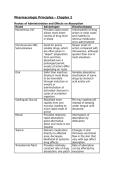
Routes of Administration and Effects on Absorption
Route Advantages Disadvantages
Intravenous (IV) Provides rapid onset; Irreversibility of drug
allows more direct action in most cases
control of drug level and inability to
in blood retrieve medication
once administered
Intramuscular (IM); Good for poorly Slower onset of
Subcutaneous soluble drugs, which action compared with
are often given in intravenous, although
“depot” preparation quicker than oral in
form and then most situations
absorbed over a
prolonged period;
onsets of action differ
depending on route
Oral Safer than injection; Variable absorption;
dosing is more likely inactivation of some
to be reversible drugs by stomach
through induction or acid and/or pH.
emesis or
administration of
activated charcoal in
cases of accidental
ingestion
Sublingual; Buccal Absorbed more Pts may swallow pill
rapidly from oral instead of keeping
mucosa, leading to under tongue until
more rapid onset of dissolved.
action
Rectal Provided relatively Interruption of
rapid absorption; absorption by
good alternative defecation
when oral route is not
feasible
Topical Delivers medication Changes in skin
directly to affected thickness and blood
area; decreases flow in the skin that
likelihood of systemic vary with age affect
drug effects. absorption
Transdermal Patch Provides relatively Rate of absorption
constant rate of drug can be affected by
absorption; one patch excessive
, can last 1 to 7 days, perspiration and body
depending on the temperature; patch
drug. may peel off.
Inhalational Provided rapid Rate of absorption
absorption; drug can be too rapid,
delivered directly to increasing the risk of
lung tissues, where exaggerated drug
most of these drugs effects.
exert their actions
EAQ Notes
Metabolism connotes the breakdown of a product. Biotransformation is
a more accurate term because some drugs are actually changed into
an active from in the liver, in contrast to being broken down for
excretion.
Tolerance is a physiologic response in which the therapeutic response
to a drug is diminished because of its prolonged presence in the body.
Bioavailability is the quantity of a drug available in the body after it is
administered either orally or via other routes. A bioavailability of 100%
is recorded when drugs are administered intravenously directly into the
bloodstream.
Oral medications, which are absorbed in the stomach and small
intestine, travel through the portal system and are metabolized by the
liver (first-pass effect) before they reach the general circulation.
Drug half-life is defined as the amount of time required for 50% of a
drug to be eliminated by the body.
o Drug half-life is extended secondary to diminished liver and renal
function in older adults.
An additive effect is said to be present when two drugs with similar
actions are administered together.
Acute therapy is implemented in the acutely or the critically ill and is
often needed to sustain life or treat disease.
Pharmacokinetics involves how the drug moves through the body,
including absorption, distribution, metabolism, and excretion.
Maintenance therapy maintains the patient in a stable state of a
disease or condition and may not actively cure the disease.
Supplemental therapies are used to supplement deficient substances
in the body along with other therapies
Palliative therapy is started when all curative therapies of end-stage
organ diseases are unsuccessful
Empiric therapy involves drug administration based on the pts
symptoms when there is a high likelihood of a certain pathologic
condition.
Enteric-coated tablets have a specialized coating that prevents the
drug from being dissolved in the stomach, where the pH is low (acidic).
Routes of Administration and Effects on Absorption
Route Advantages Disadvantages
Intravenous (IV) Provides rapid onset; Irreversibility of drug
allows more direct action in most cases
control of drug level and inability to
in blood retrieve medication
once administered
Intramuscular (IM); Good for poorly Slower onset of
Subcutaneous soluble drugs, which action compared with
are often given in intravenous, although
“depot” preparation quicker than oral in
form and then most situations
absorbed over a
prolonged period;
onsets of action differ
depending on route
Oral Safer than injection; Variable absorption;
dosing is more likely inactivation of some
to be reversible drugs by stomach
through induction or acid and/or pH.
emesis or
administration of
activated charcoal in
cases of accidental
ingestion
Sublingual; Buccal Absorbed more Pts may swallow pill
rapidly from oral instead of keeping
mucosa, leading to under tongue until
more rapid onset of dissolved.
action
Rectal Provided relatively Interruption of
rapid absorption; absorption by
good alternative defecation
when oral route is not
feasible
Topical Delivers medication Changes in skin
directly to affected thickness and blood
area; decreases flow in the skin that
likelihood of systemic vary with age affect
drug effects. absorption
Transdermal Patch Provides relatively Rate of absorption
constant rate of drug can be affected by
absorption; one patch excessive
, can last 1 to 7 days, perspiration and body
depending on the temperature; patch
drug. may peel off.
Inhalational Provided rapid Rate of absorption
absorption; drug can be too rapid,
delivered directly to increasing the risk of
lung tissues, where exaggerated drug
most of these drugs effects.
exert their actions
EAQ Notes
Metabolism connotes the breakdown of a product. Biotransformation is
a more accurate term because some drugs are actually changed into
an active from in the liver, in contrast to being broken down for
excretion.
Tolerance is a physiologic response in which the therapeutic response
to a drug is diminished because of its prolonged presence in the body.
Bioavailability is the quantity of a drug available in the body after it is
administered either orally or via other routes. A bioavailability of 100%
is recorded when drugs are administered intravenously directly into the
bloodstream.
Oral medications, which are absorbed in the stomach and small
intestine, travel through the portal system and are metabolized by the
liver (first-pass effect) before they reach the general circulation.
Drug half-life is defined as the amount of time required for 50% of a
drug to be eliminated by the body.
o Drug half-life is extended secondary to diminished liver and renal
function in older adults.
An additive effect is said to be present when two drugs with similar
actions are administered together.
Acute therapy is implemented in the acutely or the critically ill and is
often needed to sustain life or treat disease.
Pharmacokinetics involves how the drug moves through the body,
including absorption, distribution, metabolism, and excretion.
Maintenance therapy maintains the patient in a stable state of a
disease or condition and may not actively cure the disease.
Supplemental therapies are used to supplement deficient substances
in the body along with other therapies
Palliative therapy is started when all curative therapies of end-stage
organ diseases are unsuccessful
Empiric therapy involves drug administration based on the pts
symptoms when there is a high likelihood of a certain pathologic
condition.
Enteric-coated tablets have a specialized coating that prevents the
drug from being dissolved in the stomach, where the pH is low (acidic).