1
Problem 8
1. What is love & relationships?
Relationships
• Exchange relationships: participants expect/desire strict mutual benefits in their interactions
• Communal relationship: participants expect/desire mutual responsiveness to each other’s needs,
without regard whether the have given/received a benefit
Love
• Combination of often powerful emotions, thoughts, actions & usually associated with intimate
relationships
Two broad types of love
• Companionate love: caring & affection for another person that usually arises from sharing time
together
o Combines feeling of friendly affection & deep attachment
o No physiological arousal
• Passionate (romantic) love: state of intense absorption in another person that involves physiological
arousal
Three-factor Theory of Love (Hatfield & Walster)
1. Cultural determinant that acknowledges love as a state (concept of love)
2. Presence of appropriate love object
3. Emotional arousal felt when interacting with/ thinking of appropriate love object
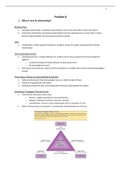
Sternberg’s Triangular Theory of Love
• Three factors that play a role in love
o Passion: roughly equivalent to sexual attraction
o Intimacy: feelings of warmth, closeness, sharing
o Commitment: resolve to main relationship even in moments of crisis
• When all three factors are present → consummate love (ultimate form of love)
, 2
2. What factors influence people falling in love (circumstances, personal dispositions
etc.)
è does it happen consciously?
Propinquity/ proximity effect
• the more we see and interact with people, the more likely they are to become our friends
• Study by Festinger, Schachter & Back (1950)
o Tracked friendship formation in apartment buildings of MIT
o Asked residence to name their three closest friends in the buildings
o 65 % of mentioned friends live in the same building
o 41 % was friends with their next-door-neighbour
o 10% was friends with someone who lived at the end of the hall
→ attraction & proximity also relies on “functional distance” (with who will you cross path the most
due to architectural design)
• Proximity works because of mere exposure effect: the more exposure we have to a stimulus the more
apt we are to like it
• The more often we see people, the more familiar they become, the more friendship develops
• Exception: if you do not like the person from the beginning, your dislike will only grow
• Study by Back, Schmukle & Egloff (2008)
o Assigned German students to a random seat at the beginning of the year
o People who sat next to each other had higher initial attractions scores from the beginning
o At the end of the year neighbours were still more likely to be friends
• Reinforcement-affect model: model of attraction that postulates that we like people who are
around when we experience a positive feeling
Similarity
• Similarity draws people together
• The more similar someone’s opinions are to yours, the more you will like the person
• Study by Newcomb (1961)
o Randomly assigned male students at university to be roommates in dormitory
o Results: Men became friends with people who were demographically similar, had similar
attitudes, values & similar personalities
• Similar interests & experiences draw us to people
o We choose to enter into certain social situations where we then find similar others (e.g.
university)
• People are drawn to other’s who have a similar appearance
o Study by Mackinnon, Jordan & Wilson (2011)
§ Analysed the seating arrangement of college students in library computer lab
§ Students who were glasses sat next to people with glasses
§ Students with similar appearance sat closer to each other
• People are drawn to people who are genetically similar to them
o Study by Christakis & Fowler
§ Found that participants shared more DNA with friends than with stranger
Physical Attractiveness
• People are drawn to people they find physical attractive
• Study by Hatfield
o Randomly matched incoming students at university for a blind date
Problem 8
1. What is love & relationships?
Relationships
• Exchange relationships: participants expect/desire strict mutual benefits in their interactions
• Communal relationship: participants expect/desire mutual responsiveness to each other’s needs,
without regard whether the have given/received a benefit
Love
• Combination of often powerful emotions, thoughts, actions & usually associated with intimate
relationships
Two broad types of love
• Companionate love: caring & affection for another person that usually arises from sharing time
together
o Combines feeling of friendly affection & deep attachment
o No physiological arousal
• Passionate (romantic) love: state of intense absorption in another person that involves physiological
arousal
Three-factor Theory of Love (Hatfield & Walster)
1. Cultural determinant that acknowledges love as a state (concept of love)
2. Presence of appropriate love object
3. Emotional arousal felt when interacting with/ thinking of appropriate love object
Sternberg’s Triangular Theory of Love
• Three factors that play a role in love
o Passion: roughly equivalent to sexual attraction
o Intimacy: feelings of warmth, closeness, sharing
o Commitment: resolve to main relationship even in moments of crisis
• When all three factors are present → consummate love (ultimate form of love)
, 2
2. What factors influence people falling in love (circumstances, personal dispositions
etc.)
è does it happen consciously?
Propinquity/ proximity effect
• the more we see and interact with people, the more likely they are to become our friends
• Study by Festinger, Schachter & Back (1950)
o Tracked friendship formation in apartment buildings of MIT
o Asked residence to name their three closest friends in the buildings
o 65 % of mentioned friends live in the same building
o 41 % was friends with their next-door-neighbour
o 10% was friends with someone who lived at the end of the hall
→ attraction & proximity also relies on “functional distance” (with who will you cross path the most
due to architectural design)
• Proximity works because of mere exposure effect: the more exposure we have to a stimulus the more
apt we are to like it
• The more often we see people, the more familiar they become, the more friendship develops
• Exception: if you do not like the person from the beginning, your dislike will only grow
• Study by Back, Schmukle & Egloff (2008)
o Assigned German students to a random seat at the beginning of the year
o People who sat next to each other had higher initial attractions scores from the beginning
o At the end of the year neighbours were still more likely to be friends
• Reinforcement-affect model: model of attraction that postulates that we like people who are
around when we experience a positive feeling
Similarity
• Similarity draws people together
• The more similar someone’s opinions are to yours, the more you will like the person
• Study by Newcomb (1961)
o Randomly assigned male students at university to be roommates in dormitory
o Results: Men became friends with people who were demographically similar, had similar
attitudes, values & similar personalities
• Similar interests & experiences draw us to people
o We choose to enter into certain social situations where we then find similar others (e.g.
university)
• People are drawn to other’s who have a similar appearance
o Study by Mackinnon, Jordan & Wilson (2011)
§ Analysed the seating arrangement of college students in library computer lab
§ Students who were glasses sat next to people with glasses
§ Students with similar appearance sat closer to each other
• People are drawn to people who are genetically similar to them
o Study by Christakis & Fowler
§ Found that participants shared more DNA with friends than with stranger
Physical Attractiveness
• People are drawn to people they find physical attractive
• Study by Hatfield
o Randomly matched incoming students at university for a blind date