

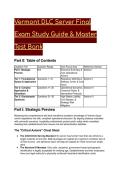
Vermont DLC Server Final
Exam Study Guide & Master
Test Bank
Part 0: Table of Contents
Cognitive Tier Question Range Core Focus Area Reference Section
Part I: Strategic N/A Executive Summary & Section I
Preview Core Operational
Axioms
Tier 1: Foundational Questions 1–10 Regulatory Definitions, Section II
Syntax & Application Statutory Limits, & Core
Hours
Tier 2: Complex Questions 11–20 Operational Scenarios, Section III
Application & Crossover Rules, &
Simulation Intervention Protocols
Tier 3: Grandmaster Questions 21–30 High-Stakes Liability, Section IV
Synthesis Civil Statutes, &
Strategic Risk
Mitigation
Part I: Strategic Preview
Mastering this comprehensive test bank transforms academic knowledge of Vermont liquor
control regulations into elite, compliant operational execution. By aligning statutory mandates
with real-world scenarios, hospitality professionals protect public safety while completely
shielding their establishments from severe civil and administrative liabilities.
The "Critical Axioms" Cheat Sheet
● The 2/32/4 Drink Serving Standard: No server may furnish more than two drinks to a
single customer at one time. Malt beverages are capped at a maximum container size of
32 fluid ounces , and spirituous liquor servings are capped at 4 fluid ounces per single
drink.
● The Absolute ID Mandate: Only valid, unexpired, government-issued photographic
identification is legally acceptable for verifying age. Establishments and their employees
have zero legal authority to physically confiscate fraudulent identification cards;
, confiscation is strictly reserved for sworn law enforcement officers.
● Dram Shop Liability Threshold (7 V.S.A. § 501): Civil liability is triggered when a
licensee negligently serves an "apparently under the influence" patron who exhibits
perceptible signs of impairment, or serves a minor. The statute of limitations for filing a
civil action under § 501 is strictly two years from the date of the injury.
● Mandated License Revocation (7 V.S.A. § 503): If a civil judgment recovered under the
Dram Shop Act remains unsatisfied for 30 days, the control commissioners or the state
liquor board must immediately revoke the licensee's retail permit.
● On-Premises Hours and Consumption (7 V.S.A. § 62): On-premises First- and
Third-class licensees may sell alcoholic beverages between 8:00 a.m. and 2:00 a.m. the
next morning. All physical consumption of alcoholic beverages must cease entirely on the
licensed premises by 2:30 a.m..
Part II: The Elite Test Bank
Tier 1: Foundational Syntax & Application (Questions 1–10)
Q1: An employee is hired to work at a multi-concept establishment in Burlington that features
both a retail market holding a Second-class license and a casual dining room holding a
First-class license. The employee is exactly 16 years of age and has successfully completed the
appropriate Vermont Division of Liquor Control (DLC) in-house training program. Based on the
youth employment standards of the Vermont Department of Liquor and Lottery, which statement
regarding the employee's allowable duties is the MOST ACCURATE? A) The employee is
legally permitted to both operate the cash register to sell packaged beer in the market and serve
glasses of wine to guests in the dining room. B) The employee is legally permitted to operate
the cash register to sell packaged beer in the market, but is strictly prohibited from pouring,
serving, or handling alcohol in the dining room. C) The employee is legally prohibited from
performing any cash register duties in the market, but may serve alcohol in the dining room
under the direct physical supervision of a manager. D) The employee is completely barred from
working at either concept because the minimum age to handle or sell alcoholic beverages in any
capacity in Vermont is 18.
● The Answer: B (The employee is legally permitted to operate the cash register to sell
packaged beer in the market, but is strictly prohibited from pouring, serving, or handling
alcohol in the dining room.)
● Distractor Analysis:
○ A is incorrect: Completed in-house training cannot override the strict statutory
minimum age of 18 required for on-premises servers.
○ C is incorrect: The cash register sales are legally permitted for 16-year-olds under a
Second-class license, while on-premises service remains restricted to those 18 or
older.
○ D is incorrect: Vermont law explicitly permits 16-year-olds to sell alcohol and
tobacco in Second-class retail environments.
The Mentor's Analysis: Statutory compliance requires a clear separation between retail sales
and on-premise service age floors. When managing underage staff, the immediate priority is
matching the employee's physical age to the specific license class of the establishment. By
utilizing the age-appropriate division of labor (16 for off-premise sales, 18 for on-premise
service), the licensee bypasses the common trap of severe labor and liquor control violations.
, Professional/Academic Intuition: Age sixteen is the hard deck for retail cashiers; age
eighteen is the absolute threshold for on-premise bartenders and servers.
Double-space
Q2: A career bartender relocates to Montpelier and accepts a position at a new craft cocktail
bar. The bartender presents an online server certification issued by an approved third-party
provider that is dated exactly 23 months prior to the date of hire. Based on the education
regulations of the Vermont Division of Liquor Control, which conclusion regarding the
certification's validity is the MOST ACCURATE? A) The certification has expired because all
Vermont server training must be renewed annually. B) The certification is fully valid at the time of
hire, but the bartender must undergo approved re-certification training before the 24-month
mark is reached. C) The certification is void because third-party online training certificates are
non-transferable between employers. D) The certification is valid for a full three-year period
under the state's modern streamlined licensing standard.
● The Answer: B (The certification is fully valid at the time of hire, but the bartender must
undergo approved re-certification training before the 24-month mark is reached.)
● Distractor Analysis:
○ A is incorrect: The statutory validity period for server and seller training in Vermont
is 24 months, not 12 months.
○ C is incorrect: Approved third-party and online training certifications are portable
across the state, unlike specific in-house permits.
○ D is incorrect: A three-year period applies to licensees attending enforcement
seminars, not standard employee server certifications.
The Mentor's Analysis: Professional credentials must be monitored for continuous compliance.
When onboarded at a new facility, the immediate priority is verifying the issue date of the
prospective employee's server certificate. By utilizing the 24-month renewal cycle, the operator
bypasses the common trap of allowing uncertified or expired staff to serve alcohol, which
triggers immediate administrative fines. Professional/Academic Intuition: All retail and
on-premise server certifications expire exactly two years from the date of issue.
Double-space
Q3: A server at a resort in Killington completes a formal in-house server training program run by
the resort's certified trainer. Three months later, the server takes a second job at an independent
tavern down the road. Based on the regulations of the Vermont Division of Liquor Control
regarding in-house training programs, which statement is the MOST ACCURATE? A) The
server can use the resort's in-house certificate at the tavern because all DLC-approved
certifications are valid statewide. B) The server must complete a new training program at the
tavern because in-house training certifications are strictly non-transferable and only valid at the
original business. C) The server can work at the tavern if both managers sign a joint waiver
recognizing the prior resort training. D) The server's in-house training is valid for the second job
only if both establishments hold the exact same class of liquor license.
● The Answer: B (The server must complete a new training program at the tavern because
in-house training certifications are strictly non-transferable and only valid at the original
business.)
● Distractor Analysis:
○ A is incorrect: General state or approved 3rd-party certificates are portable, but
in-house specific certifications are not.
○ C is incorrect: Management waivers cannot bypass the statutory requirement for
valid server training.
○ D is incorrect: License matching does not allow the transfer of an in-house
Exam Study Guide & Master
Test Bank
Part 0: Table of Contents
Cognitive Tier Question Range Core Focus Area Reference Section
Part I: Strategic N/A Executive Summary & Section I
Preview Core Operational
Axioms
Tier 1: Foundational Questions 1–10 Regulatory Definitions, Section II
Syntax & Application Statutory Limits, & Core
Hours
Tier 2: Complex Questions 11–20 Operational Scenarios, Section III
Application & Crossover Rules, &
Simulation Intervention Protocols
Tier 3: Grandmaster Questions 21–30 High-Stakes Liability, Section IV
Synthesis Civil Statutes, &
Strategic Risk
Mitigation
Part I: Strategic Preview
Mastering this comprehensive test bank transforms academic knowledge of Vermont liquor
control regulations into elite, compliant operational execution. By aligning statutory mandates
with real-world scenarios, hospitality professionals protect public safety while completely
shielding their establishments from severe civil and administrative liabilities.
The "Critical Axioms" Cheat Sheet
● The 2/32/4 Drink Serving Standard: No server may furnish more than two drinks to a
single customer at one time. Malt beverages are capped at a maximum container size of
32 fluid ounces , and spirituous liquor servings are capped at 4 fluid ounces per single
drink.
● The Absolute ID Mandate: Only valid, unexpired, government-issued photographic
identification is legally acceptable for verifying age. Establishments and their employees
have zero legal authority to physically confiscate fraudulent identification cards;
, confiscation is strictly reserved for sworn law enforcement officers.
● Dram Shop Liability Threshold (7 V.S.A. § 501): Civil liability is triggered when a
licensee negligently serves an "apparently under the influence" patron who exhibits
perceptible signs of impairment, or serves a minor. The statute of limitations for filing a
civil action under § 501 is strictly two years from the date of the injury.
● Mandated License Revocation (7 V.S.A. § 503): If a civil judgment recovered under the
Dram Shop Act remains unsatisfied for 30 days, the control commissioners or the state
liquor board must immediately revoke the licensee's retail permit.
● On-Premises Hours and Consumption (7 V.S.A. § 62): On-premises First- and
Third-class licensees may sell alcoholic beverages between 8:00 a.m. and 2:00 a.m. the
next morning. All physical consumption of alcoholic beverages must cease entirely on the
licensed premises by 2:30 a.m..
Part II: The Elite Test Bank
Tier 1: Foundational Syntax & Application (Questions 1–10)
Q1: An employee is hired to work at a multi-concept establishment in Burlington that features
both a retail market holding a Second-class license and a casual dining room holding a
First-class license. The employee is exactly 16 years of age and has successfully completed the
appropriate Vermont Division of Liquor Control (DLC) in-house training program. Based on the
youth employment standards of the Vermont Department of Liquor and Lottery, which statement
regarding the employee's allowable duties is the MOST ACCURATE? A) The employee is
legally permitted to both operate the cash register to sell packaged beer in the market and serve
glasses of wine to guests in the dining room. B) The employee is legally permitted to operate
the cash register to sell packaged beer in the market, but is strictly prohibited from pouring,
serving, or handling alcohol in the dining room. C) The employee is legally prohibited from
performing any cash register duties in the market, but may serve alcohol in the dining room
under the direct physical supervision of a manager. D) The employee is completely barred from
working at either concept because the minimum age to handle or sell alcoholic beverages in any
capacity in Vermont is 18.
● The Answer: B (The employee is legally permitted to operate the cash register to sell
packaged beer in the market, but is strictly prohibited from pouring, serving, or handling
alcohol in the dining room.)
● Distractor Analysis:
○ A is incorrect: Completed in-house training cannot override the strict statutory
minimum age of 18 required for on-premises servers.
○ C is incorrect: The cash register sales are legally permitted for 16-year-olds under a
Second-class license, while on-premises service remains restricted to those 18 or
older.
○ D is incorrect: Vermont law explicitly permits 16-year-olds to sell alcohol and
tobacco in Second-class retail environments.
The Mentor's Analysis: Statutory compliance requires a clear separation between retail sales
and on-premise service age floors. When managing underage staff, the immediate priority is
matching the employee's physical age to the specific license class of the establishment. By
utilizing the age-appropriate division of labor (16 for off-premise sales, 18 for on-premise
service), the licensee bypasses the common trap of severe labor and liquor control violations.
, Professional/Academic Intuition: Age sixteen is the hard deck for retail cashiers; age
eighteen is the absolute threshold for on-premise bartenders and servers.
Double-space
Q2: A career bartender relocates to Montpelier and accepts a position at a new craft cocktail
bar. The bartender presents an online server certification issued by an approved third-party
provider that is dated exactly 23 months prior to the date of hire. Based on the education
regulations of the Vermont Division of Liquor Control, which conclusion regarding the
certification's validity is the MOST ACCURATE? A) The certification has expired because all
Vermont server training must be renewed annually. B) The certification is fully valid at the time of
hire, but the bartender must undergo approved re-certification training before the 24-month
mark is reached. C) The certification is void because third-party online training certificates are
non-transferable between employers. D) The certification is valid for a full three-year period
under the state's modern streamlined licensing standard.
● The Answer: B (The certification is fully valid at the time of hire, but the bartender must
undergo approved re-certification training before the 24-month mark is reached.)
● Distractor Analysis:
○ A is incorrect: The statutory validity period for server and seller training in Vermont
is 24 months, not 12 months.
○ C is incorrect: Approved third-party and online training certifications are portable
across the state, unlike specific in-house permits.
○ D is incorrect: A three-year period applies to licensees attending enforcement
seminars, not standard employee server certifications.
The Mentor's Analysis: Professional credentials must be monitored for continuous compliance.
When onboarded at a new facility, the immediate priority is verifying the issue date of the
prospective employee's server certificate. By utilizing the 24-month renewal cycle, the operator
bypasses the common trap of allowing uncertified or expired staff to serve alcohol, which
triggers immediate administrative fines. Professional/Academic Intuition: All retail and
on-premise server certifications expire exactly two years from the date of issue.
Double-space
Q3: A server at a resort in Killington completes a formal in-house server training program run by
the resort's certified trainer. Three months later, the server takes a second job at an independent
tavern down the road. Based on the regulations of the Vermont Division of Liquor Control
regarding in-house training programs, which statement is the MOST ACCURATE? A) The
server can use the resort's in-house certificate at the tavern because all DLC-approved
certifications are valid statewide. B) The server must complete a new training program at the
tavern because in-house training certifications are strictly non-transferable and only valid at the
original business. C) The server can work at the tavern if both managers sign a joint waiver
recognizing the prior resort training. D) The server's in-house training is valid for the second job
only if both establishments hold the exact same class of liquor license.
● The Answer: B (The server must complete a new training program at the tavern because
in-house training certifications are strictly non-transferable and only valid at the original
business.)
● Distractor Analysis:
○ A is incorrect: General state or approved 3rd-party certificates are portable, but
in-house specific certifications are not.
○ C is incorrect: Management waivers cannot bypass the statutory requirement for
valid server training.
○ D is incorrect: License matching does not allow the transfer of an in-house

